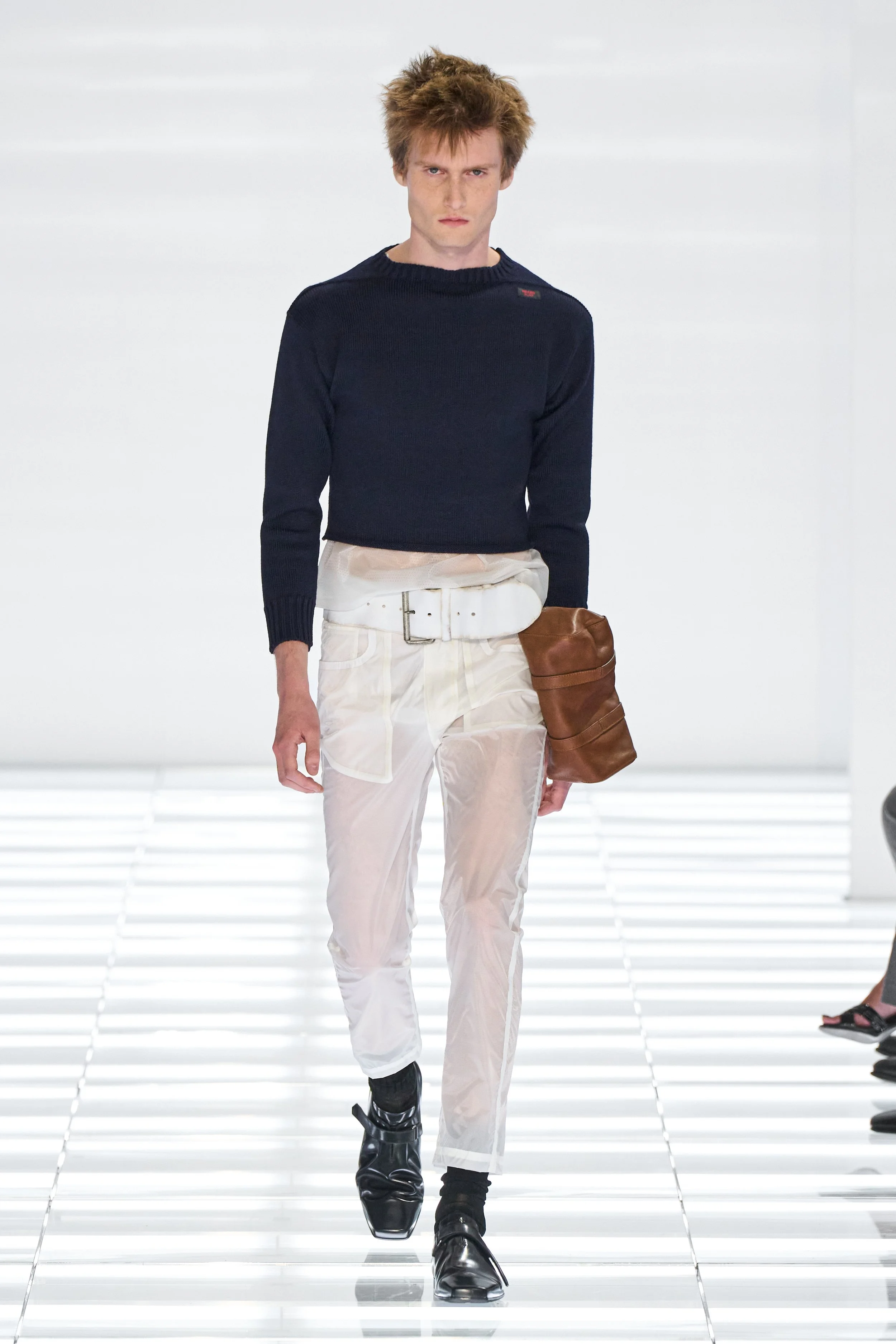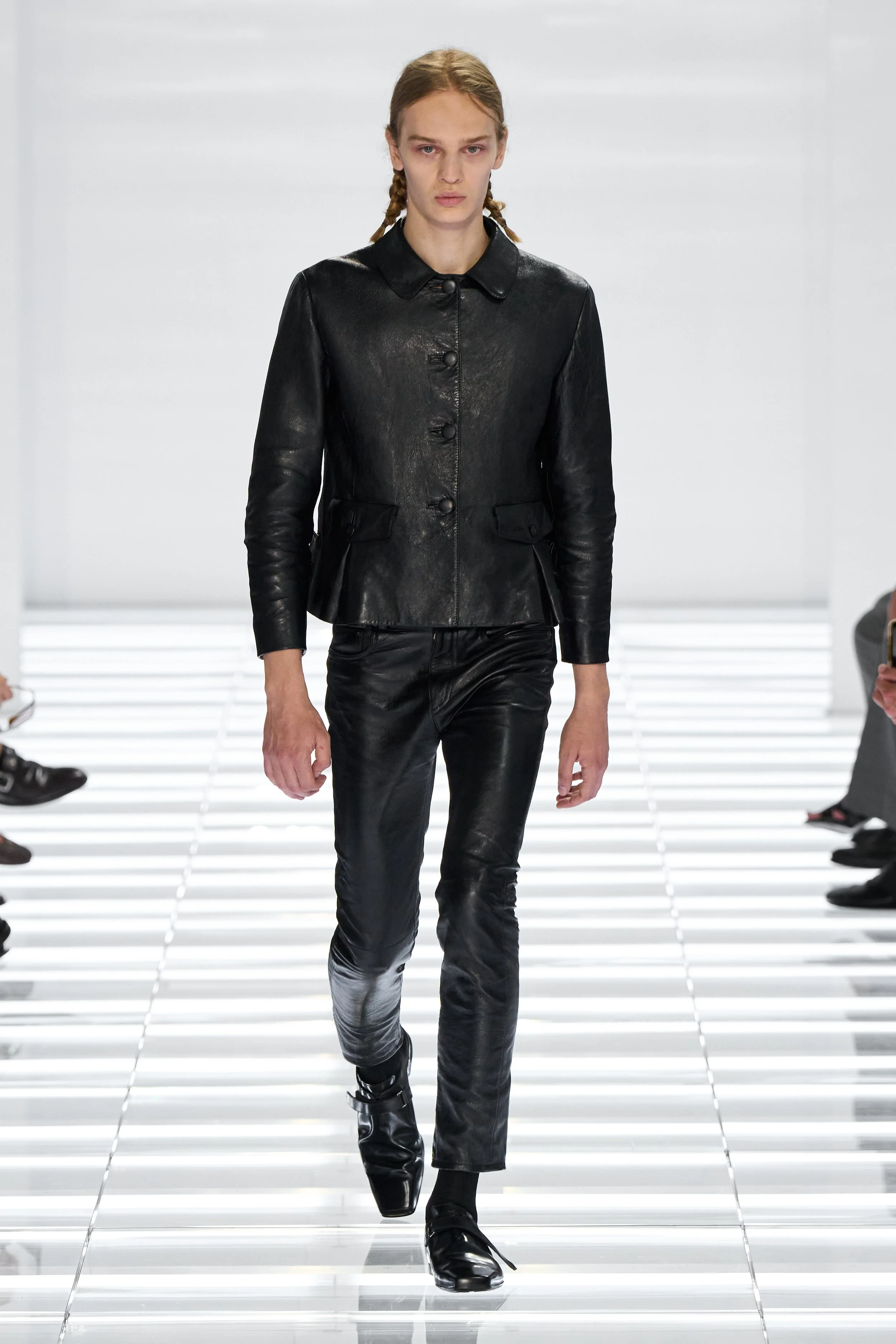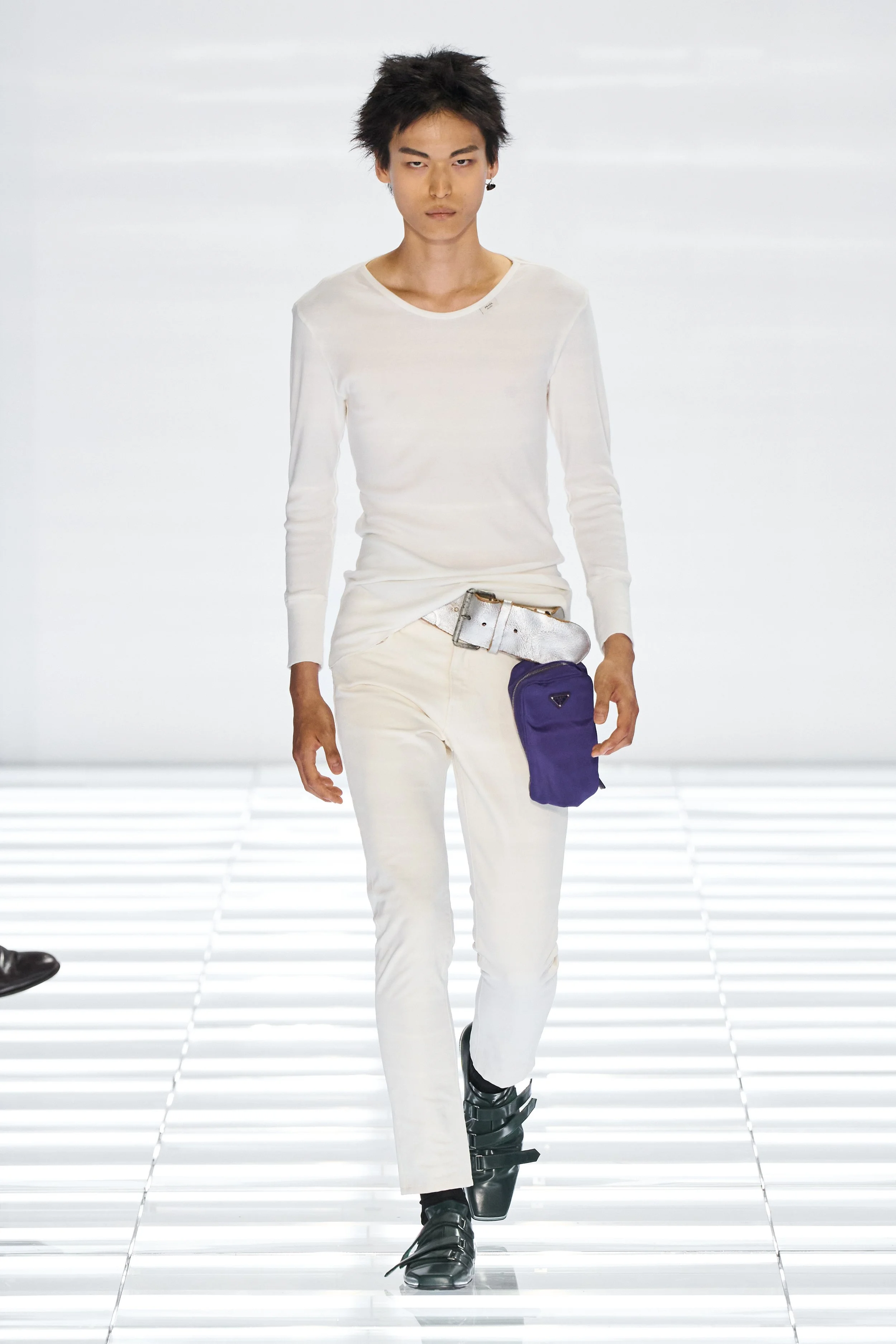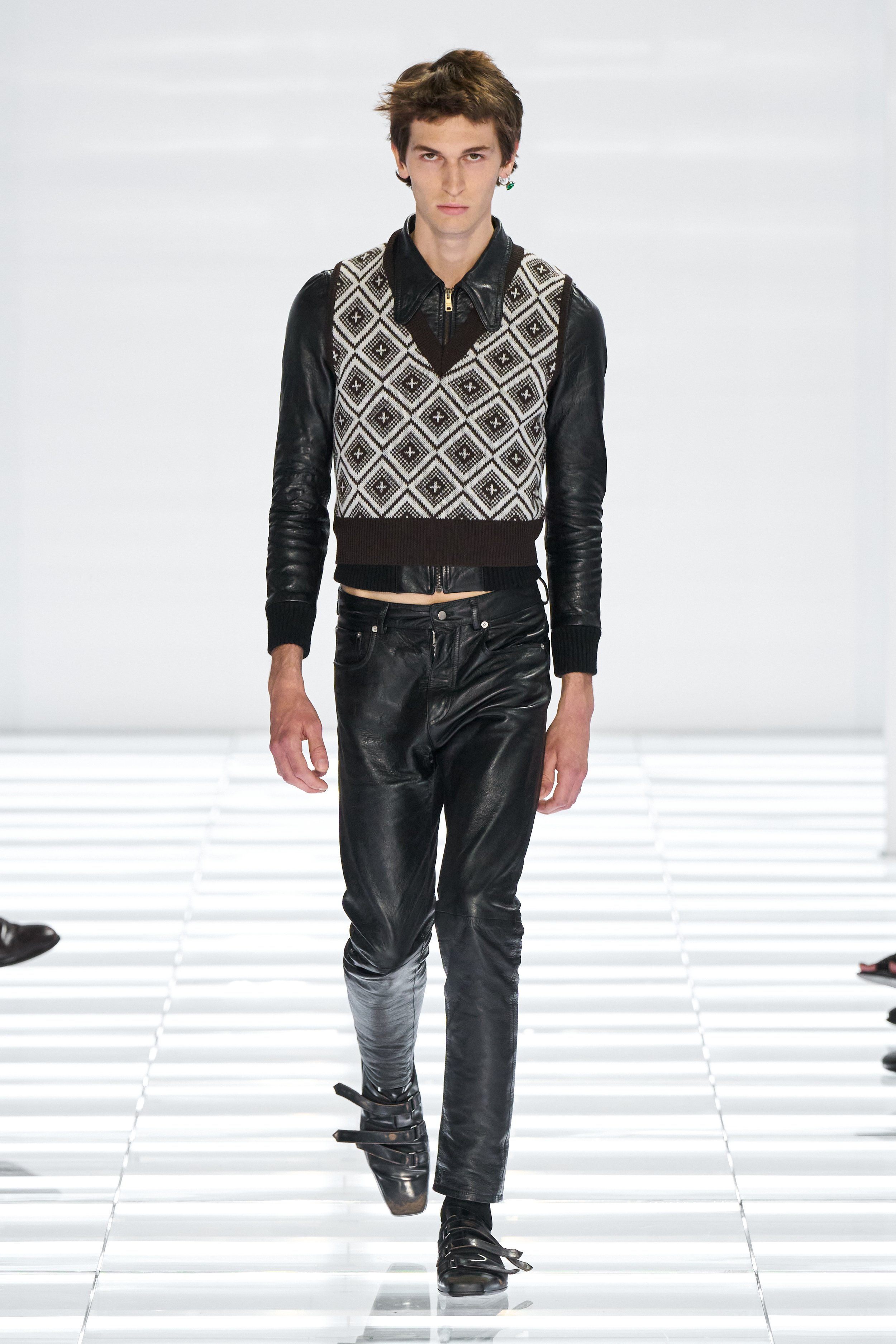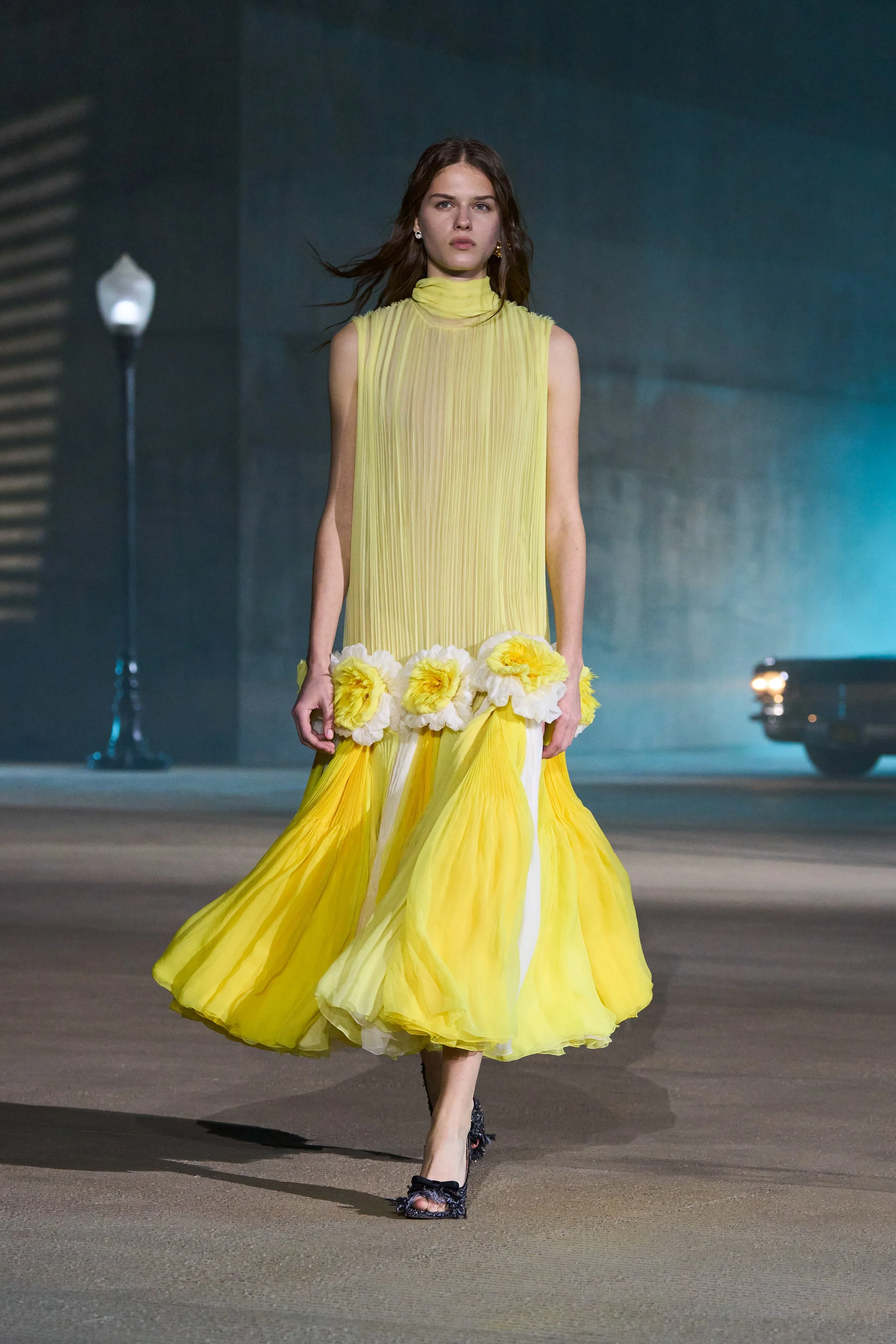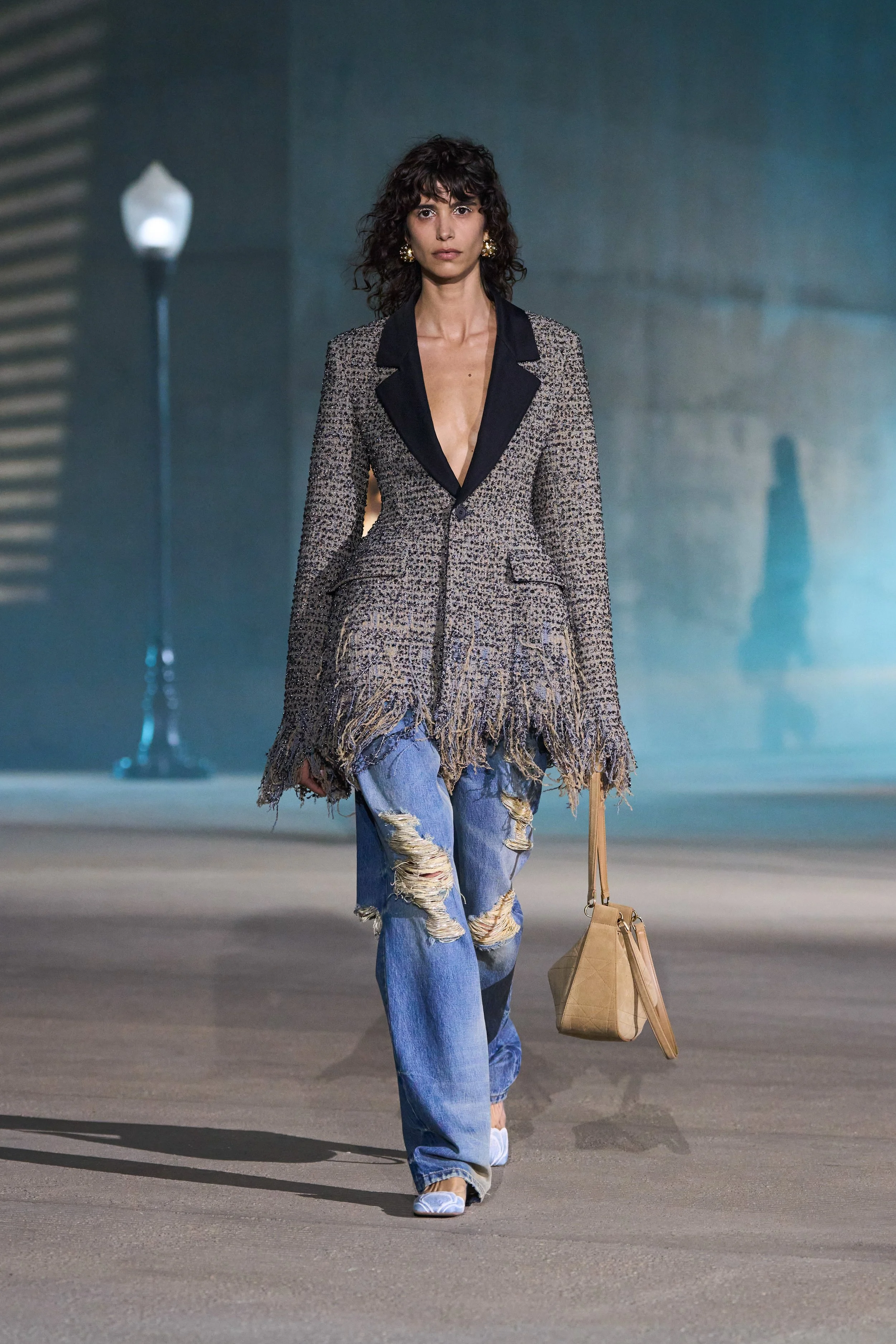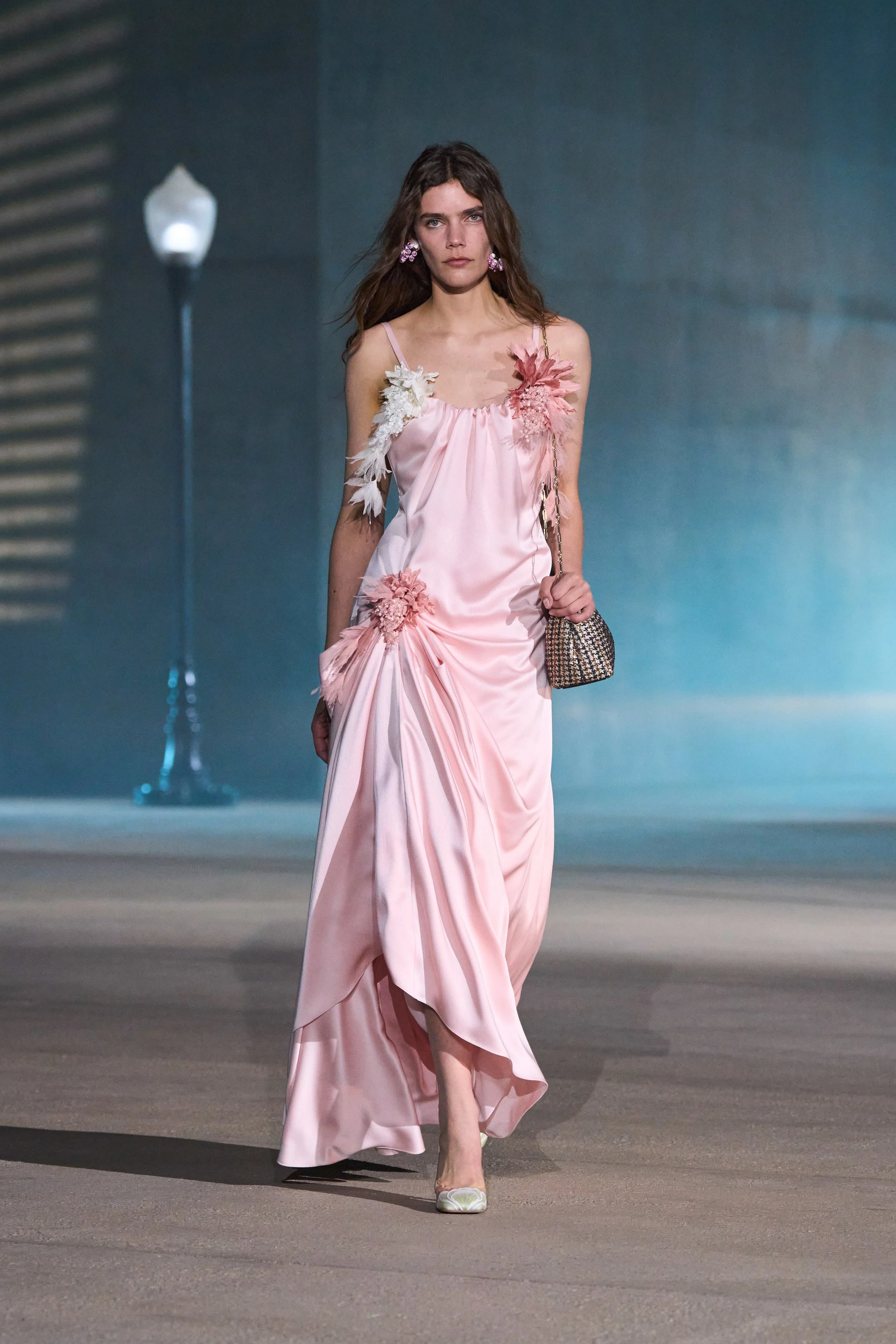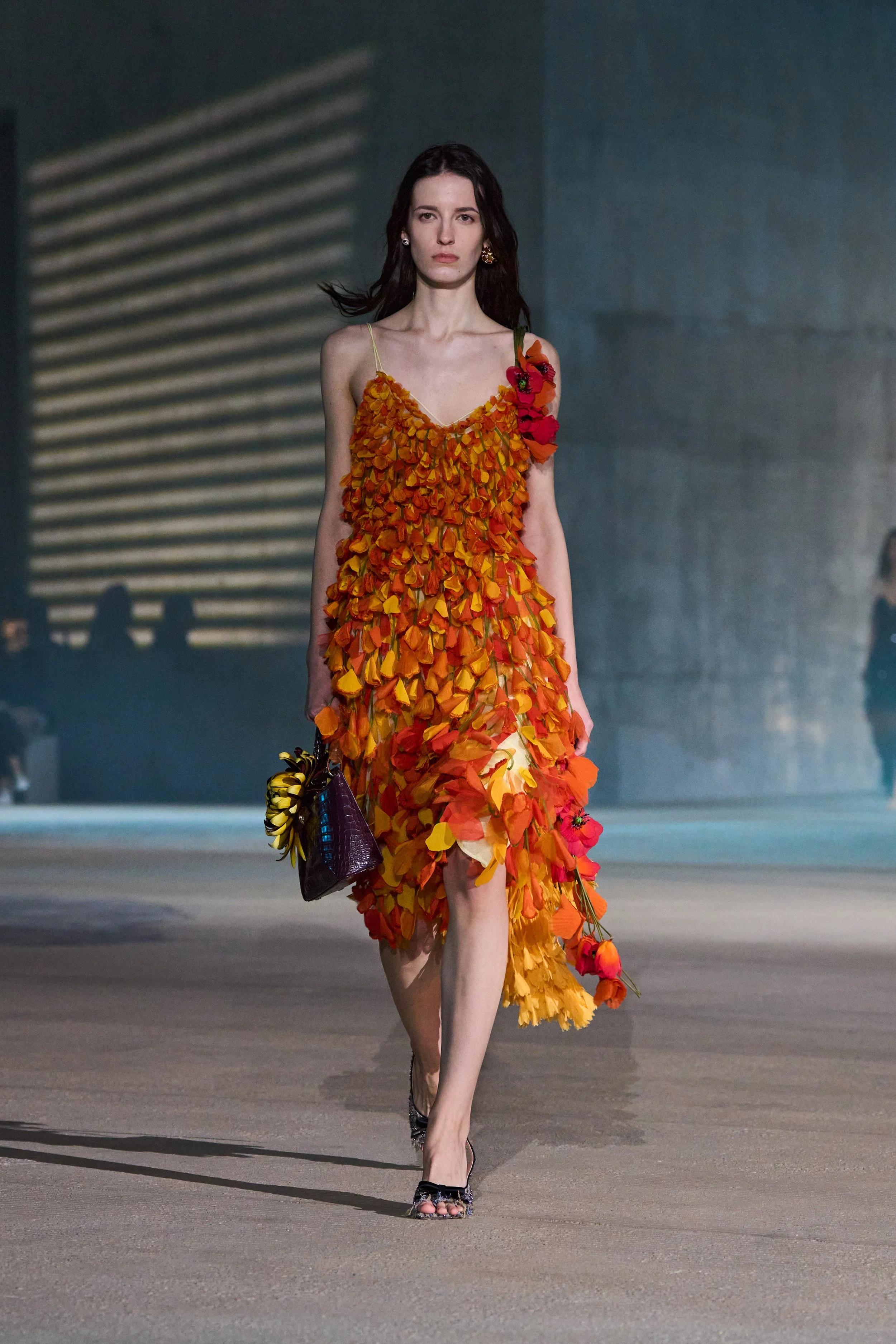
showreport

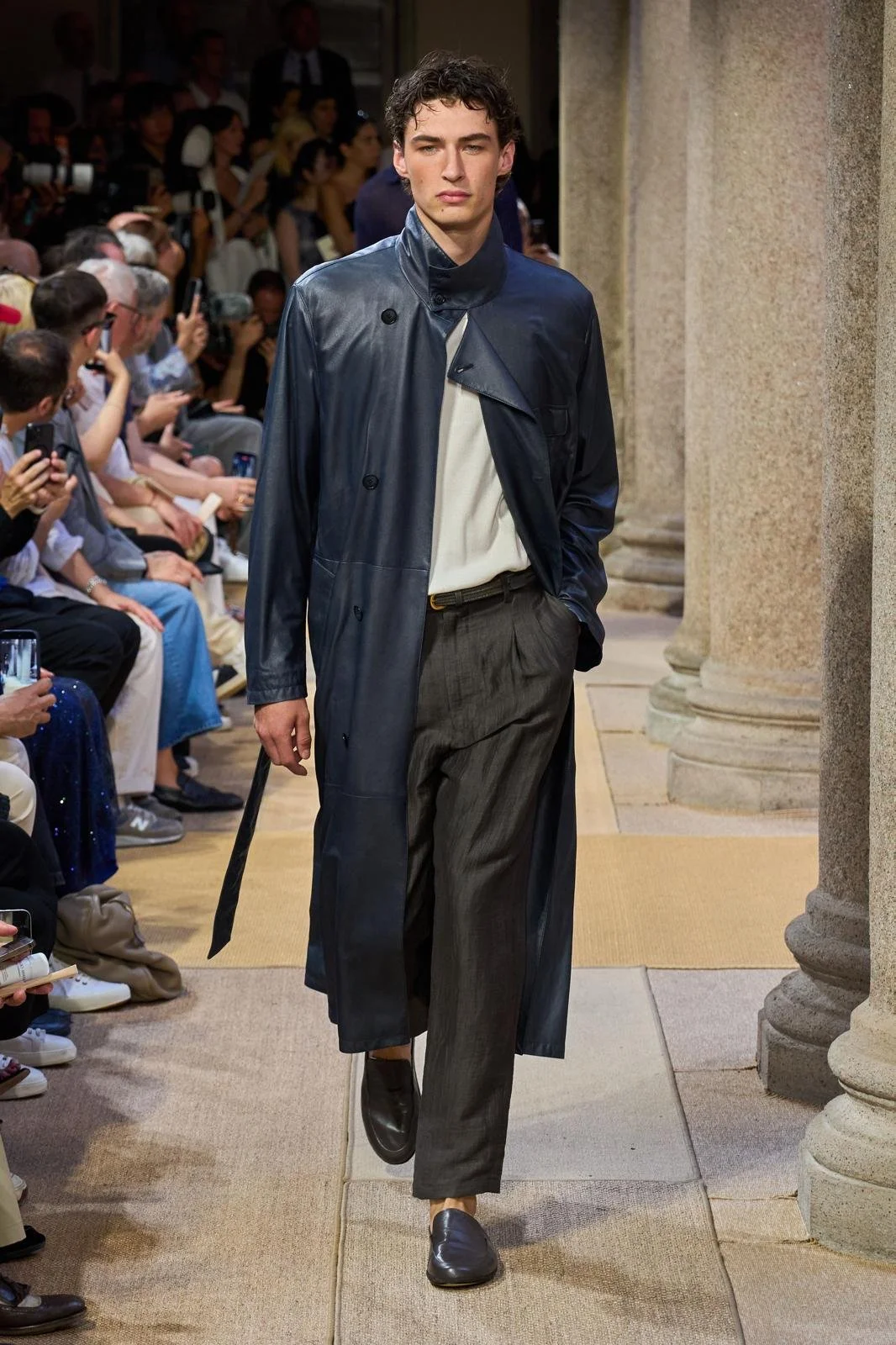
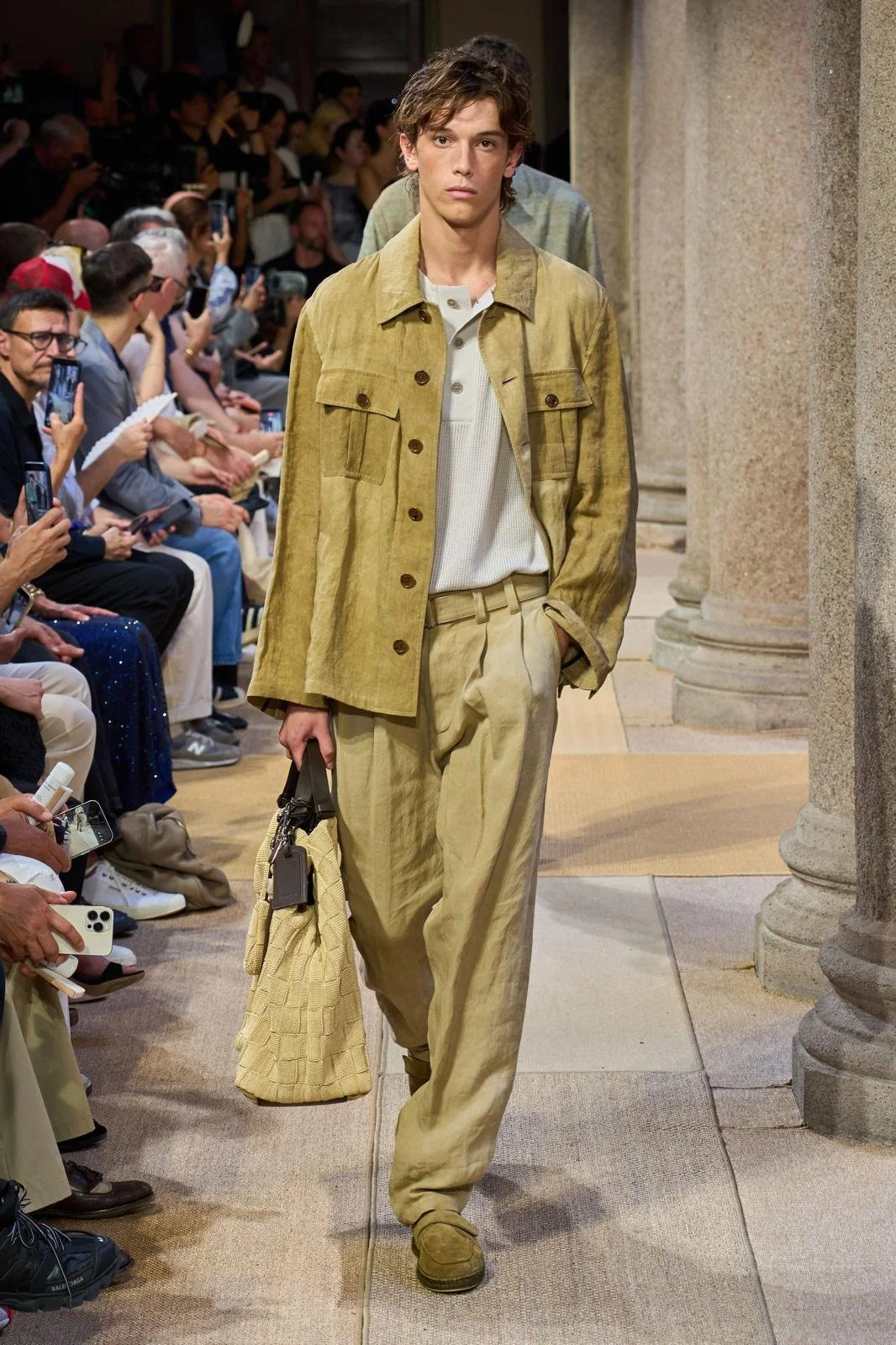
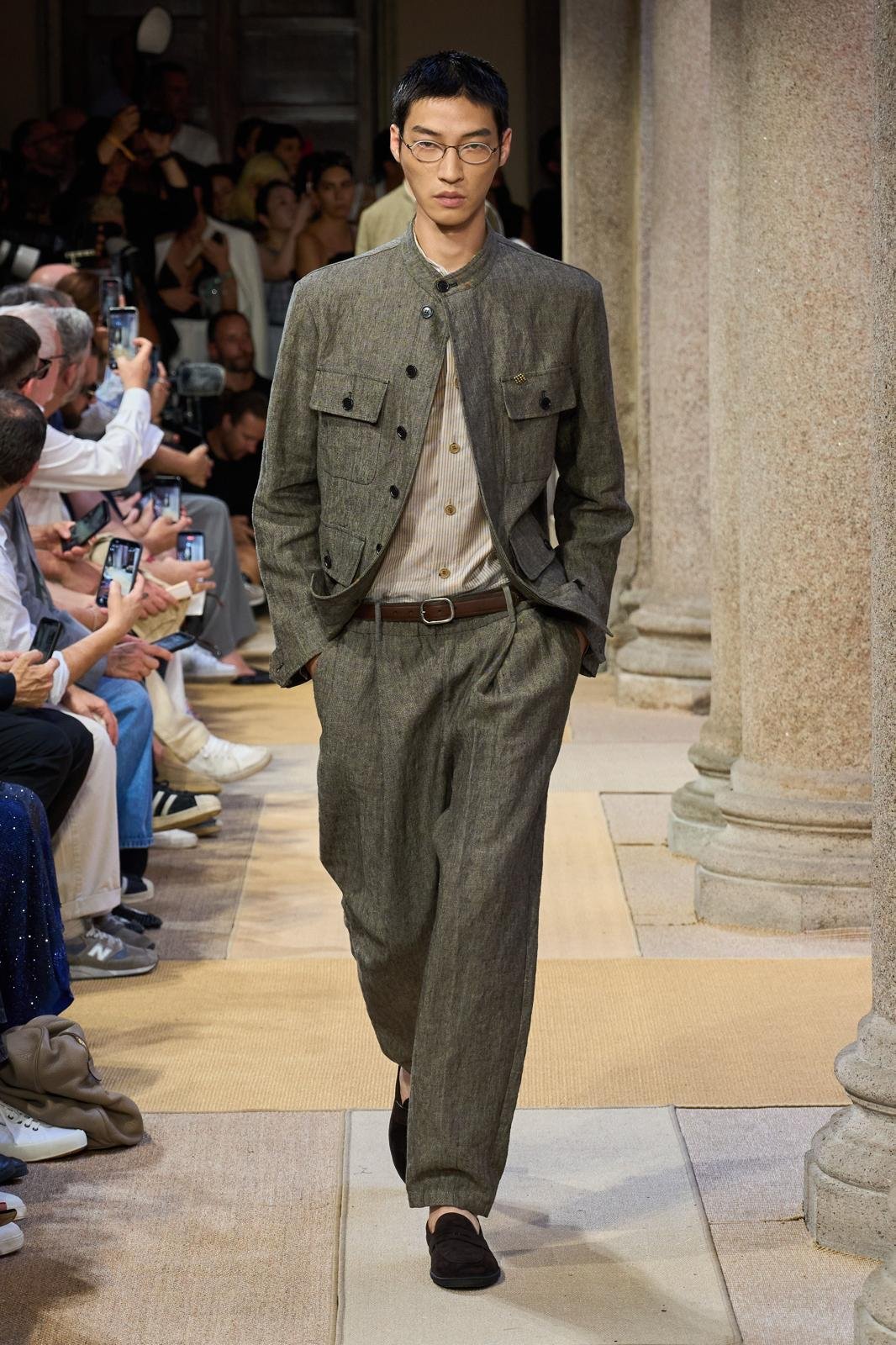
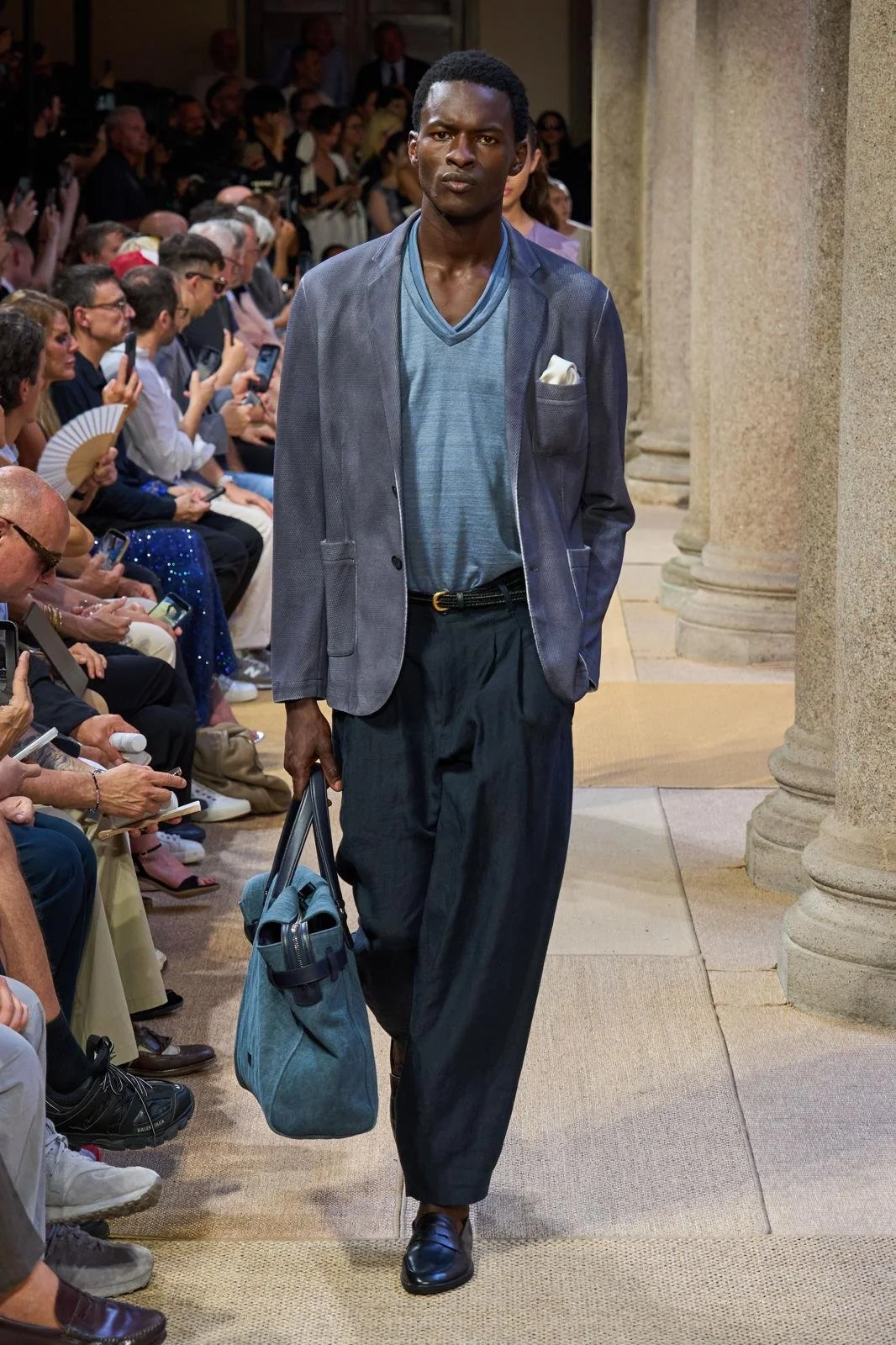
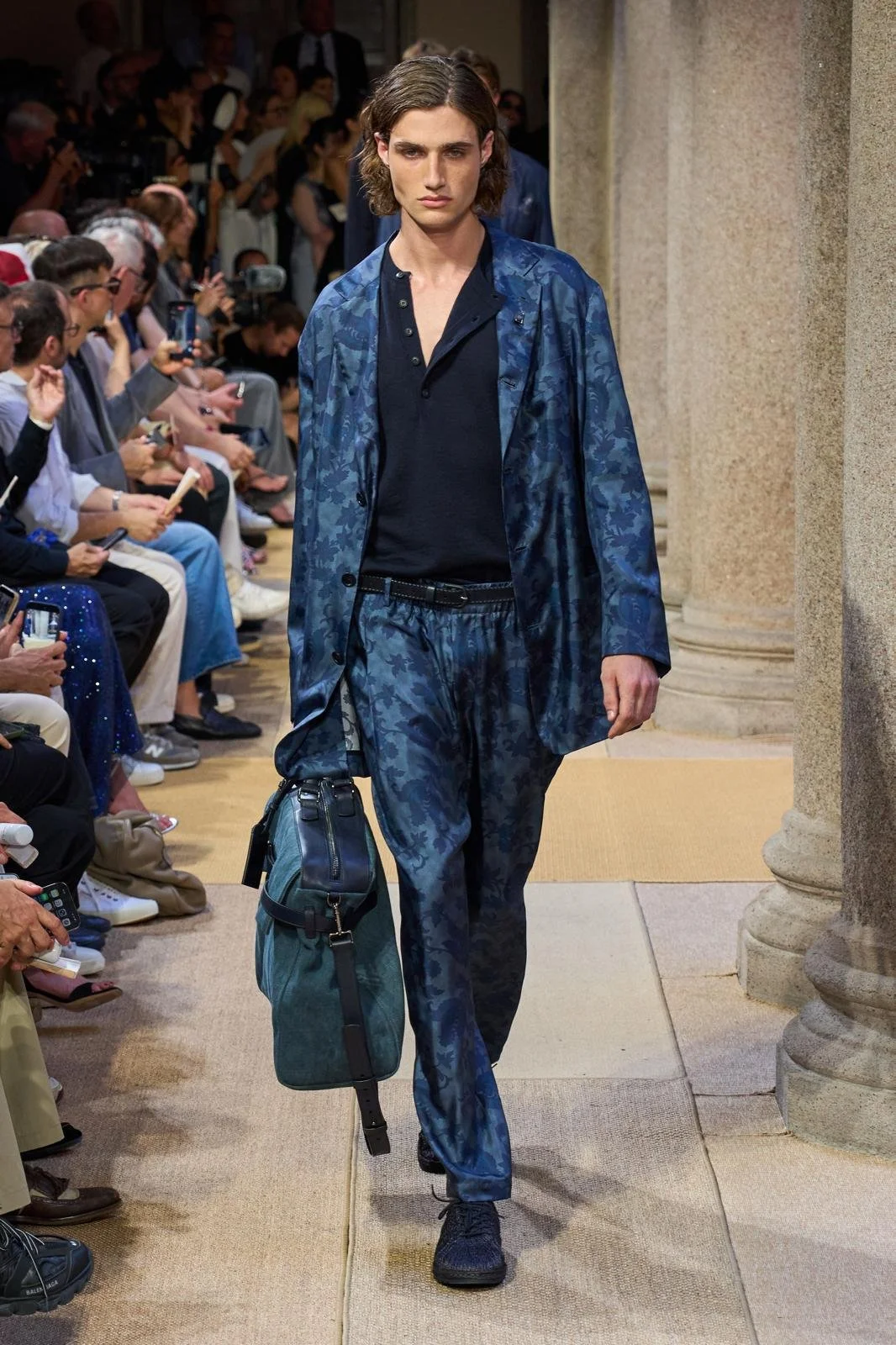
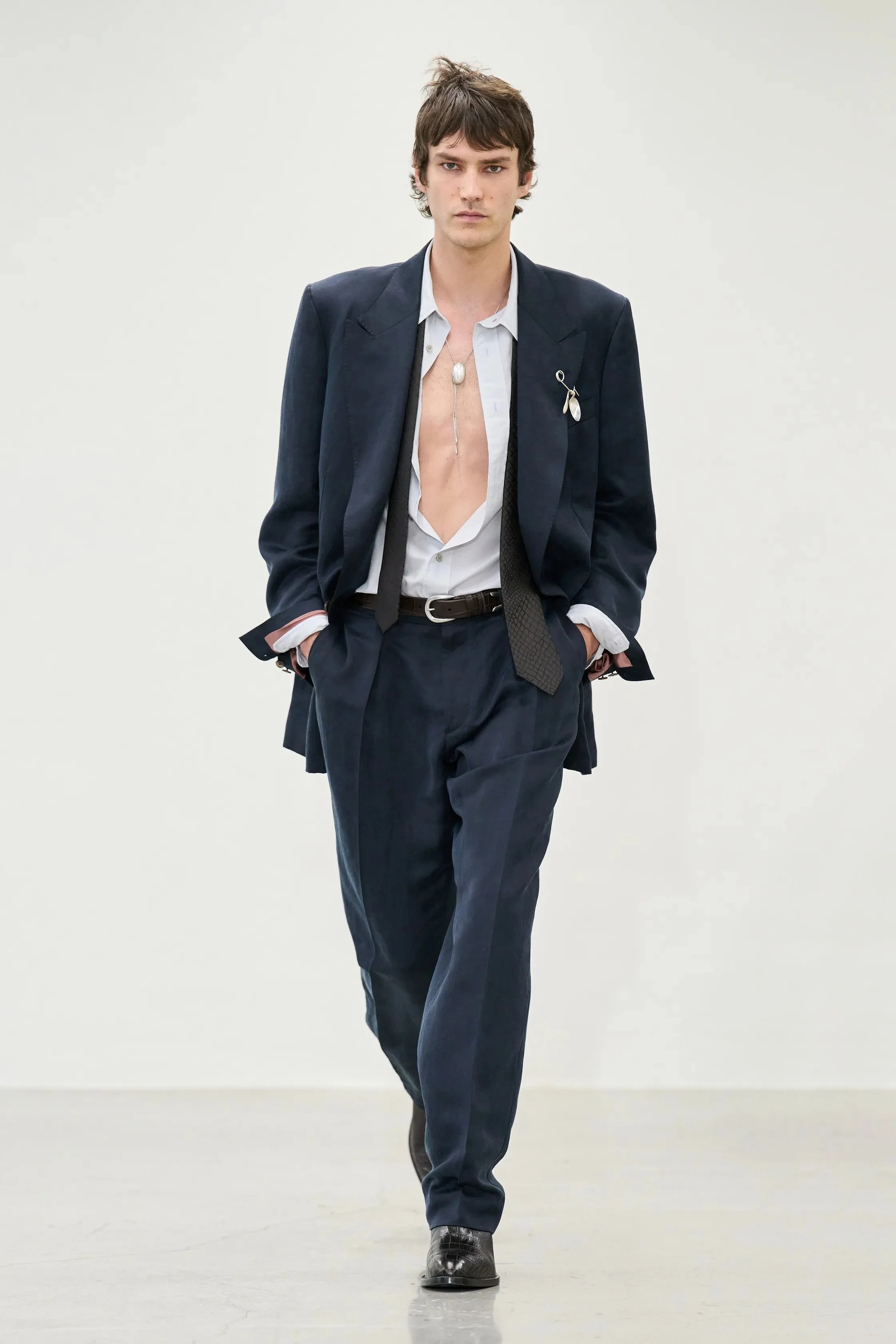
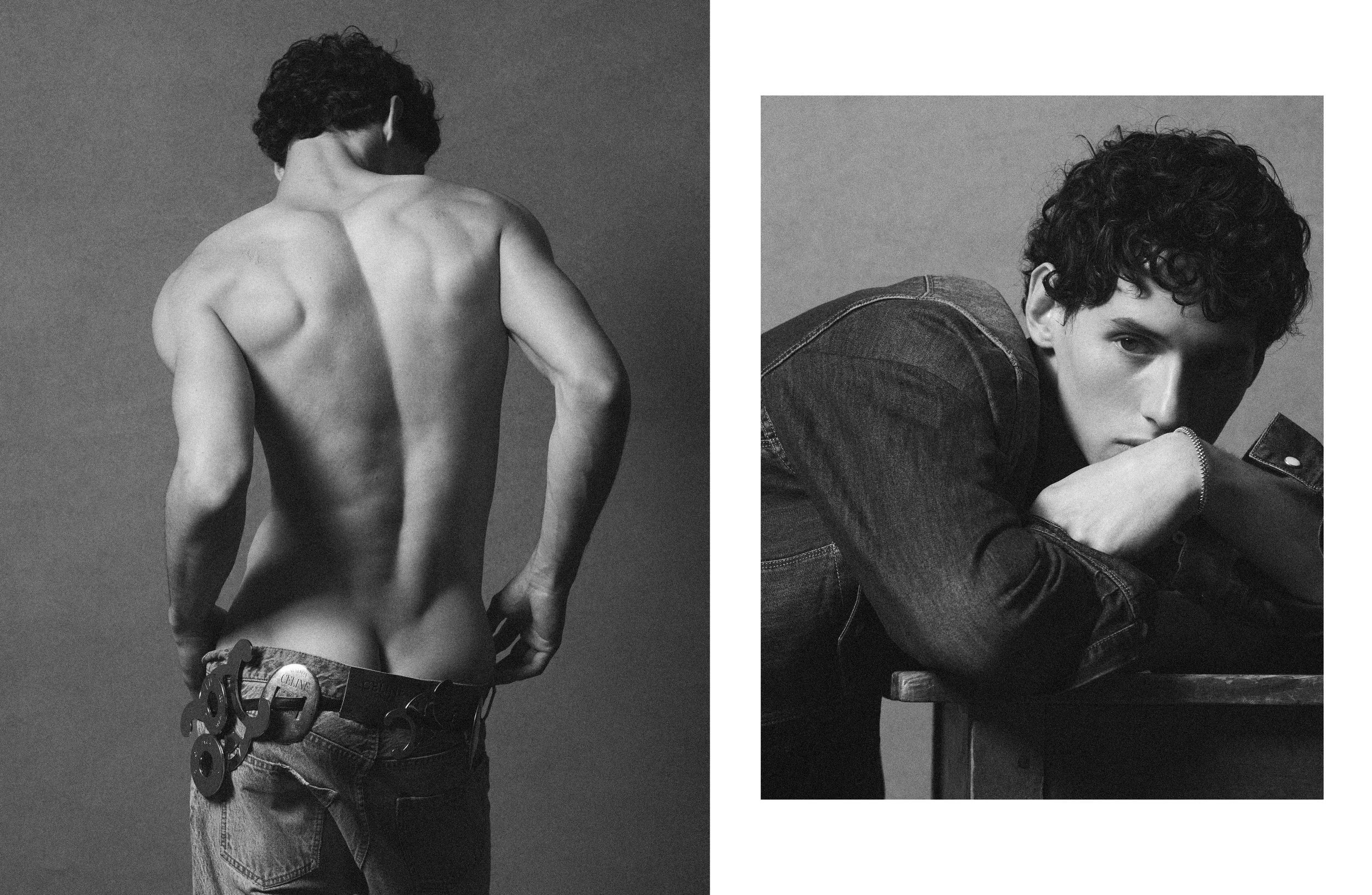
GIORGIO ARMANI SS27

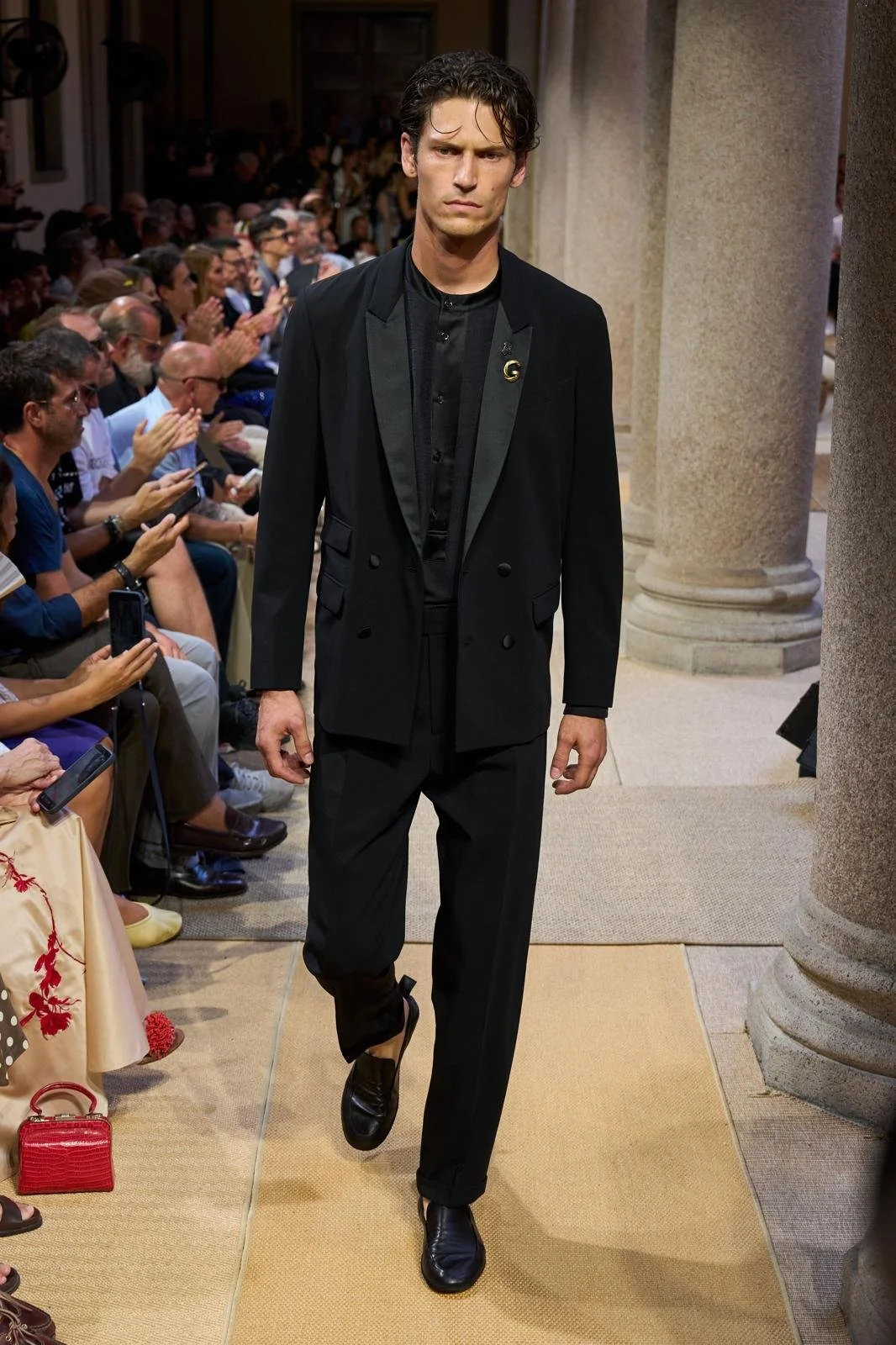
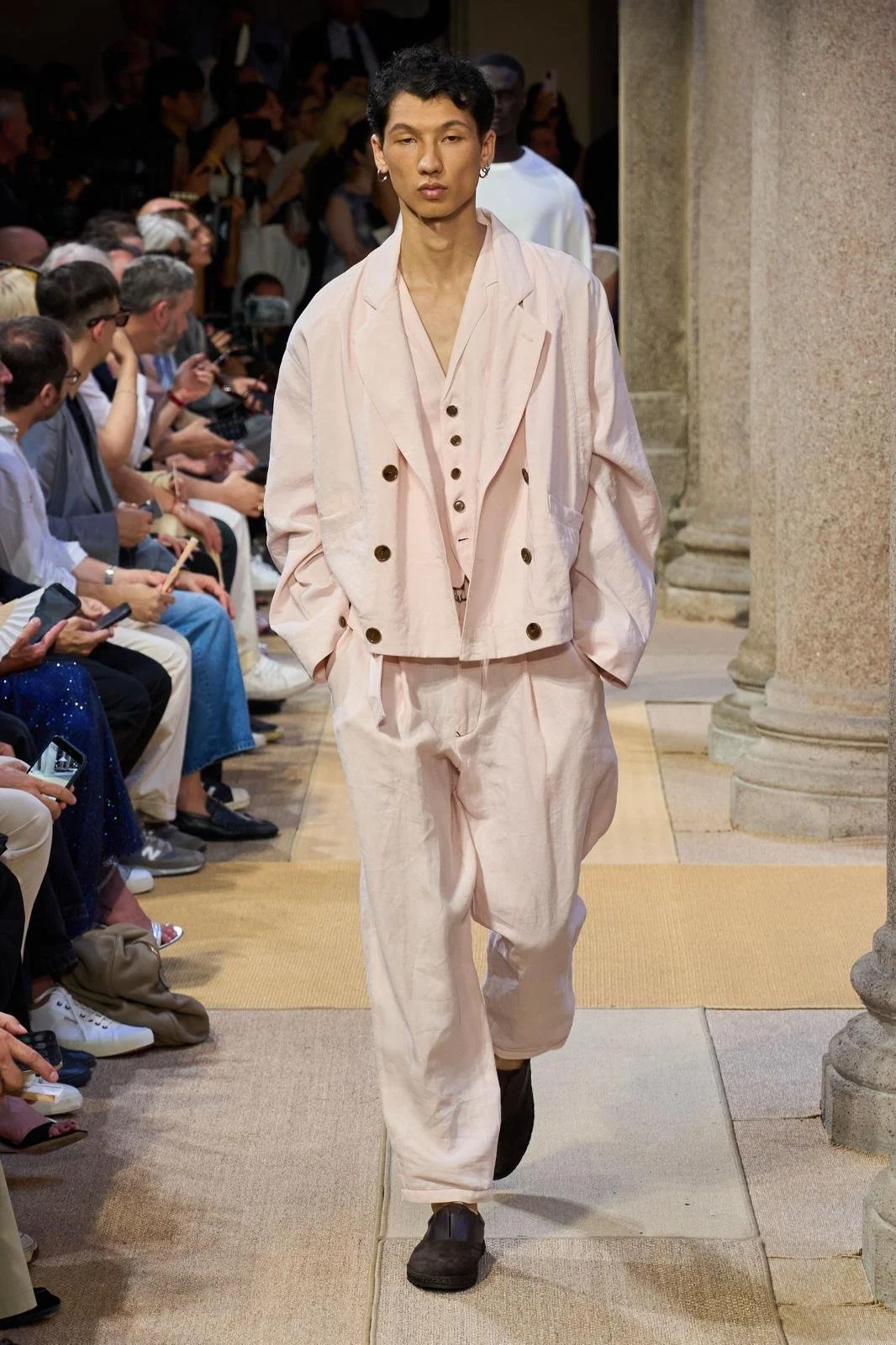
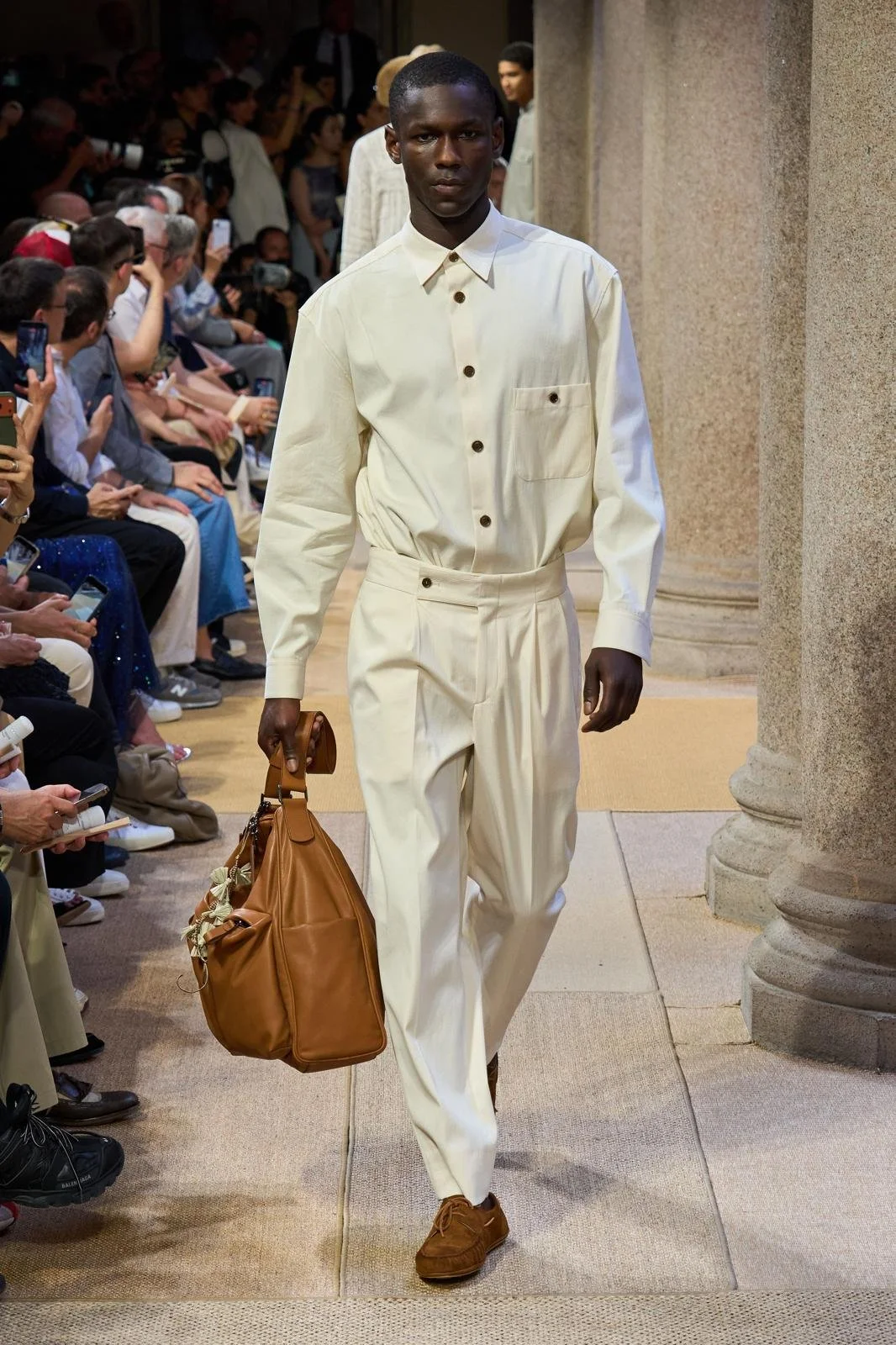
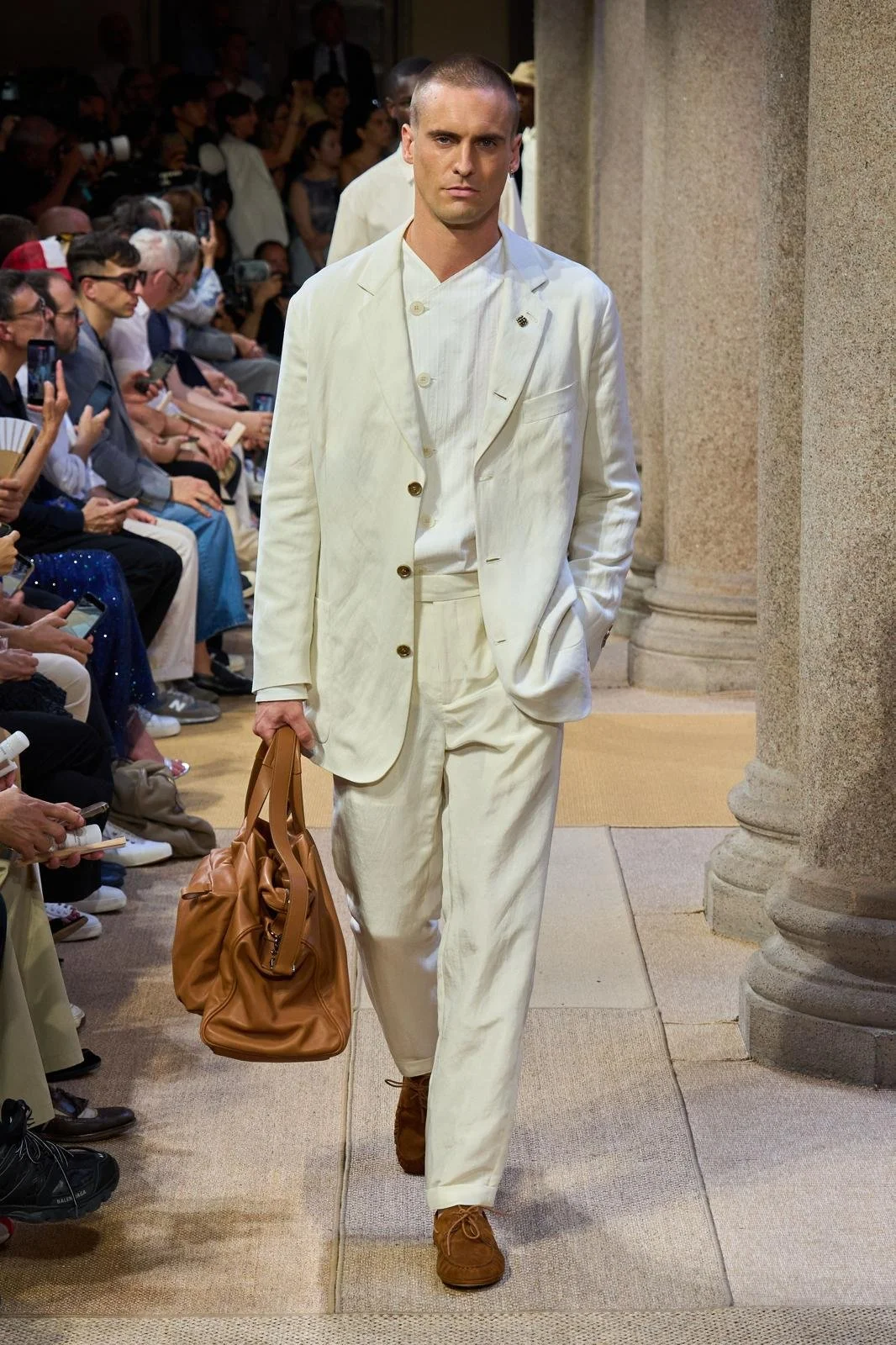
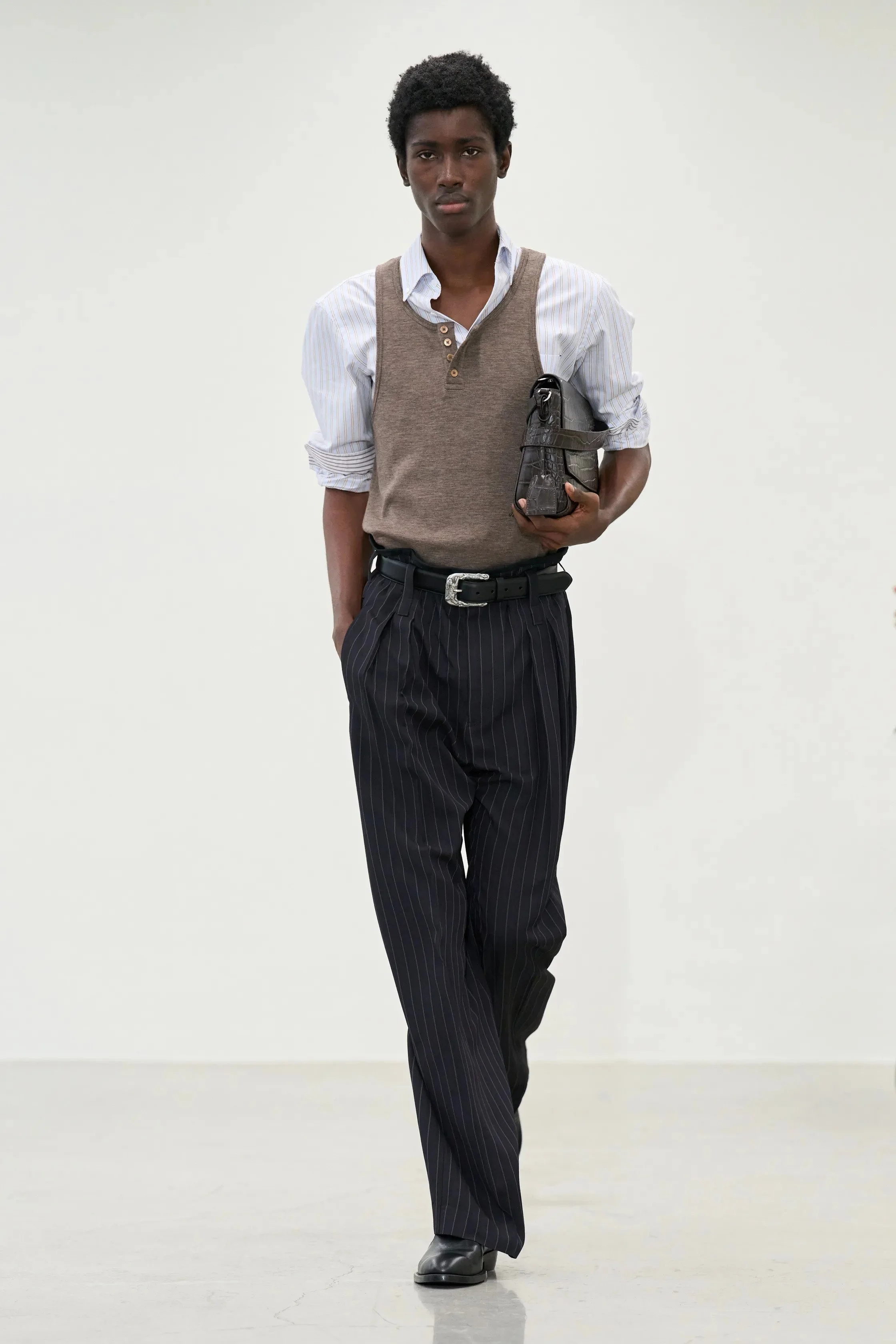
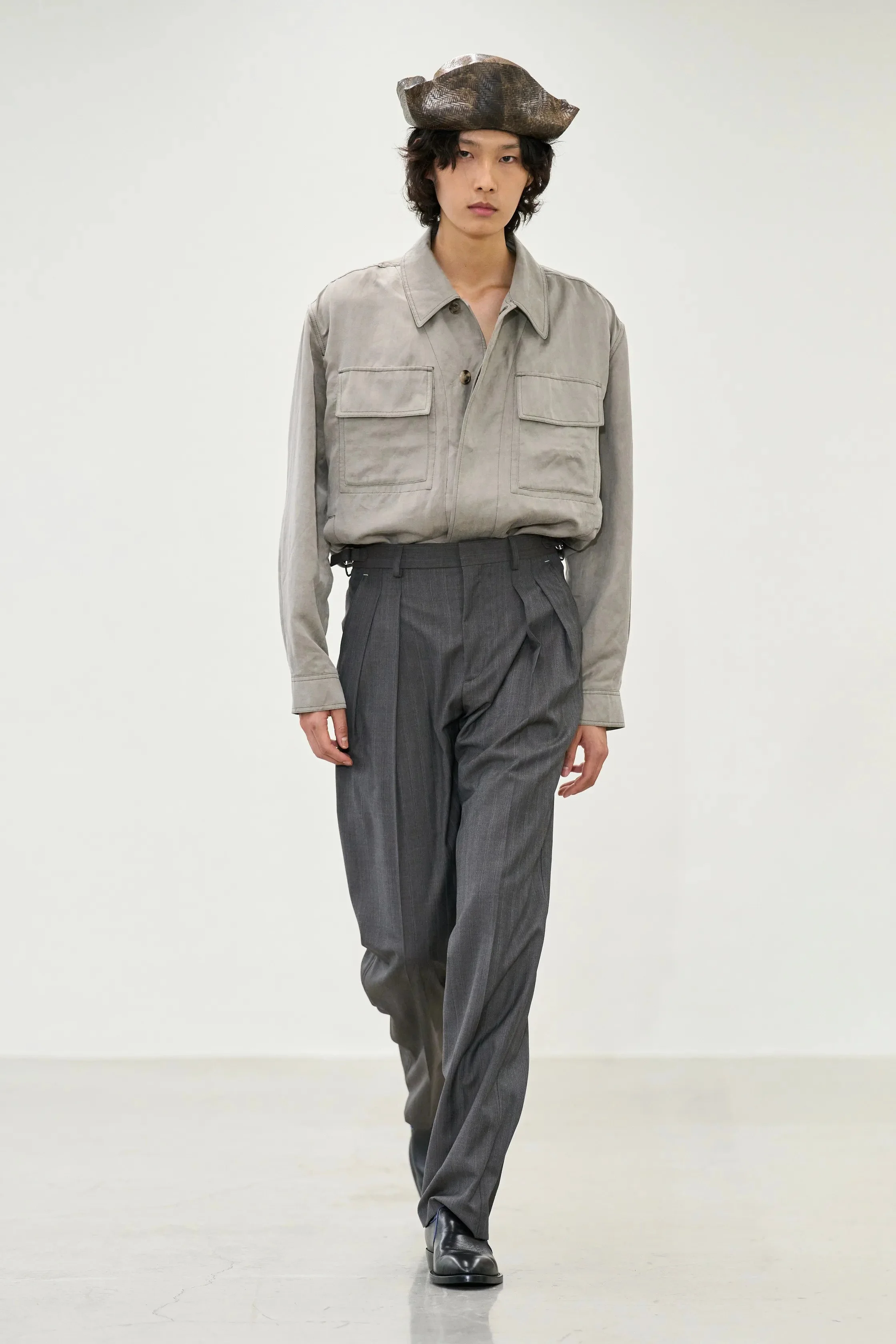
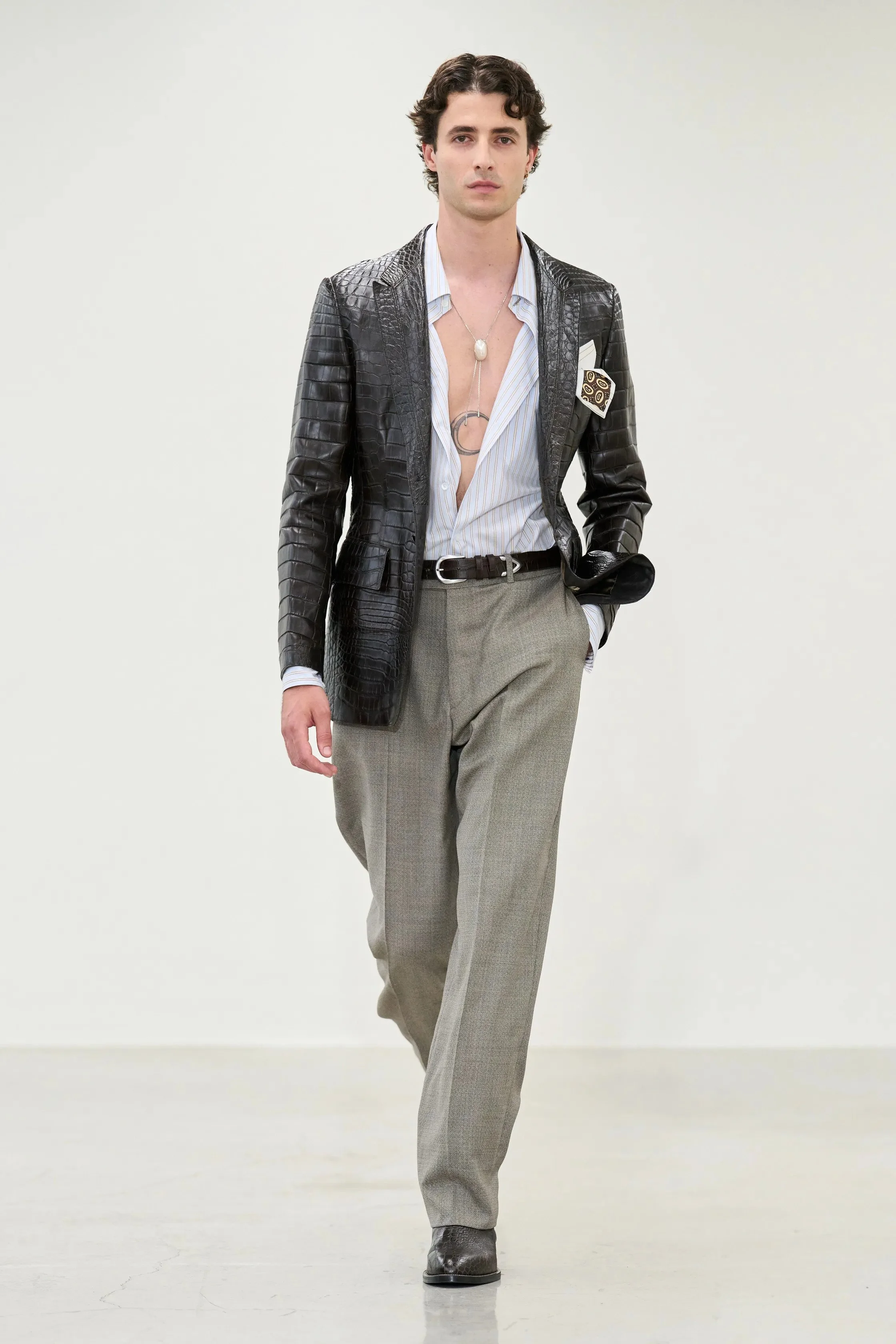
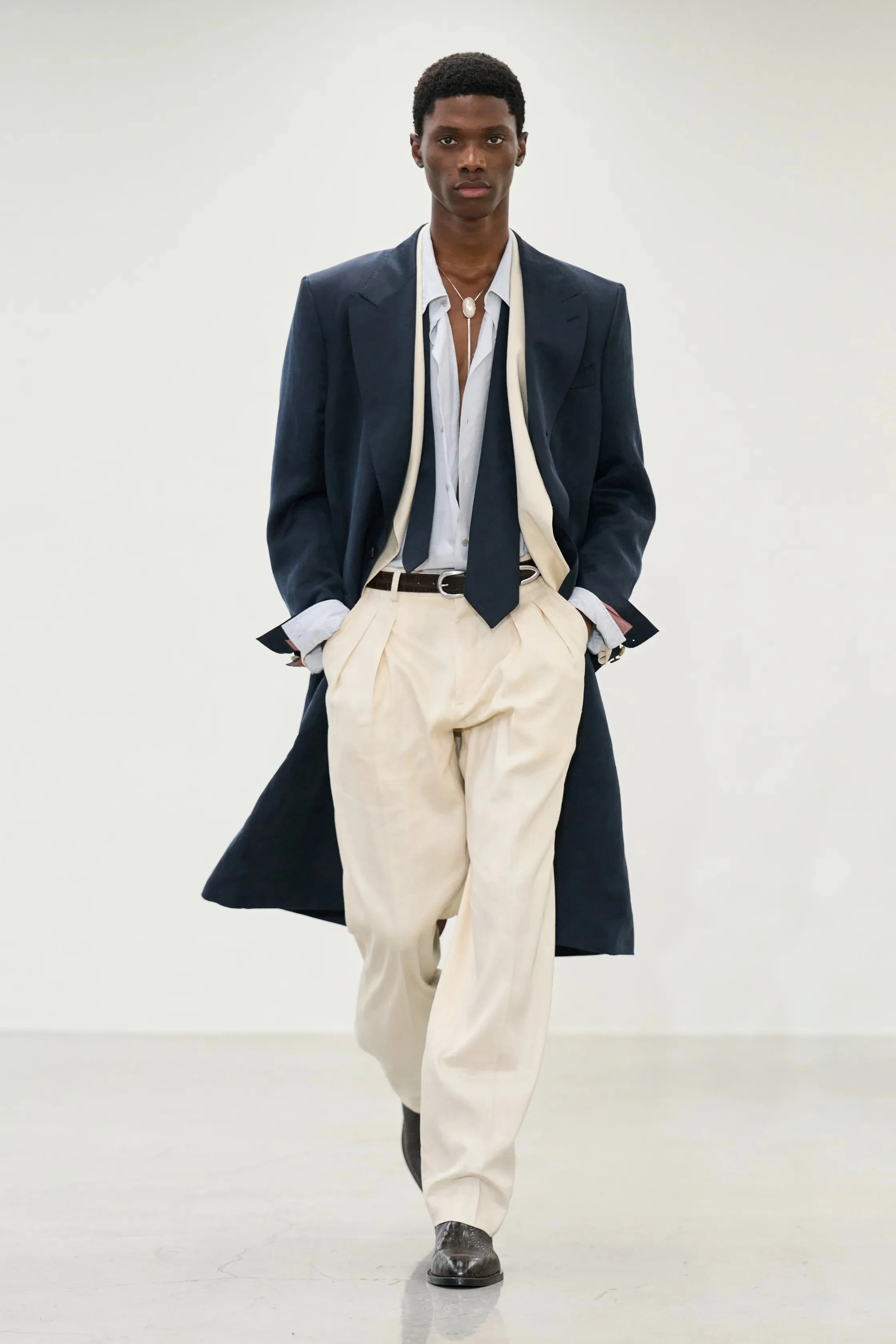
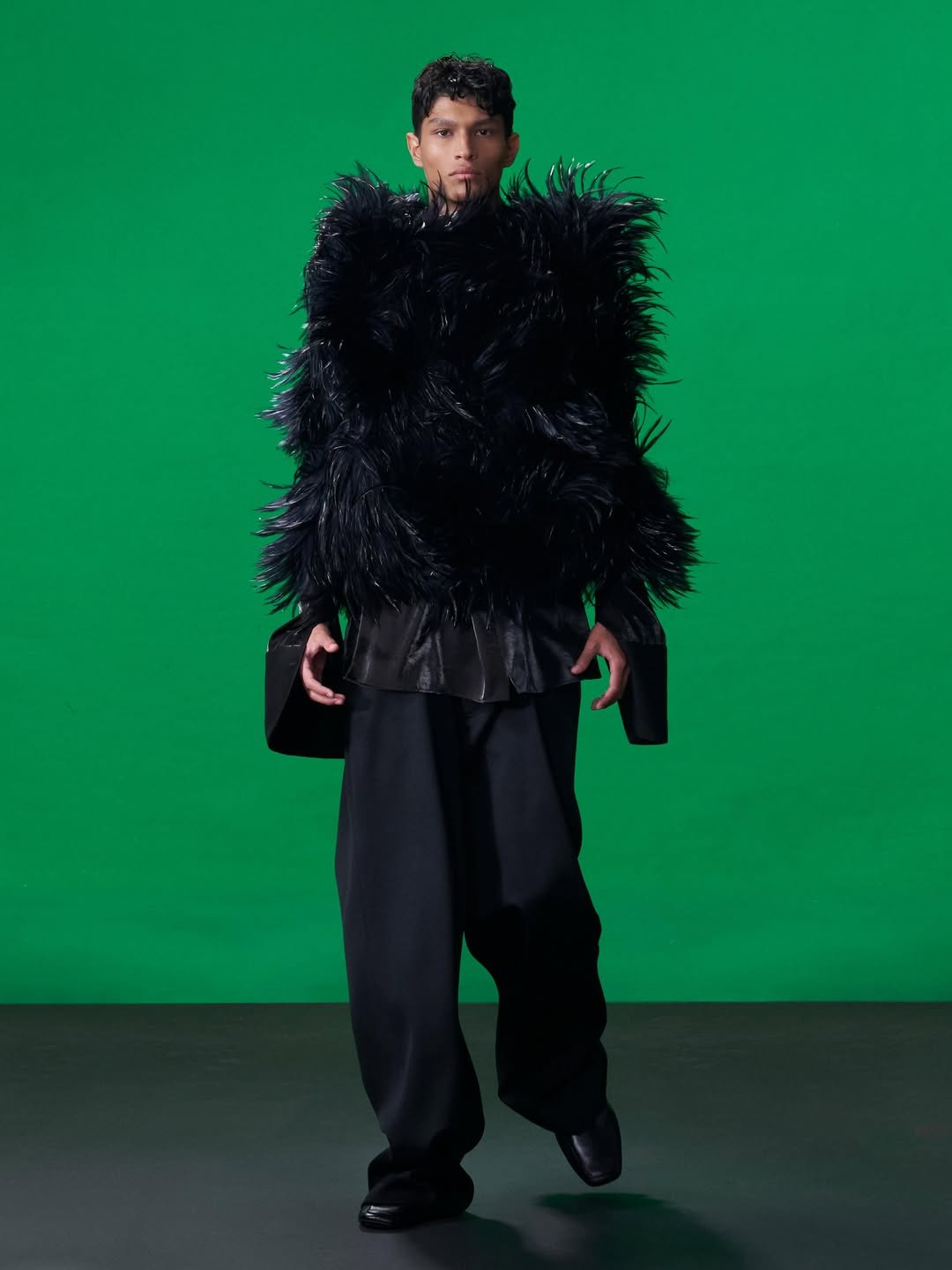
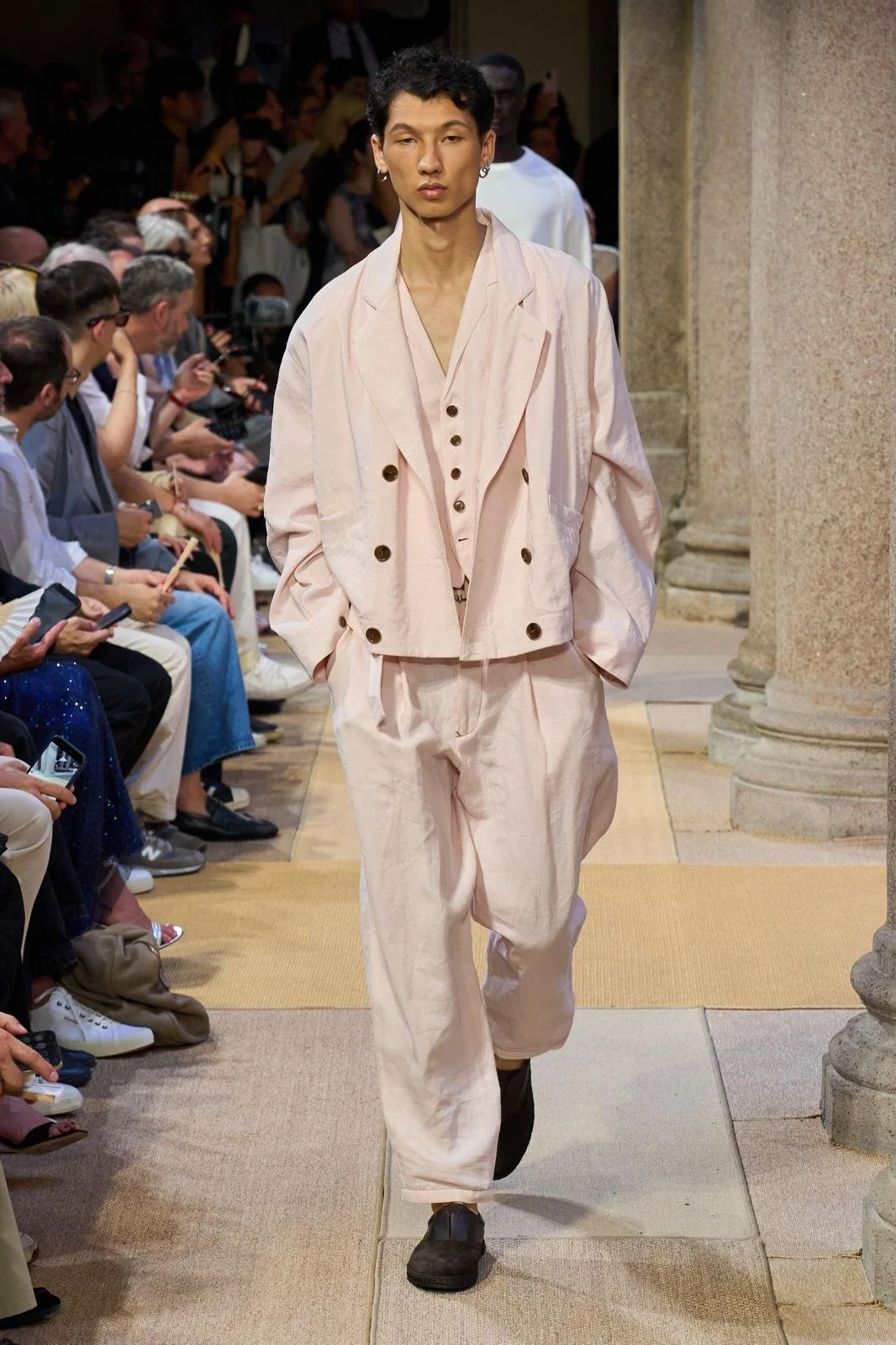
Closing Milan Fashion Week, Leo Dell’Orco and Silvana Armani, Giorgio Armani’s menswear creative director and the label’s head of womenswear, respectively, opted to join forces. While Dell’Orco presented his Spring/Summer 2027 menswear lineup for the Italian legacy brand, Silvana Armani showcased her latest cruise collection. Men’s and women’s looks were blended smoothly, all of them inspired by the Mediterranean atmosphere.

“The Mediterranean, long a place of encounter and exchange, is an open universe shaped by stories, cultures and inspirations that intertwine through travel and the transformation that every experience brings,” read the Mediterranean Market collection notes.

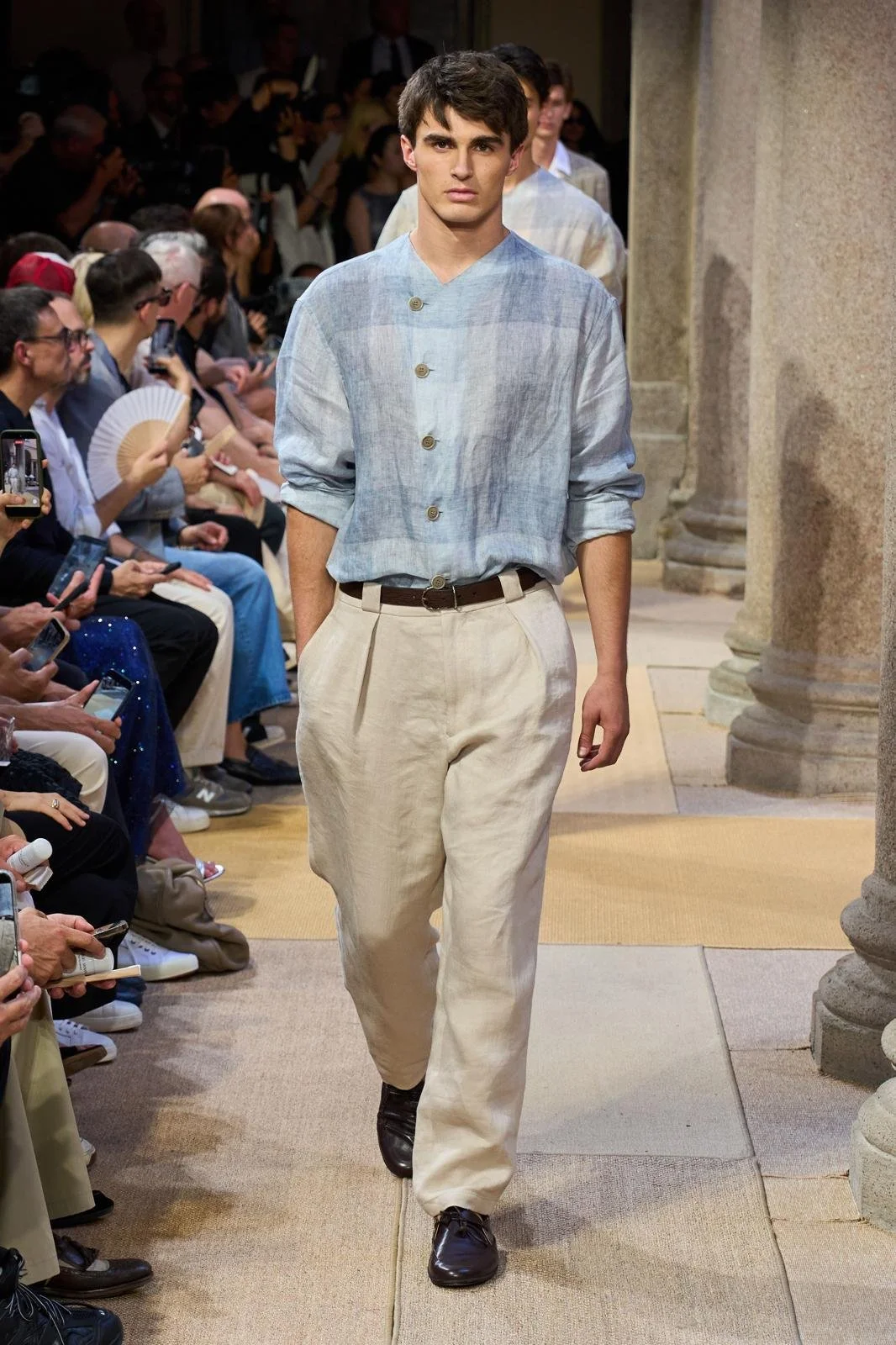
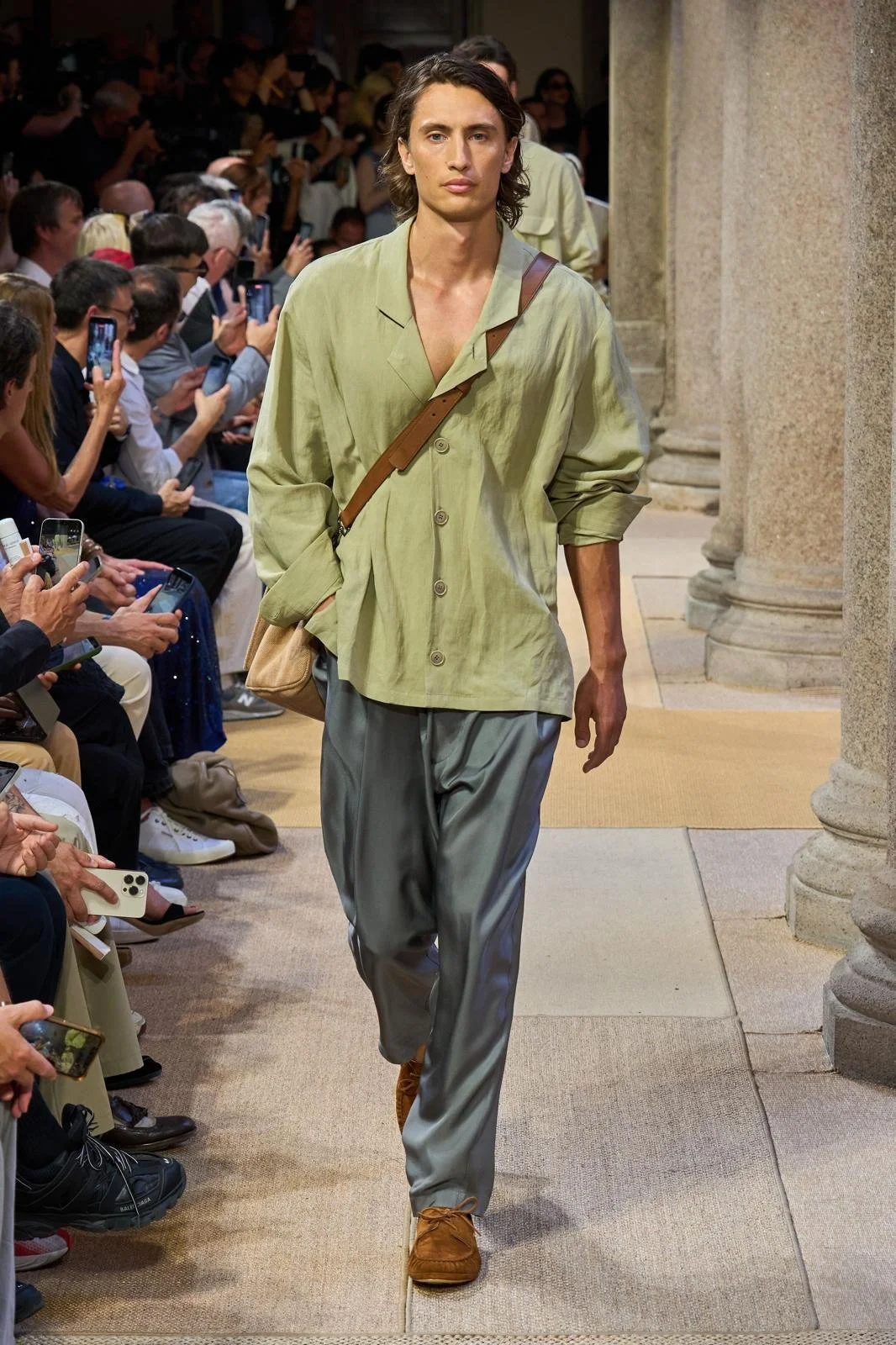
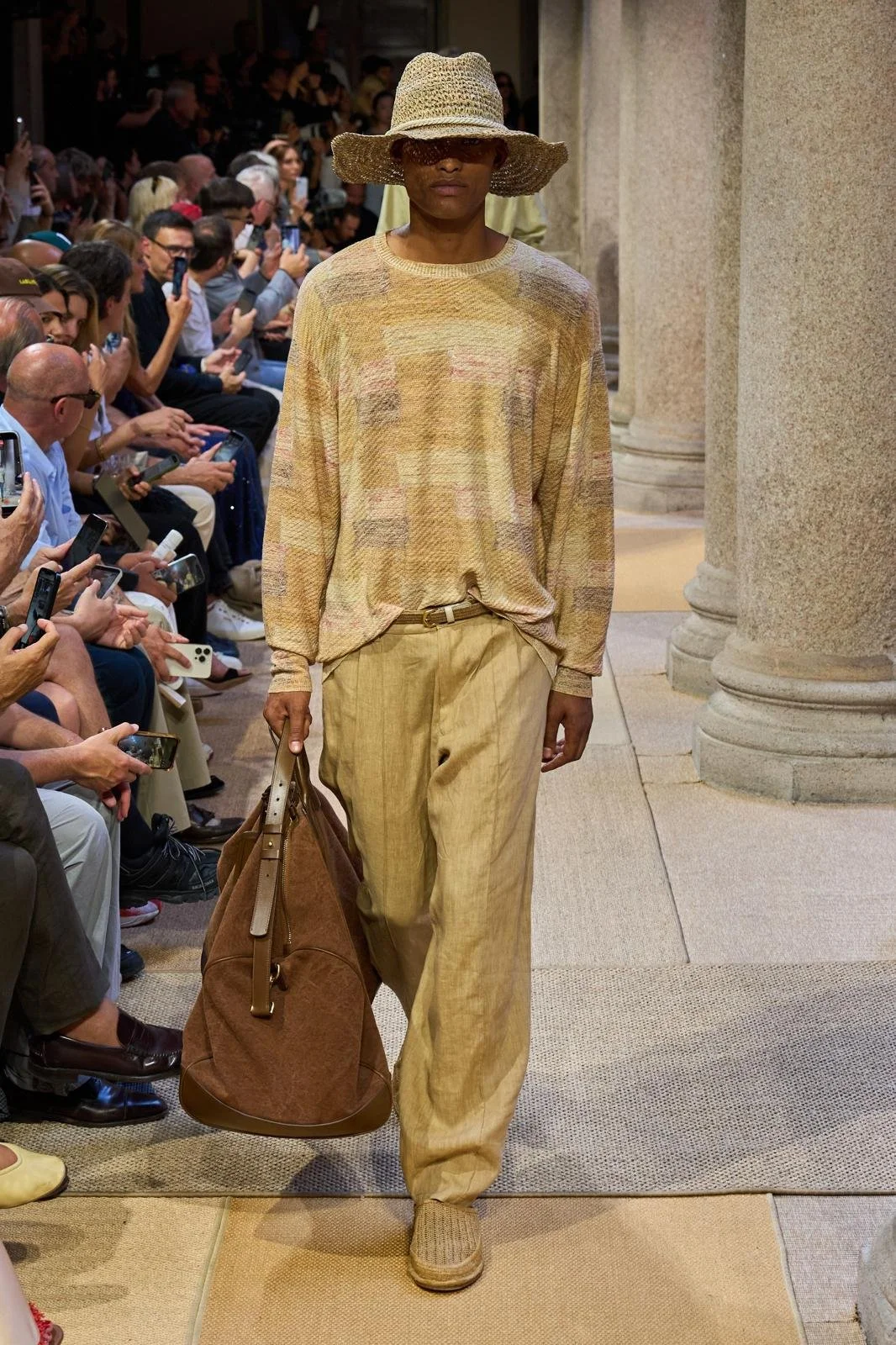
Classic Italian tailoring will always be the foundation of Giorgio Armani, but now it seems like there is progressively more and more appetite for a touch of newness. Take, for example, the denim-looking shirts, which were actually ultralight shantung silk. Or the predominance of more washed-out colours and sandy hues, made to look and feel like lived-in fabrics – a common theme of this and previous seasons.

Speaking of colour, they were drawn from the Mediterranean landscapes, architecture, and lifestyle and transformed into a familiar Armani palette: whites resembled sun-scorched stone shades, while cobalt and midnight blues referred to the sky and the seas. Muted gold referenced glistening sunlight, and spice and earthy tones shared the space with dark blue florals and other cool-toned pieces, added to convey the shade of Italian porticoes.

When unveiled, Armani collections often follow a clear order, normally evolving from day-to-day, more casual garments into eveningwear and black-tie or timeless suiting. This time, it wasn’t different: fluid lines and a larger presence of denim, which dominated the catwalk and opened the show, slowly gave room to all-black trousers and jacket sets and suits.

Lapel brooches, another seasonal favourite of multiple menswear luxury labels, appeared in various looks, often in the shape of zodiac signs such as Scorpio, representing Dell’Orco’s sun, and Cancer, a nod to Giorgio Armani’s star sign. The approach was also previously adopted by Silvana Armani in her collections and perhaps will stay as a continuous way to pay homage to the late Armani. There’s no need to look closer, though; his legacy remains.
Words by Ketlyn Araujo
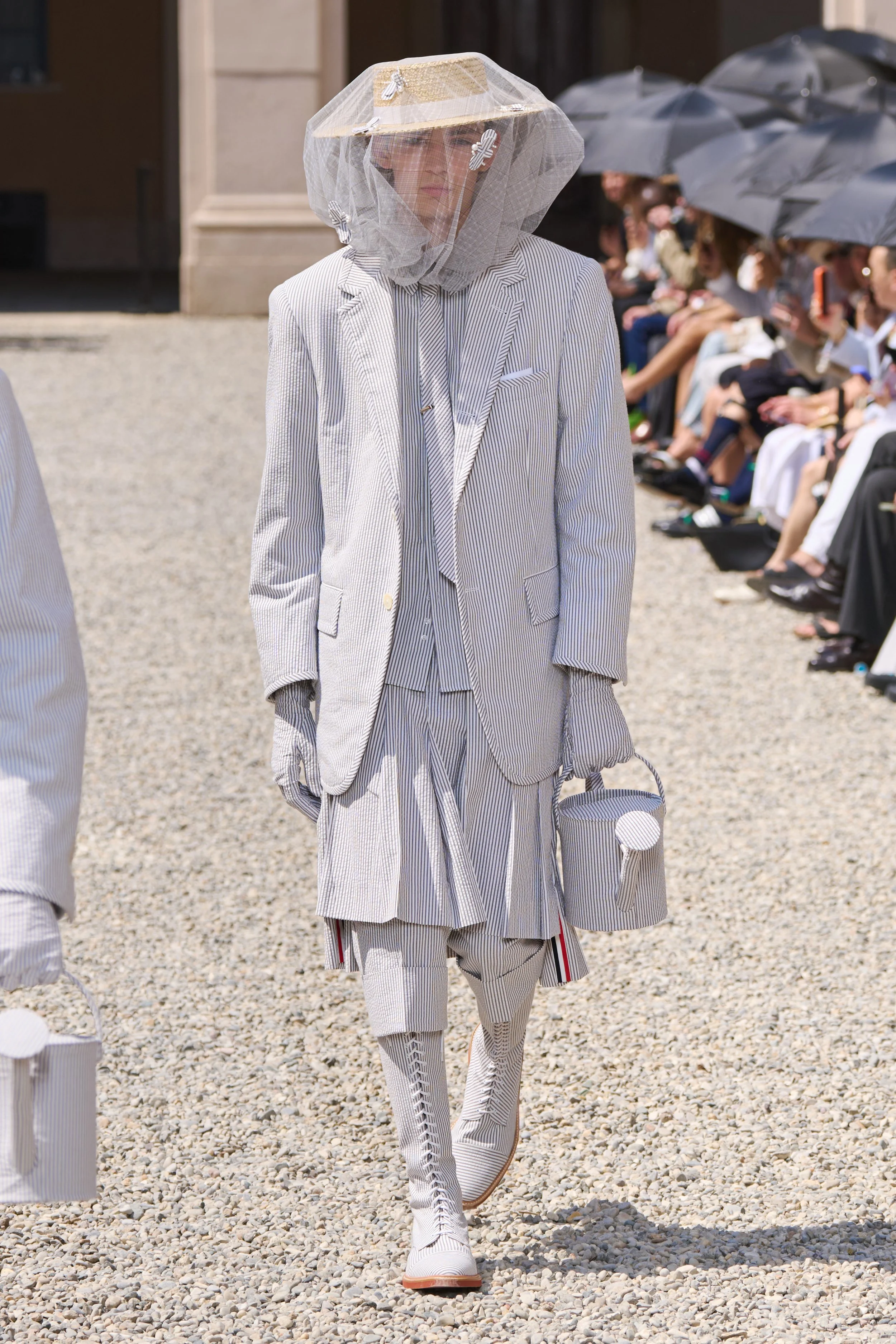
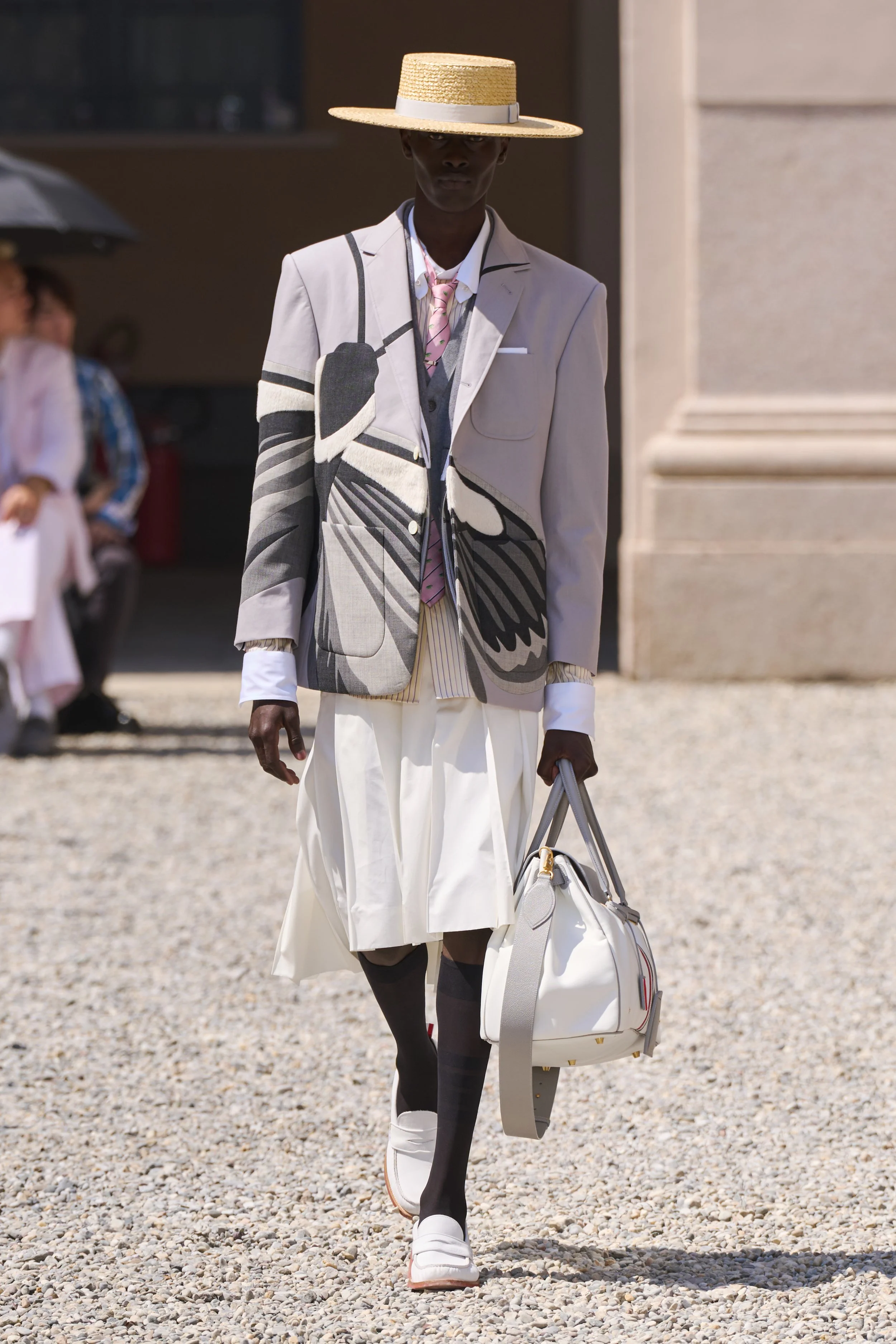
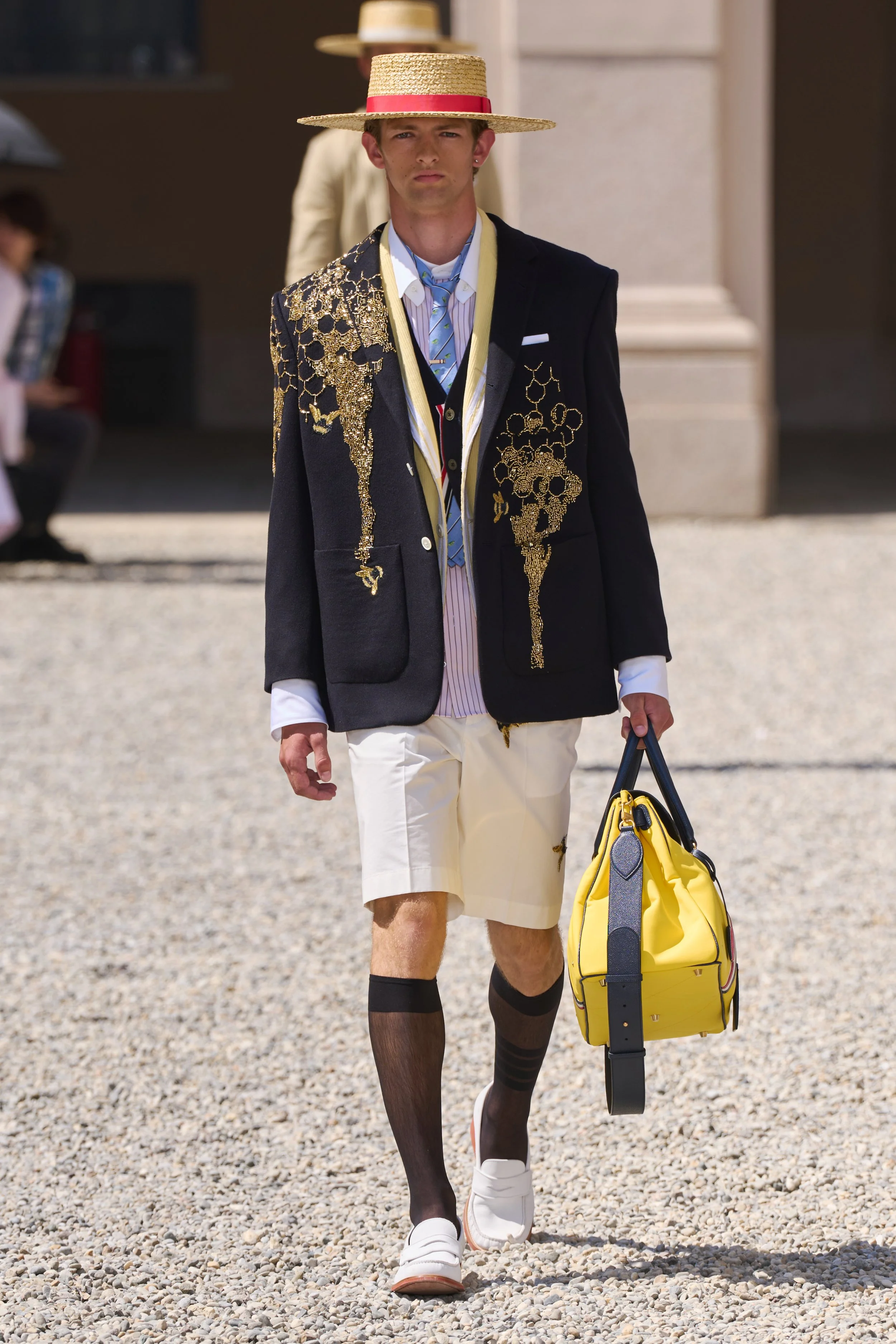
THOM BROWNE SS27

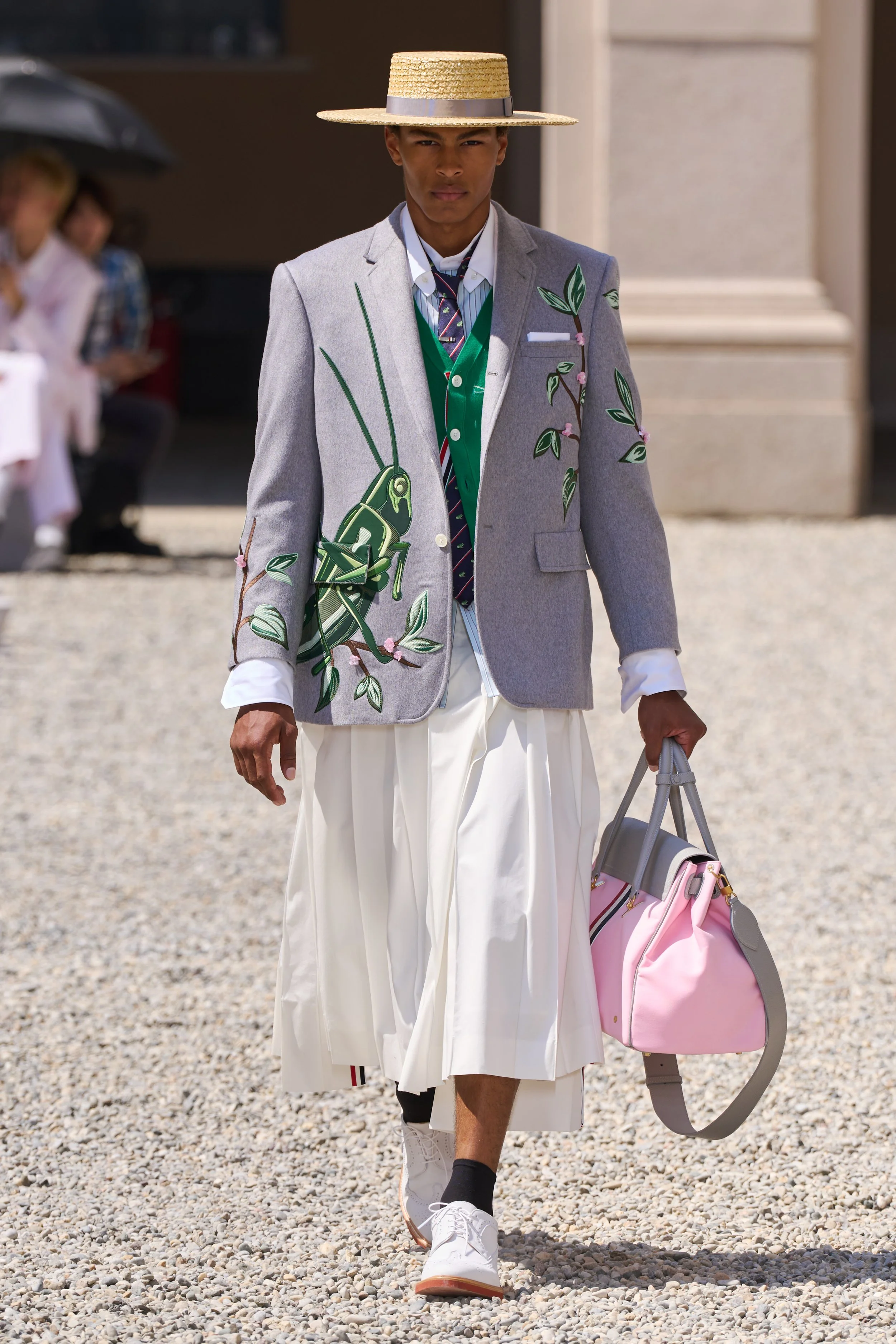
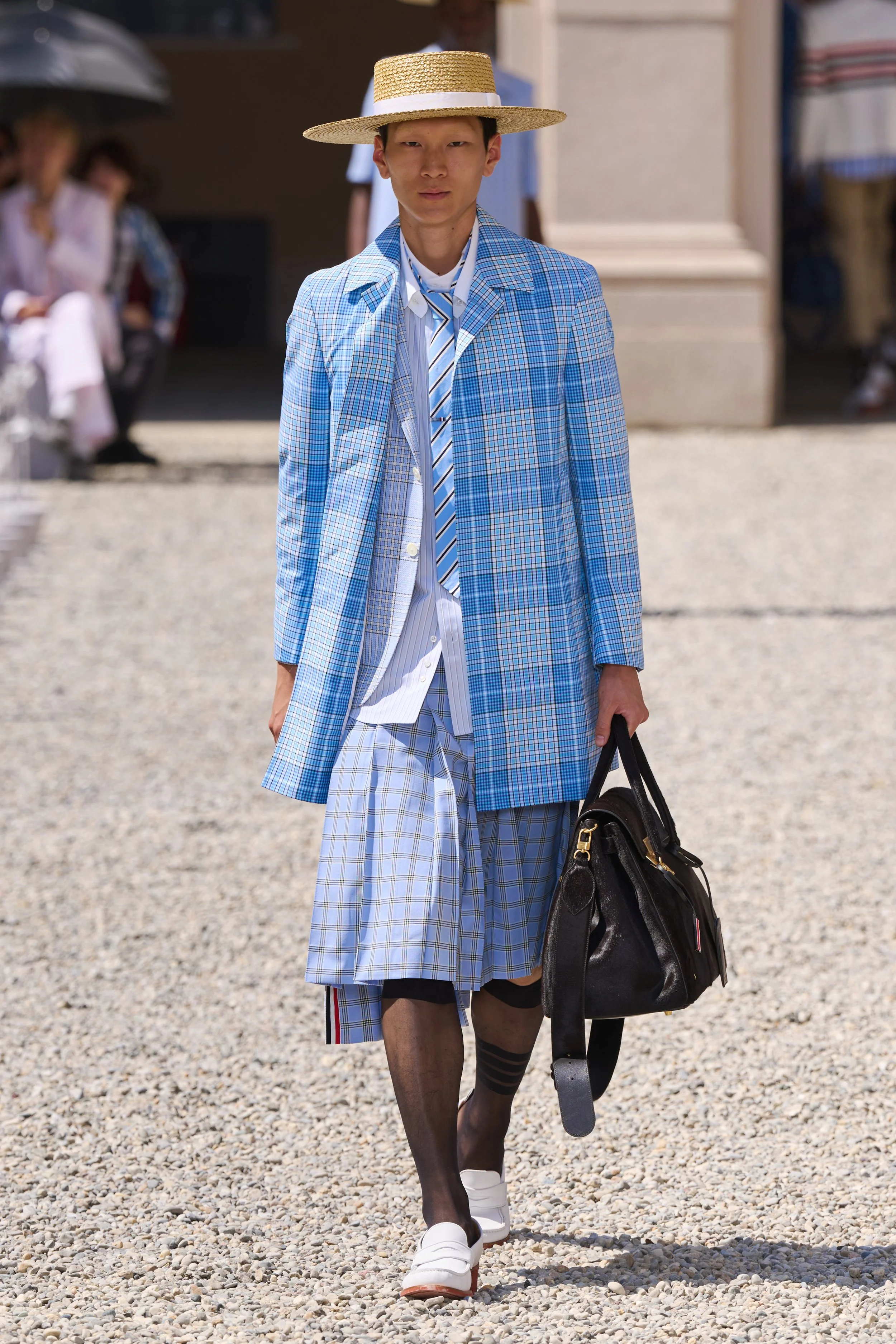
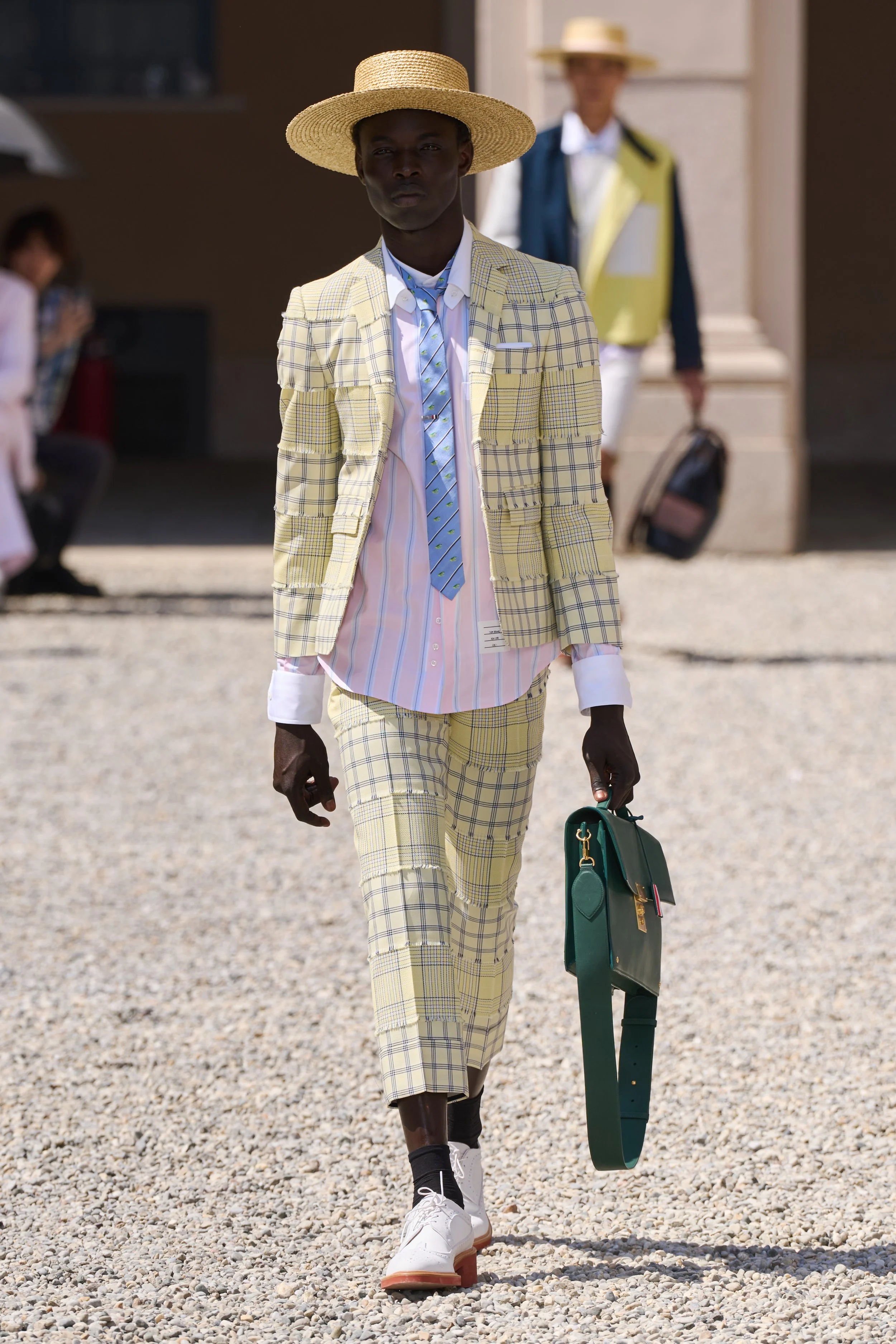
It’s not easy to find fantasy in everyday life. Try as one might, sometimes reality is all you have. The challenge feels particularly acute amid the heatwave currently sweeping Europe. There’s little on the mind besides hyperawareness of the sweat droplets dripping down one’s forehead and a desperate longing for air conditioning. Still, even beneath the blazing sun, Thom Browne manages to transport us elsewhere. For Spring/Summer 2027, the American designer went straight to the source of childhood fantasy.

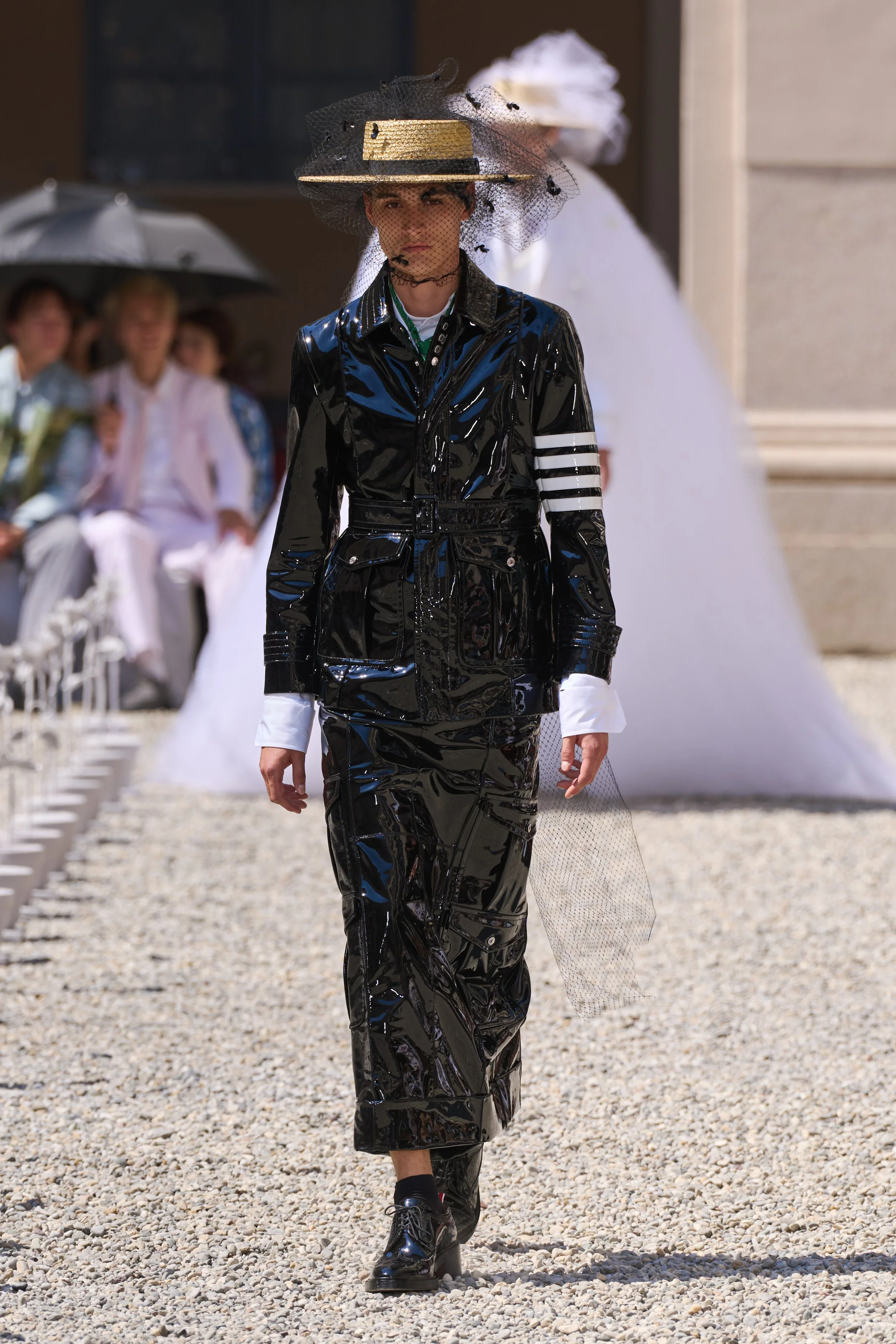
In what marks Browne’s first menswear show in Milan, the designer took a lighthearted approach, infusing the brand’s staples with playful motifs. Flying bees, dripping golden honey, dragonflies, and water lilies appeared embroidered across navy jackets and grey shorts. Nature became both decoration and narrative, transforming familiar tailoring into something a touch more dreamlike.

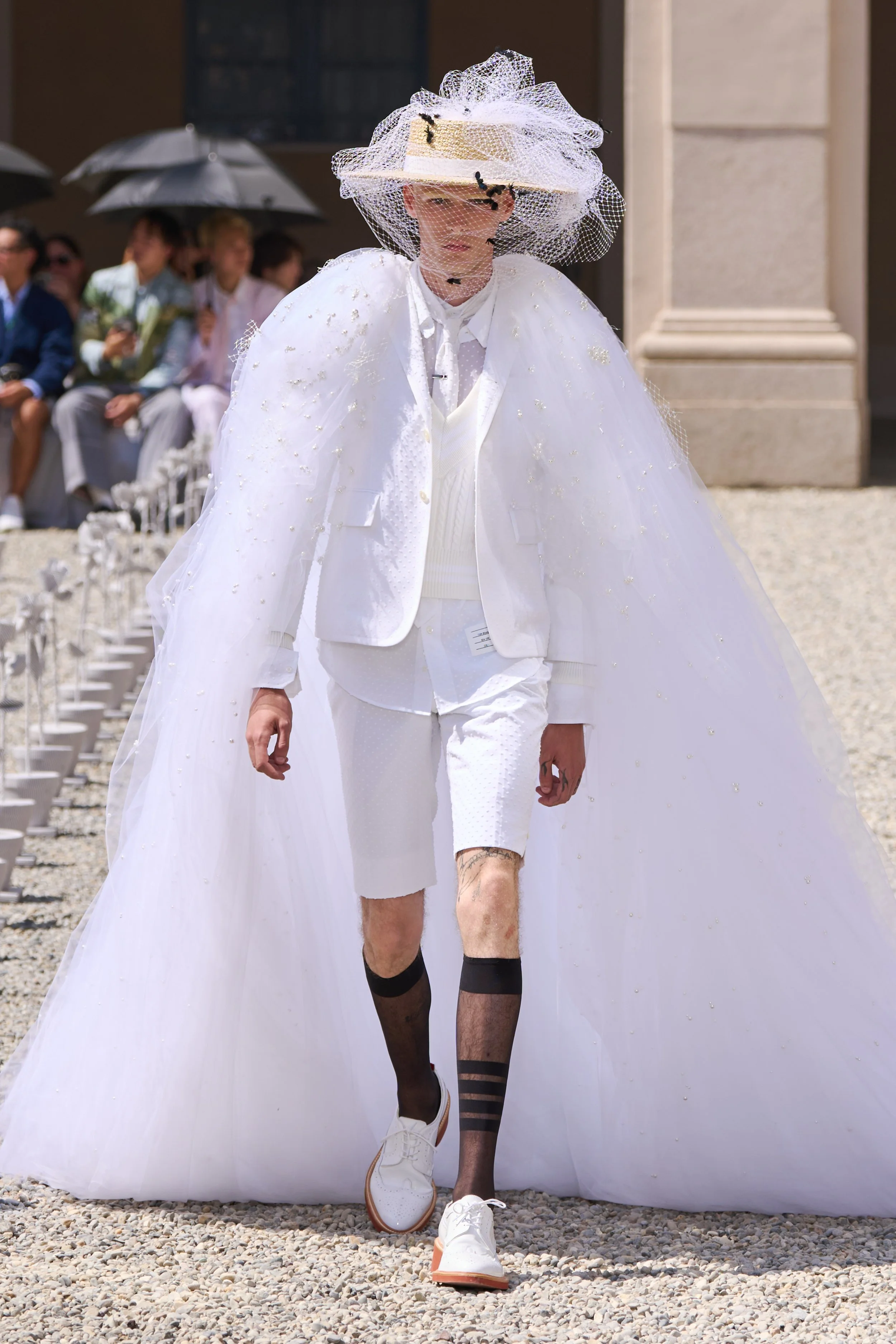
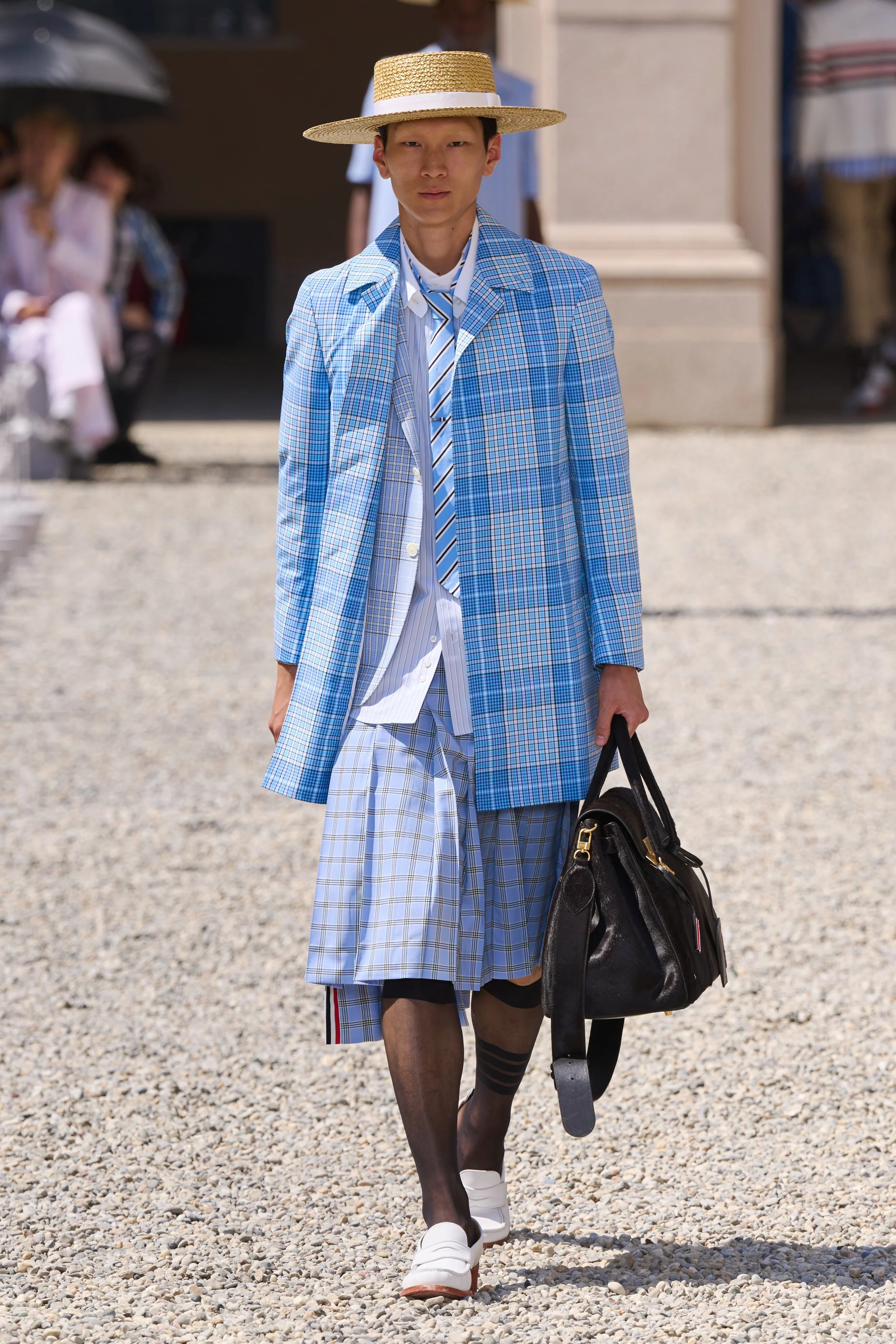
The theme was literal at times and completely camp at others. The opening look, a striped suit paired with a skirt, was topped with a hat and veil. The closing look echoed the silhouette, this time with the veil swarming with embroidered bees – the same motif seen in two dimensions earlier on a nylon parka.

Drawing from two childhood classics, A Bug’s Life and The Princess and the Frog, Browne rendered structured tailoring whimsical through pastel pinks and soft yellows. Elsewhere, dripped paint across a lightweight jacket created a splashy interpretation of houndstooth. Even at its most playful, however, the collection never abandoned Browne’s precision. The designer’s familiar silhouettes remained intact, merely complemented by moments of wonder.


Words by Pedro Vasconcelos

SAUL NASH SS27

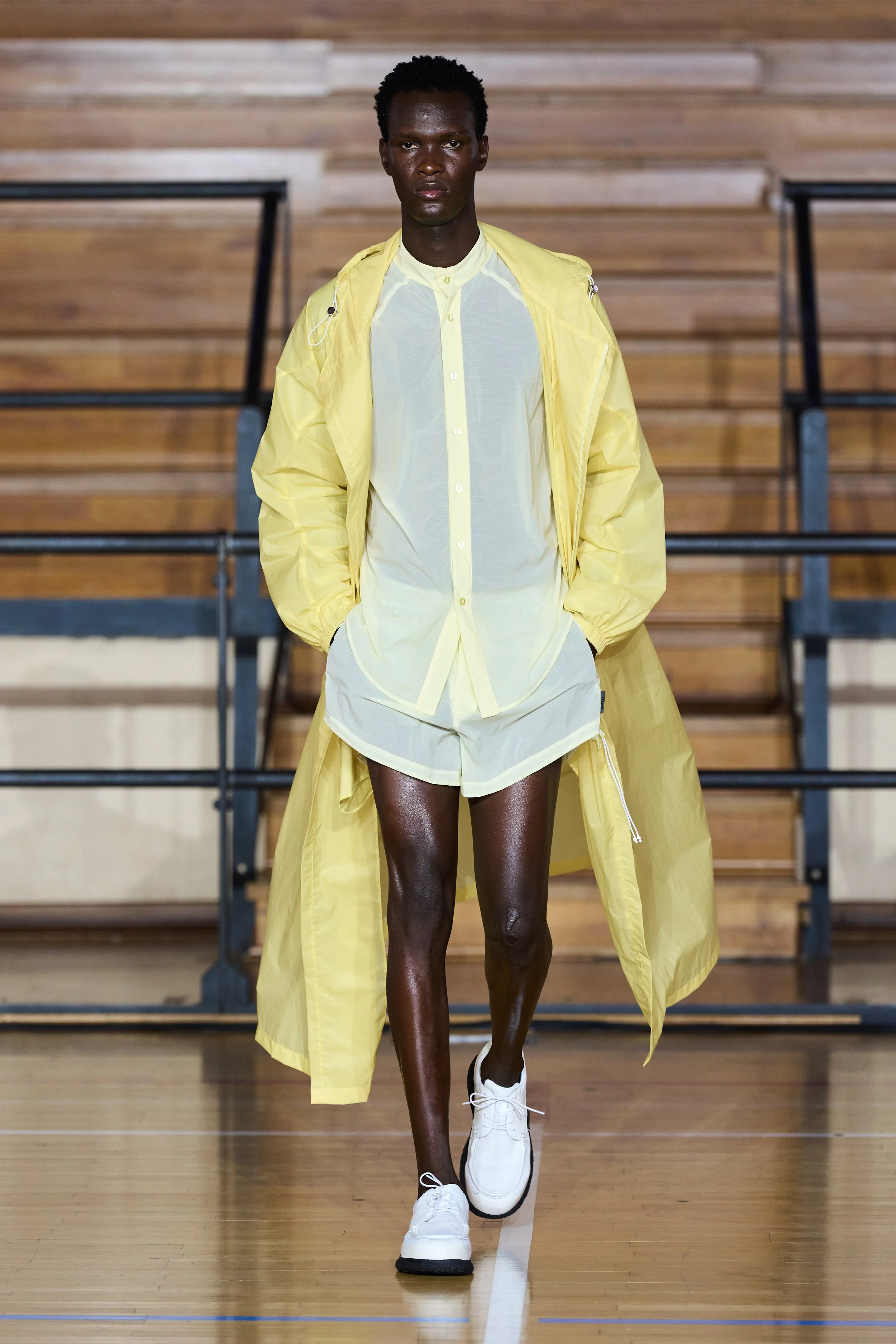
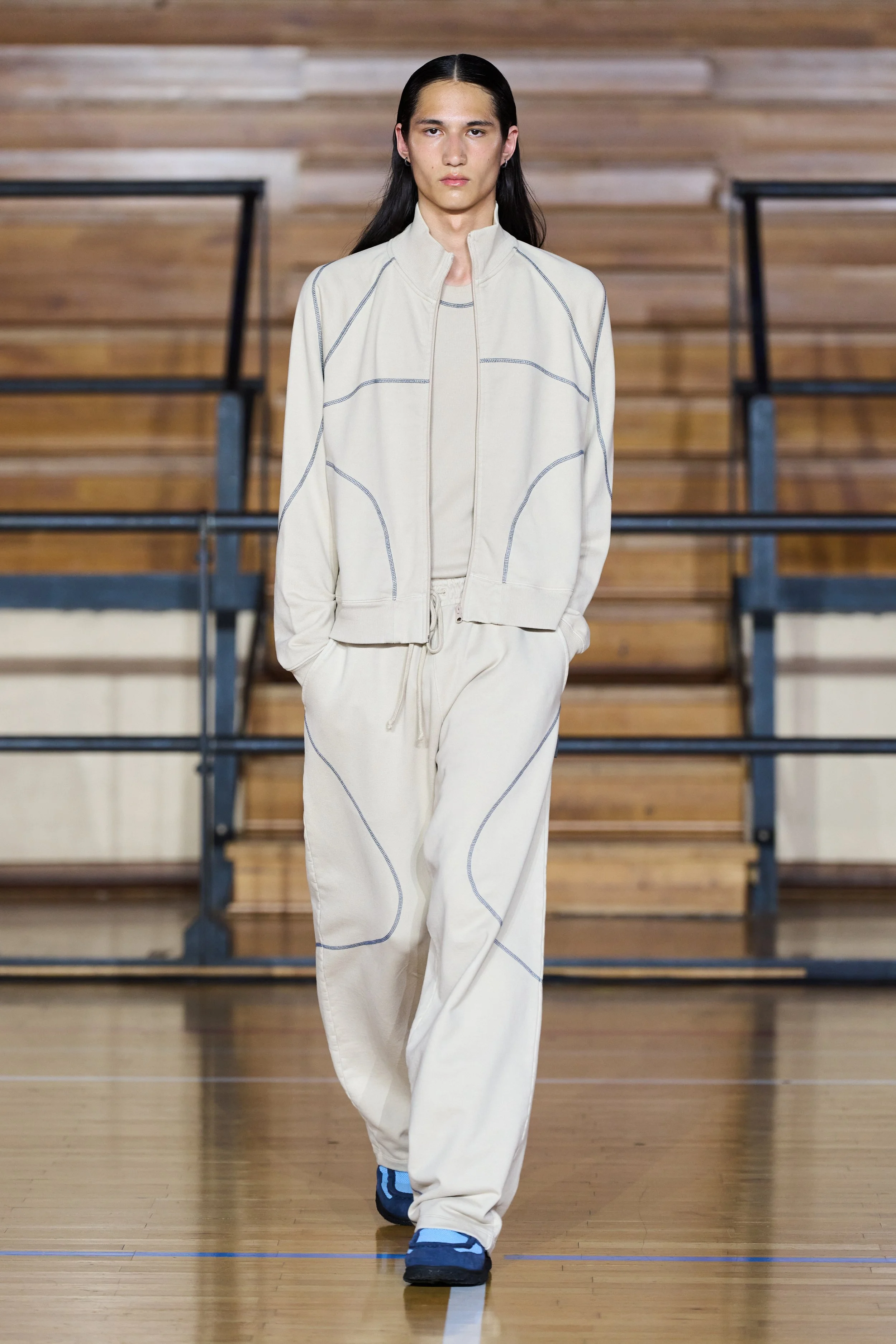
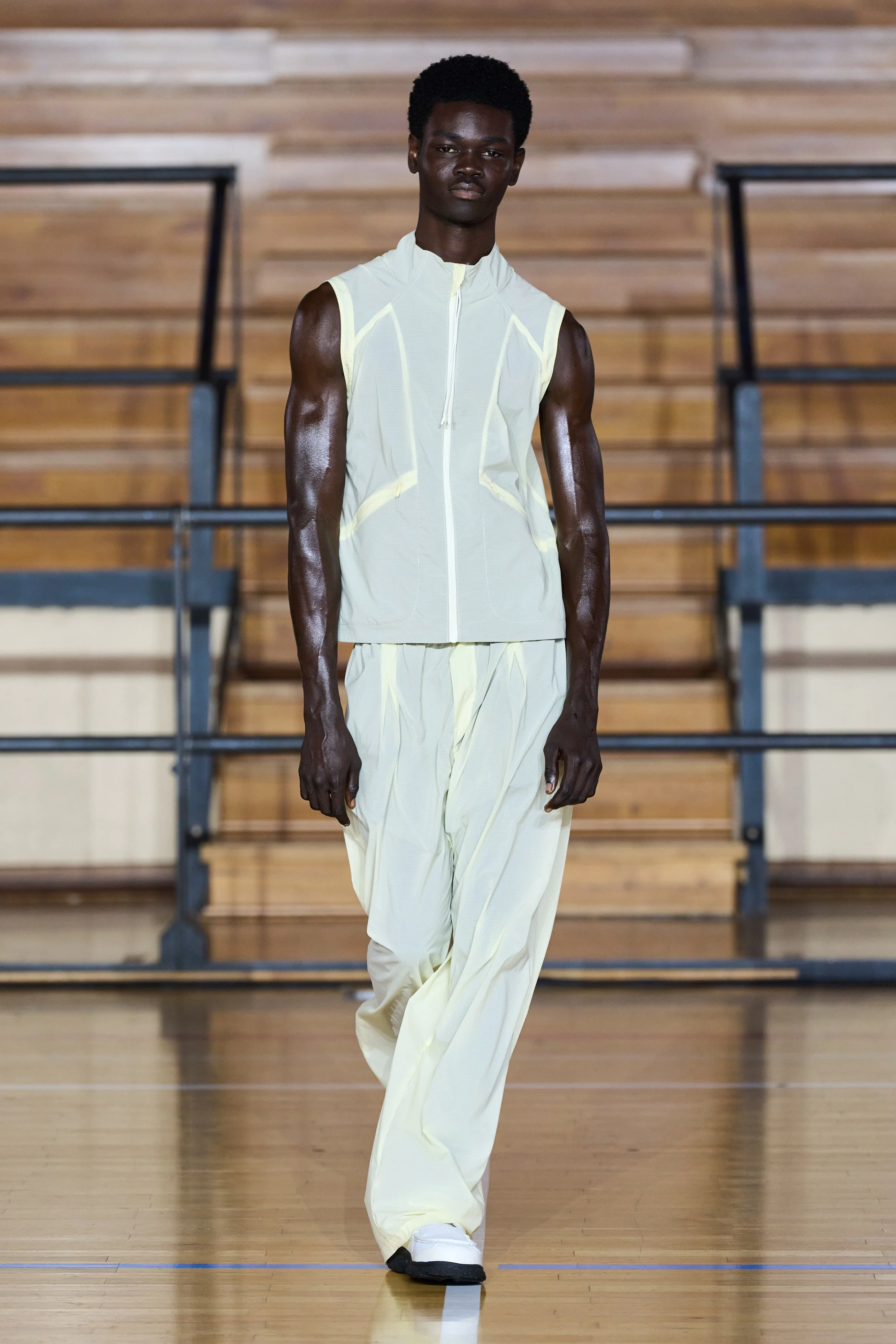
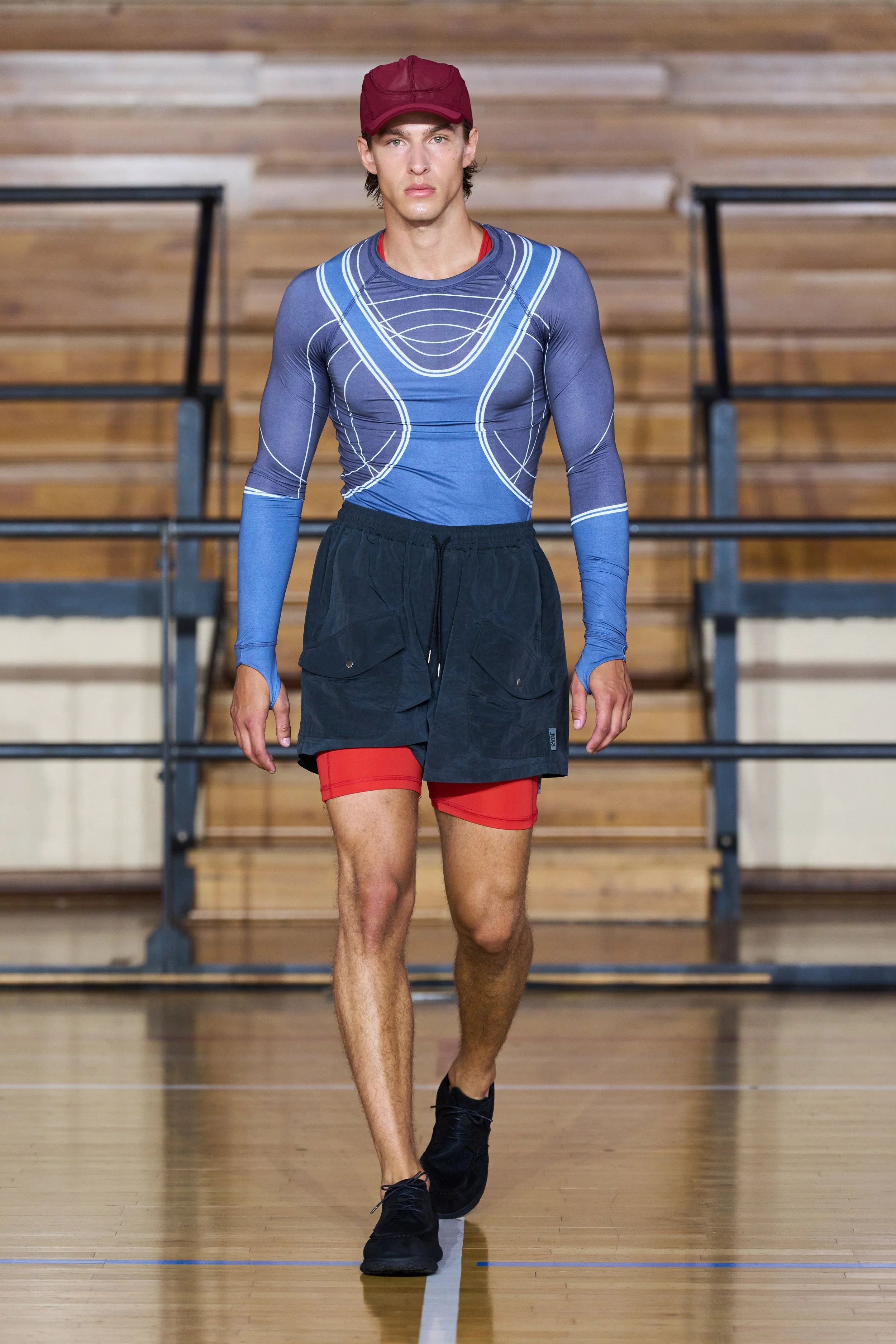
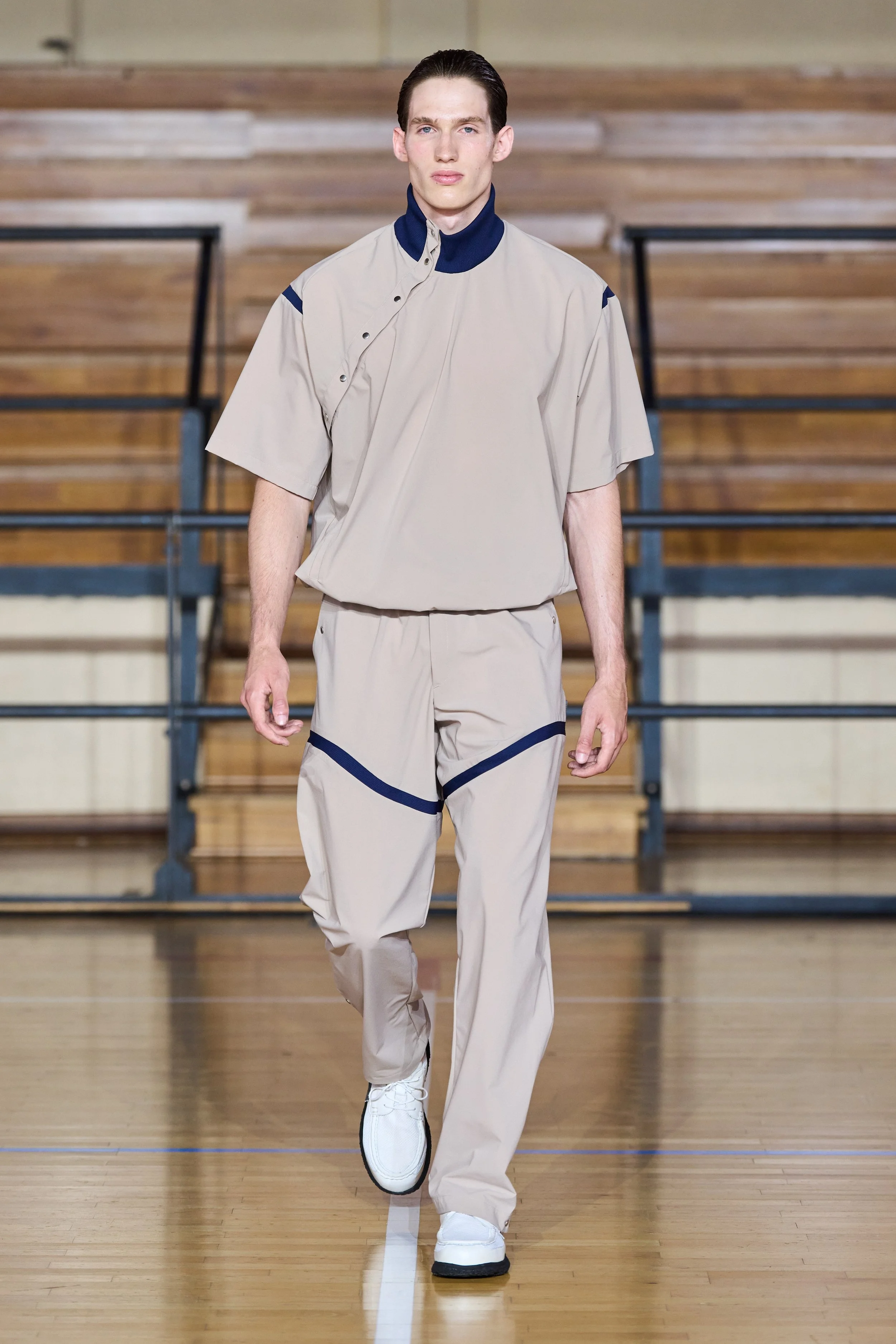
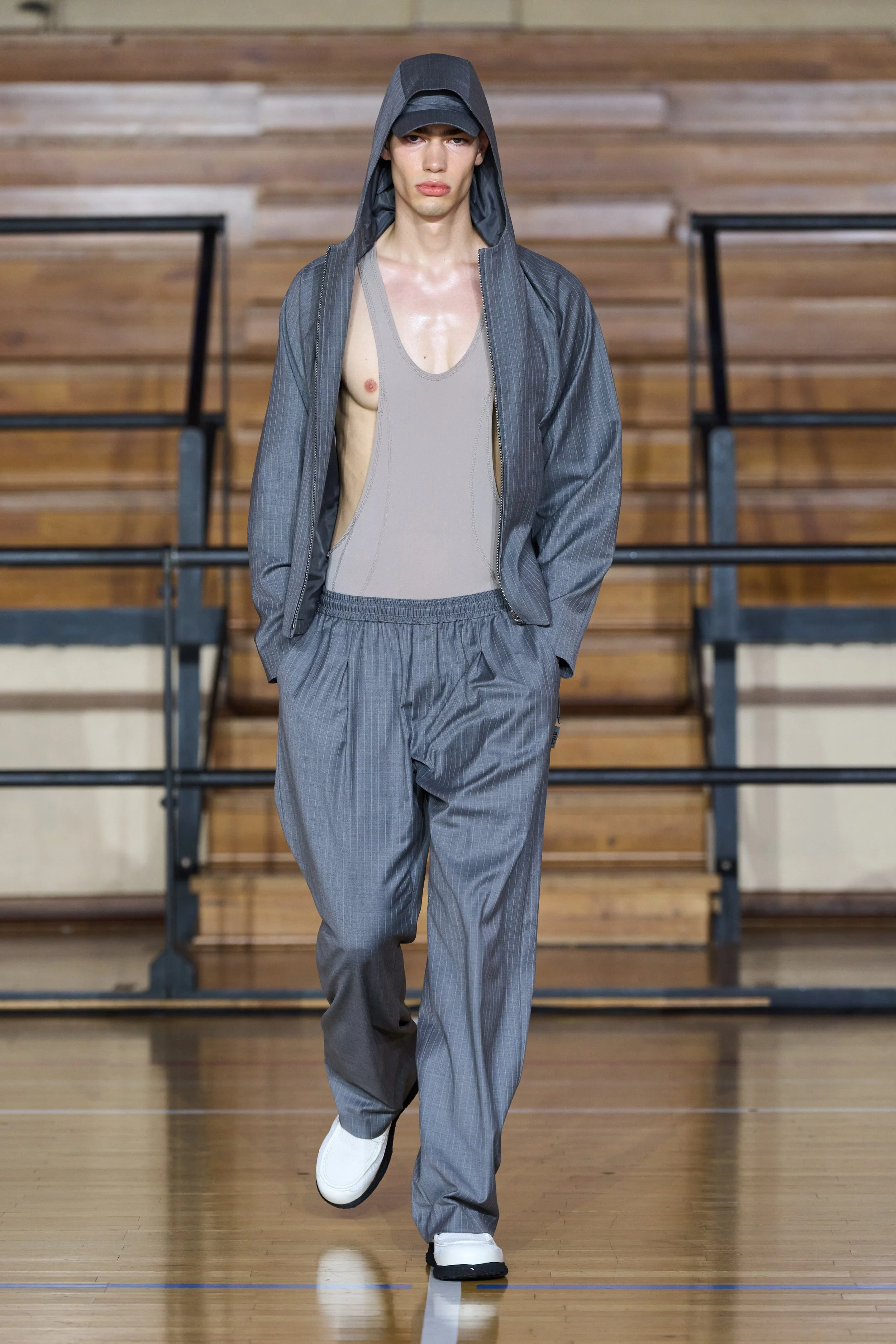
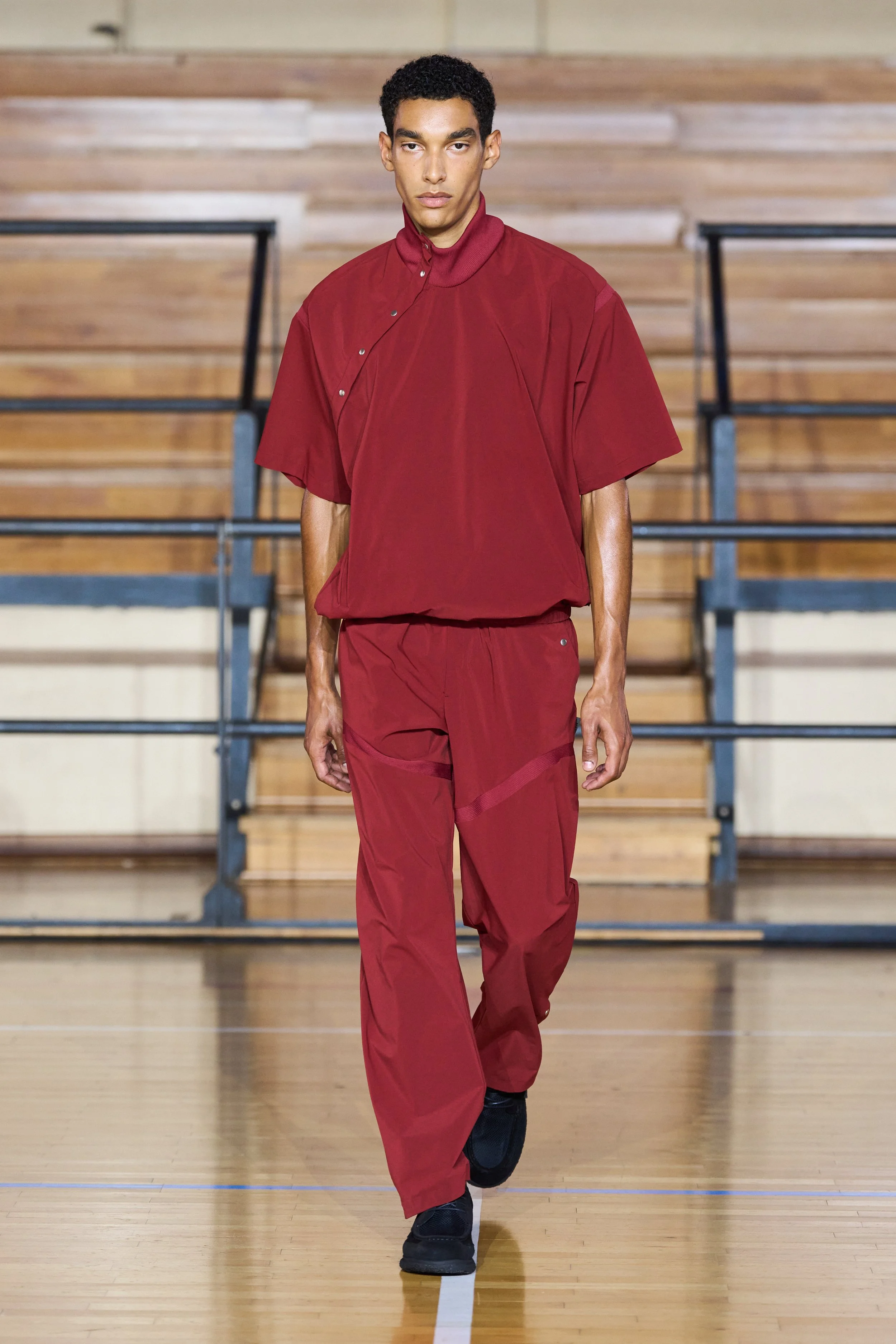
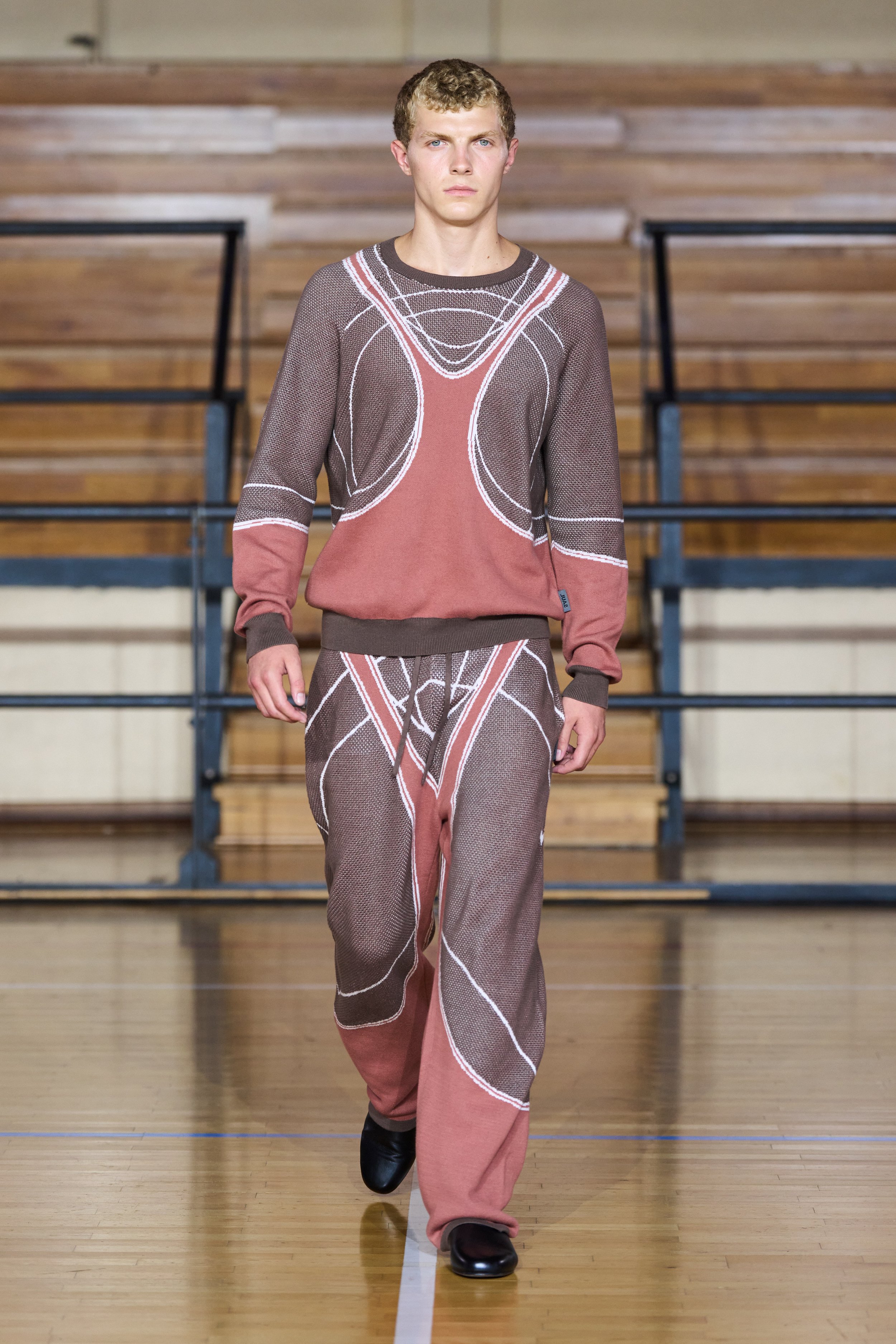
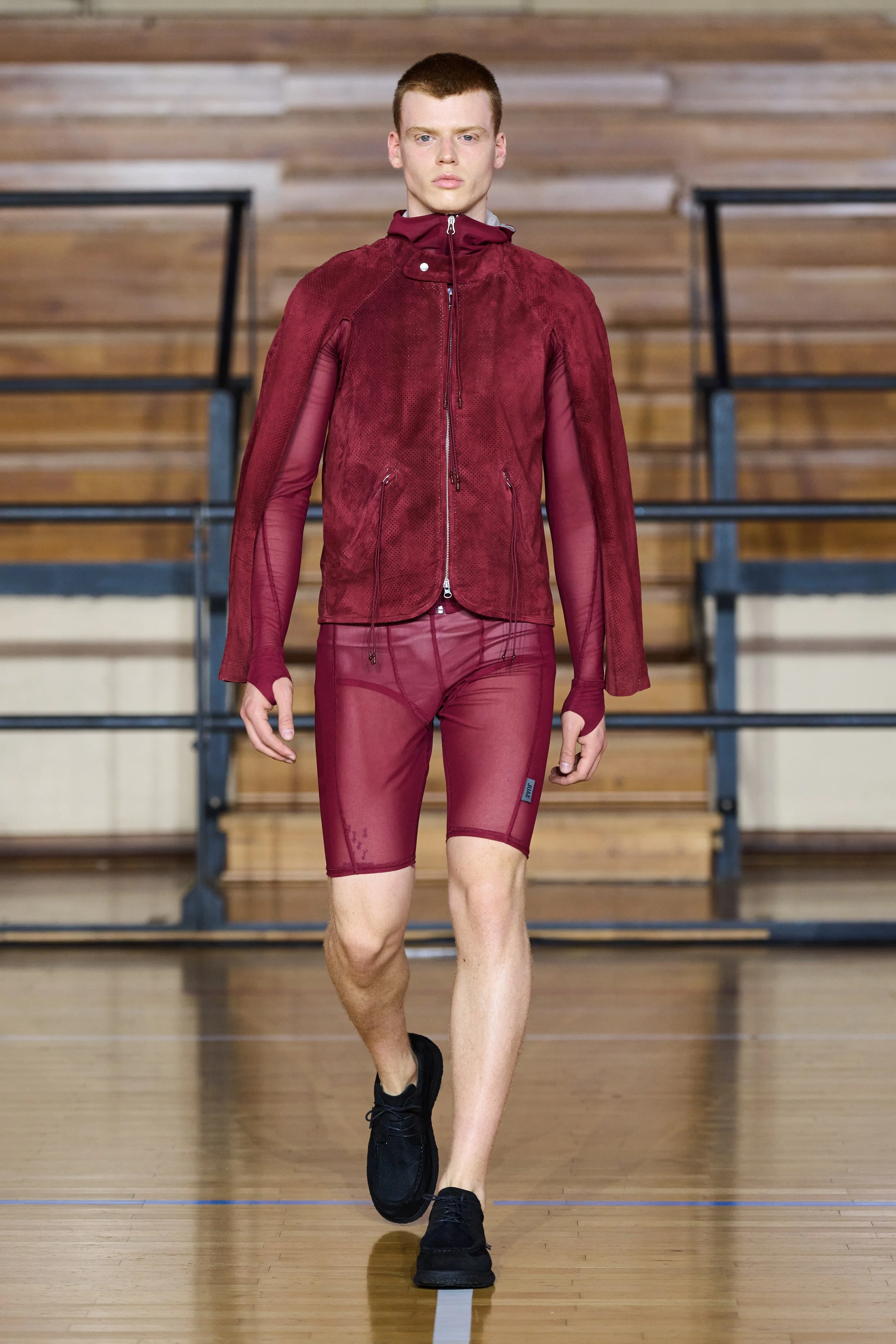
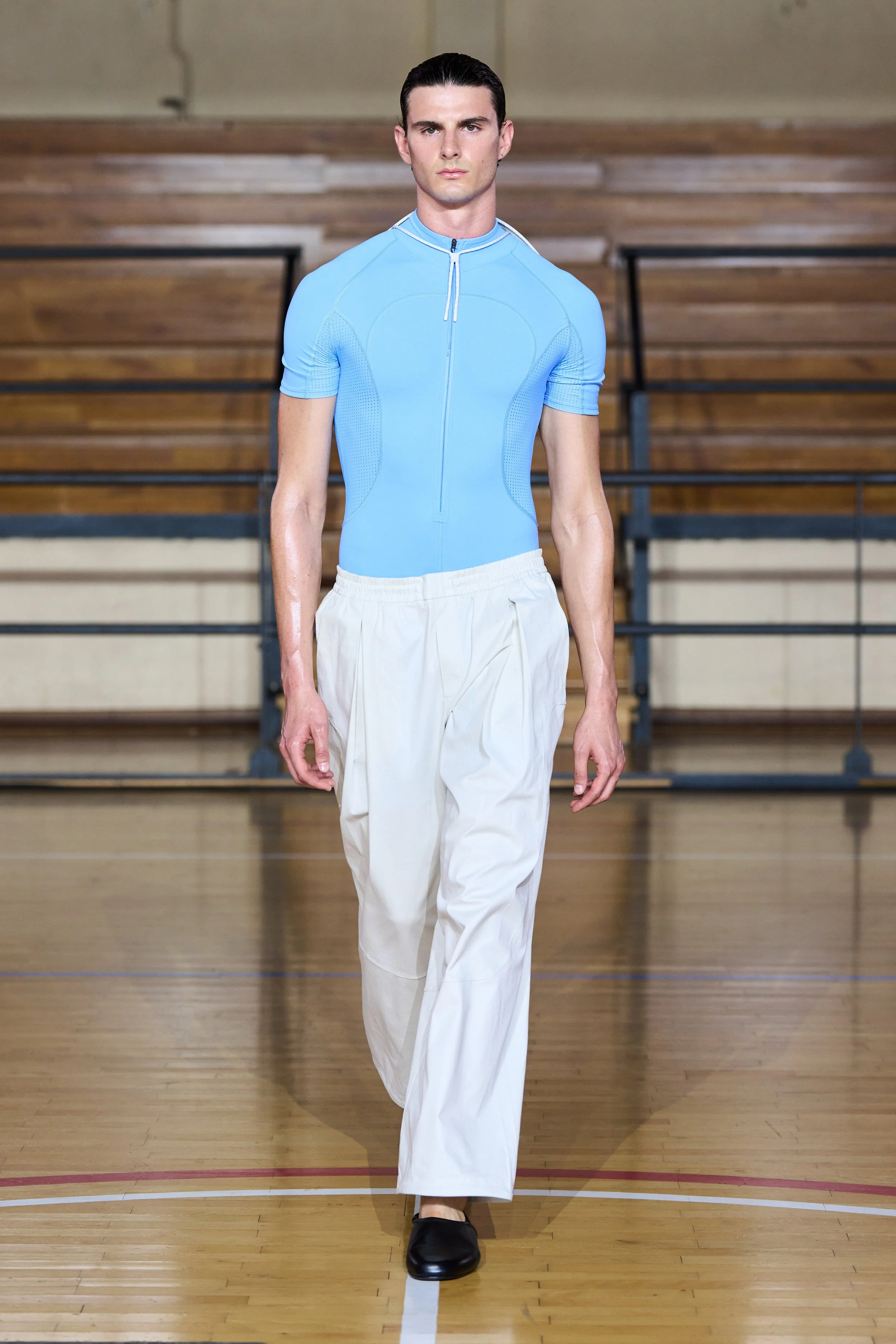
Saul Nash is a connoisseur of the male form. Through the seasons, the designer has made sportswear into a language, allowing him to stay close to the body while studying it. Where is desire, where is attention to the body, clearer than in the act of working on it? Nash utilises this proximity to theorise.

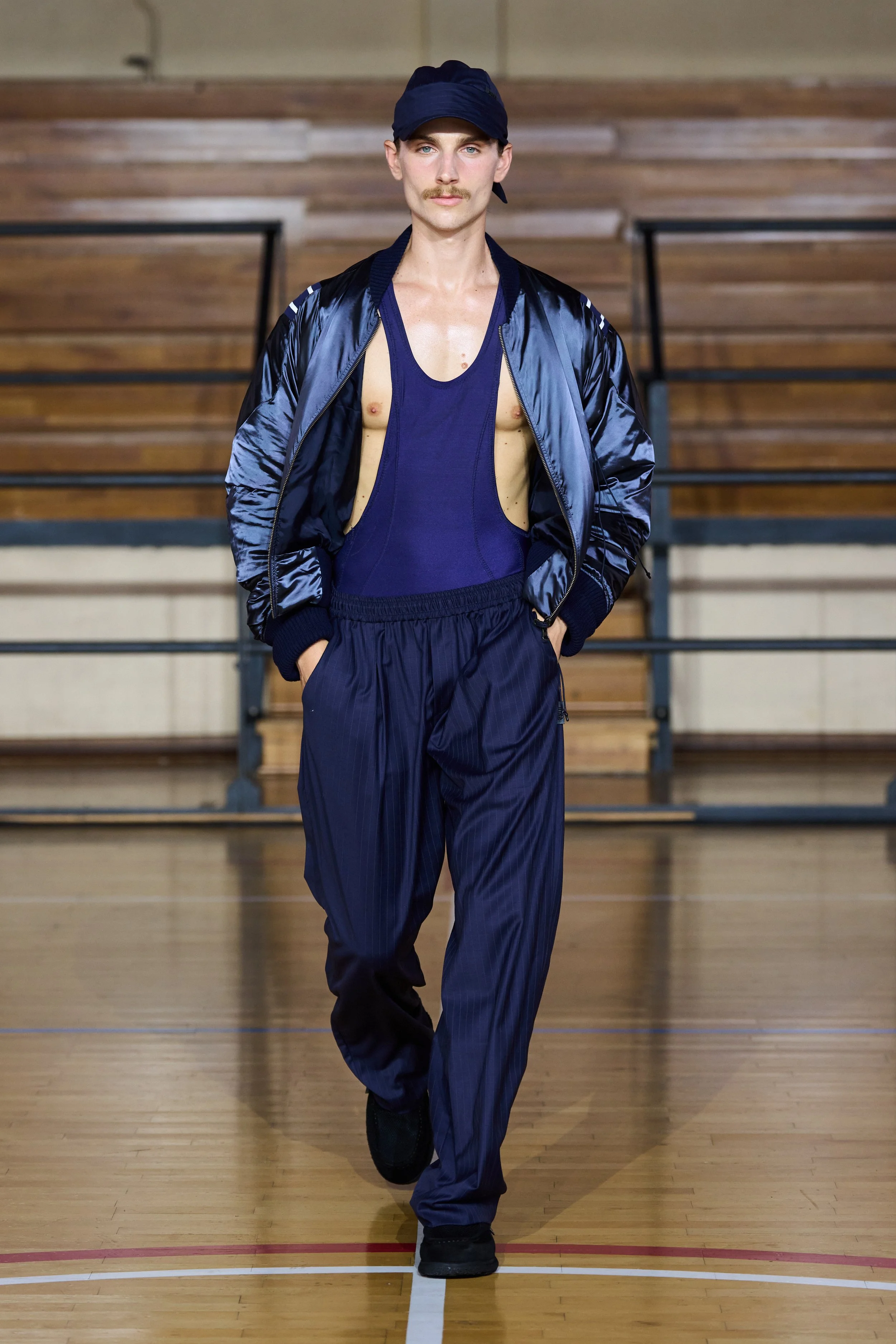
Here, Nash begins with two intersecting ideas: the idolization of male pin-ups from the 1950s and male corsetry from the Victorian era. The first is personalised through the wrestling singlet, shown here in stretchy taupe and bright navy. Hidden beneath shiny tracksuits, their erotic potential is barely concealed, peeking through as the models walk.

Singlets become more than a point of interest; they become a muse of sorts. In compression tops, their shape is manipulated, turned into a pattern that gathers at the waist and expands at the shoulders. In baggy knits, the same motif is used; its initial purpose – to define the body – now completely obsolete.

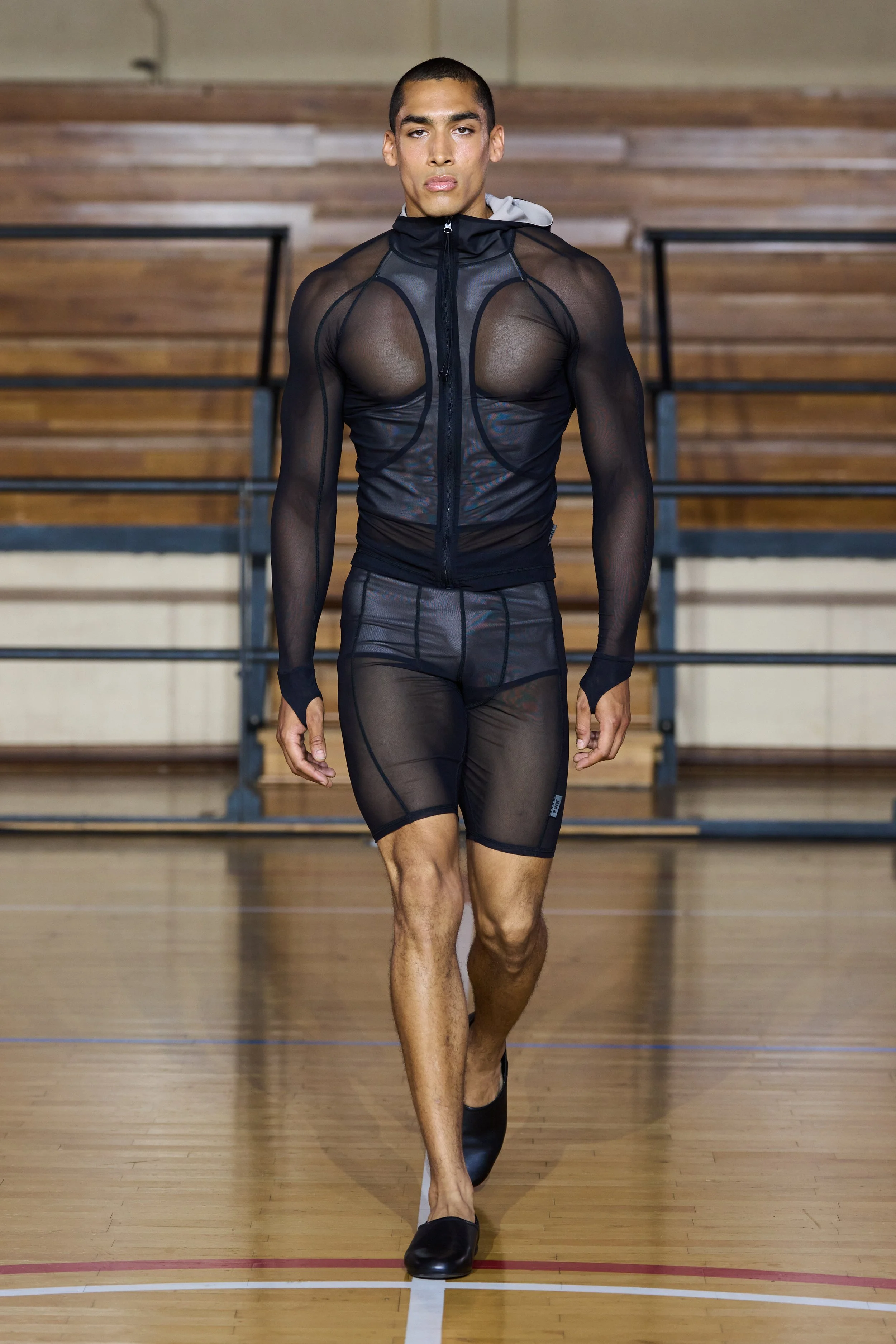
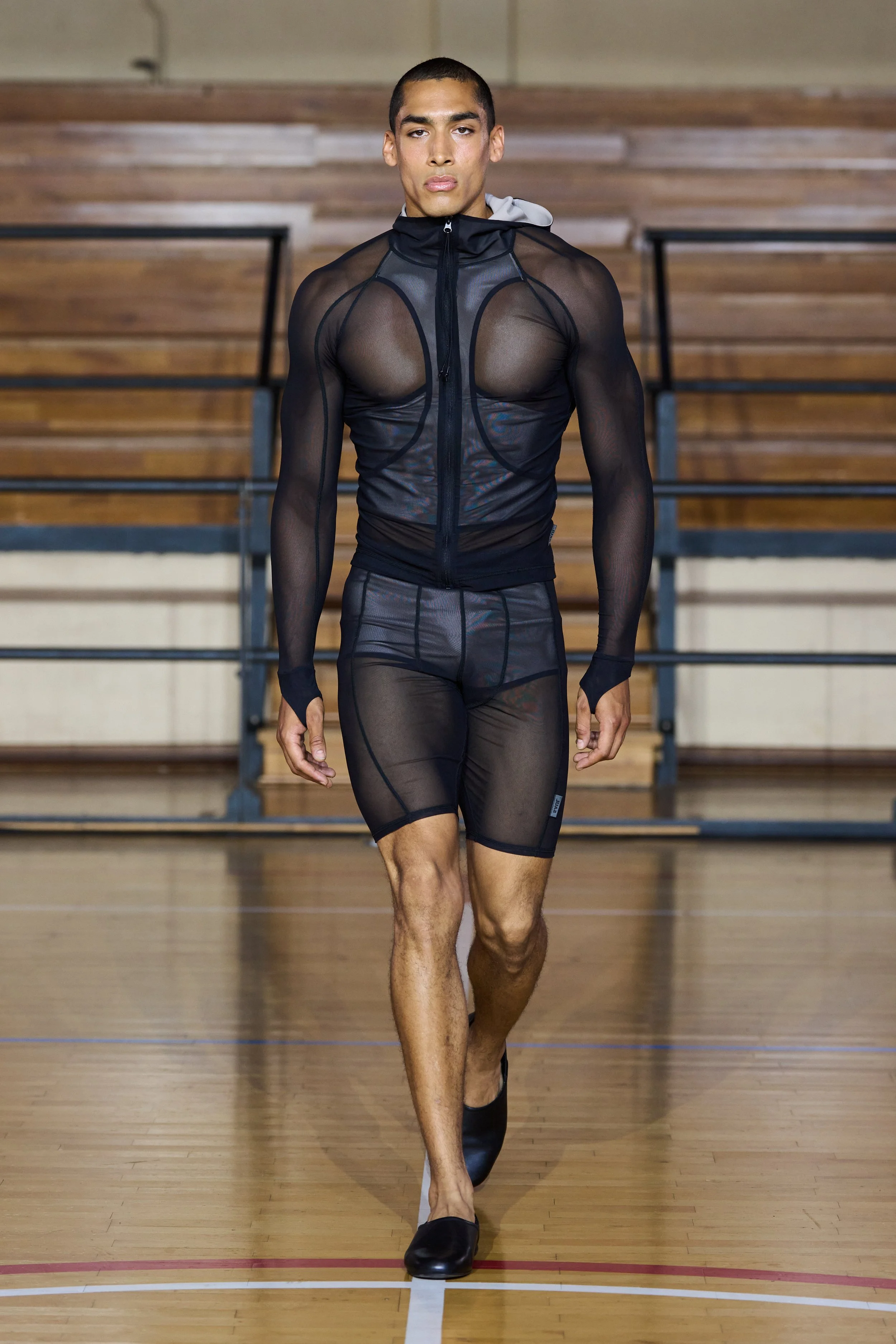
The same can’t be said of the closing look: a sheer compression shirt-and-shorts set whose seams define the body. Gripping the pecs and shaping the shoulders, tracing the quads and framing the abs.

Still, the body isn’t merely a site of sexual tension. The choice to reveal it (or conceal it) is also explored. Technical jackets and hoodies are riddled with two-way zippers, allowing the wearer to expose the physique at their own discretion.


Words by Pedro Vasconcelos

PRADA SS27

The amount of discourse that follows a Prada show is remarkable. Online, hundreds – perhaps thousands – of voices immediately begin hypothesising about the meaning of what most have only just witnessed through a livestream. From biased criticism to outright fanaticism, the reaction speaks to what Miuccia Prada, and now Raf Simons, do better than almost anyone else in fashion: they create intellectual discourse. Everyone wants to be part of the conversation.

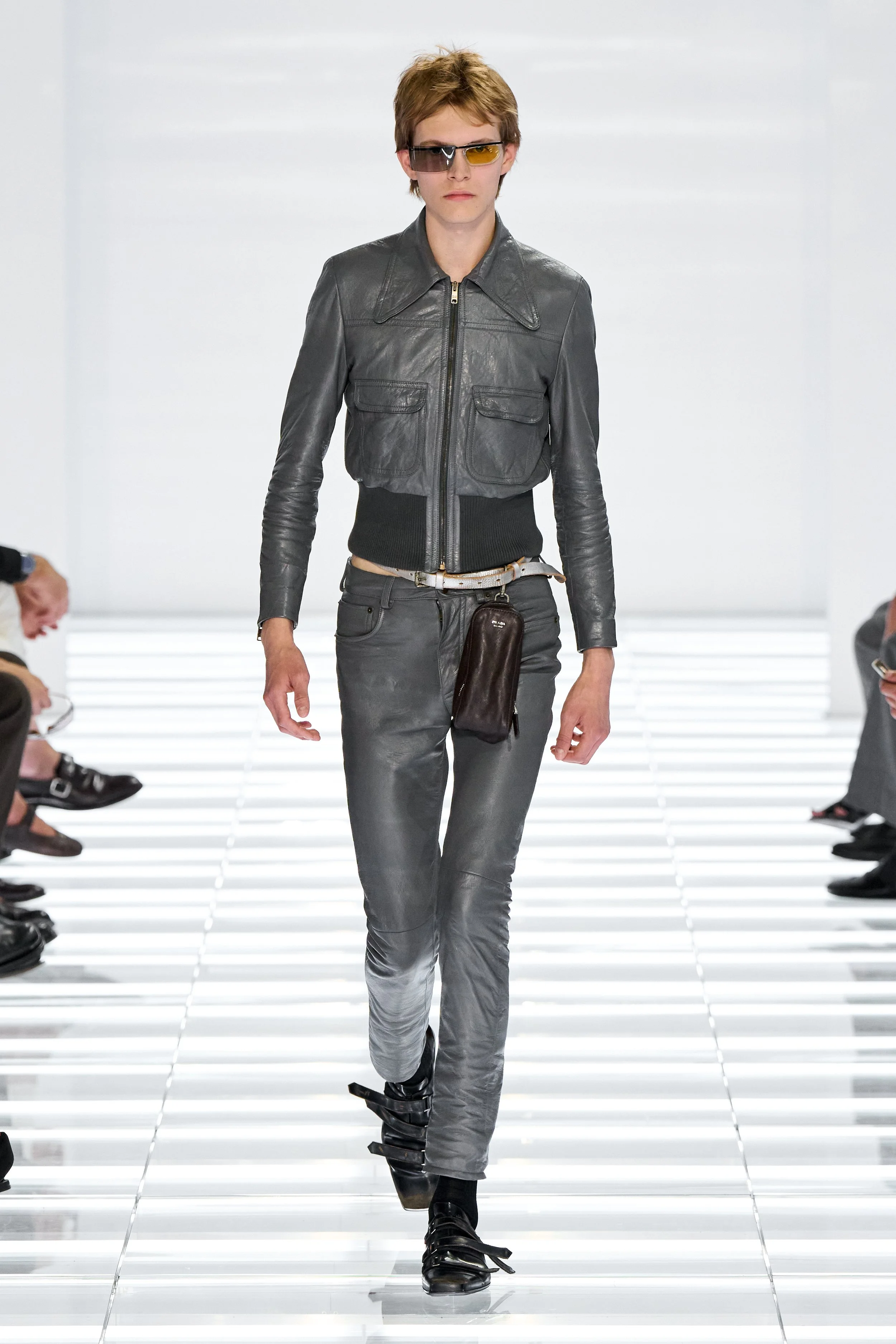
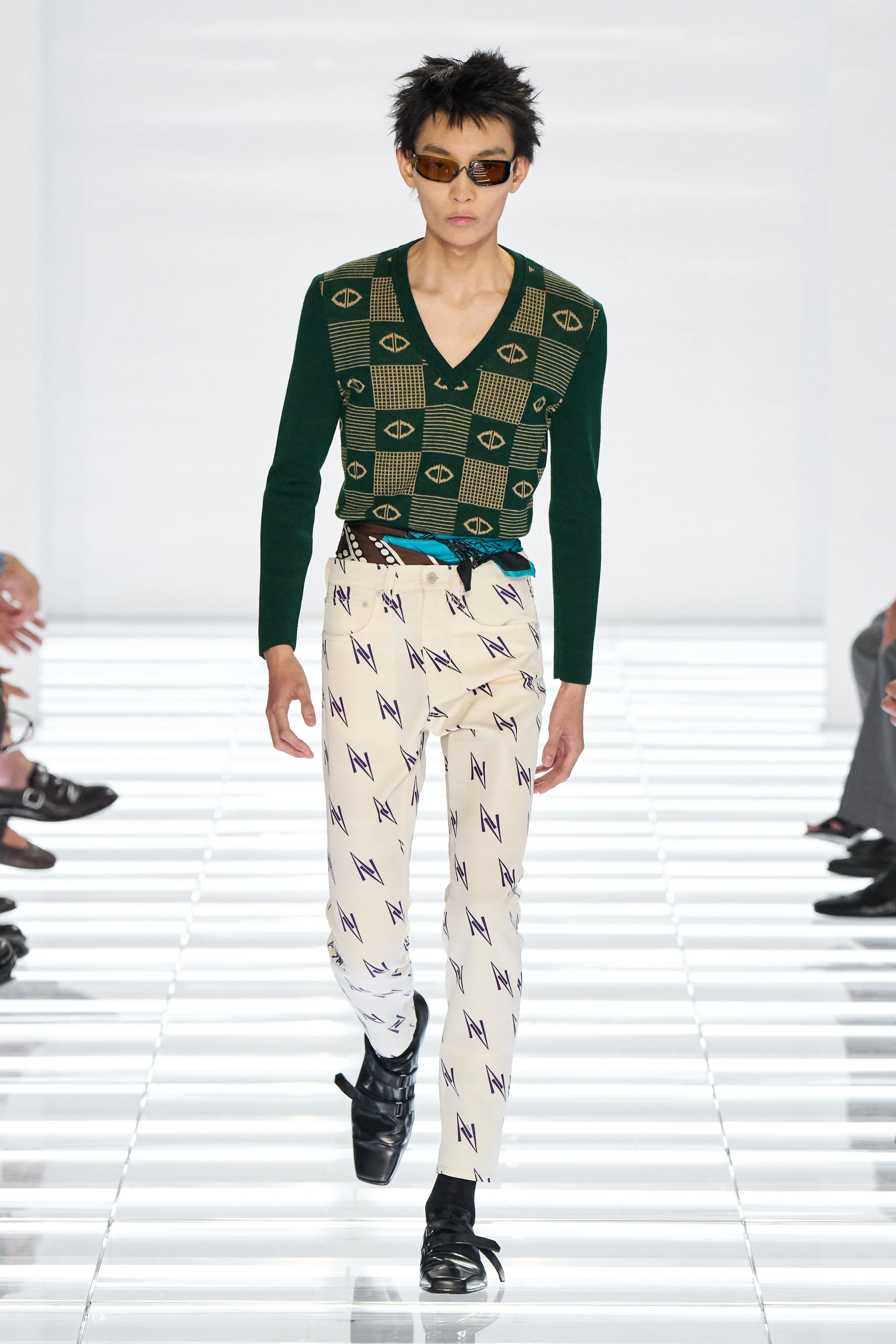
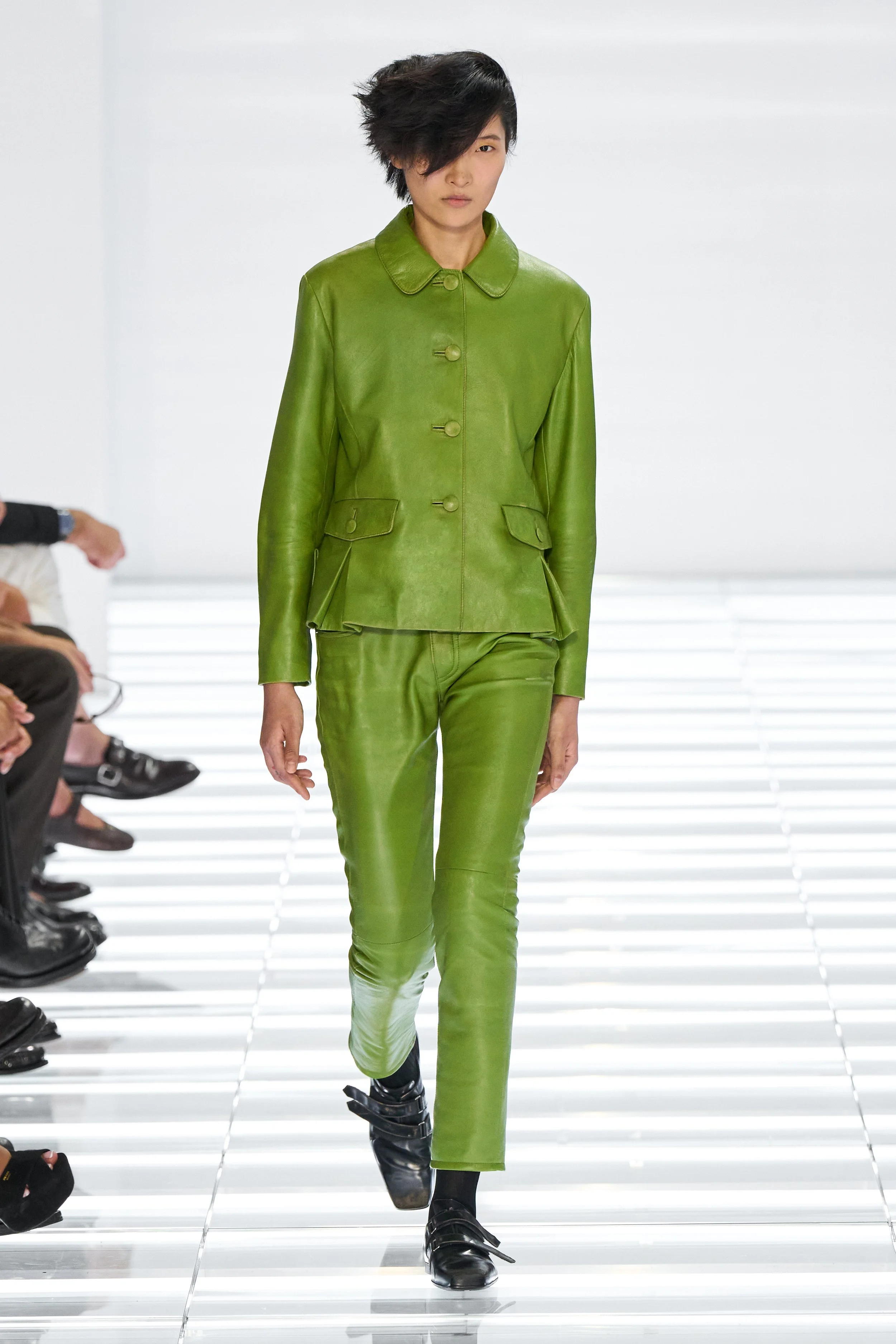
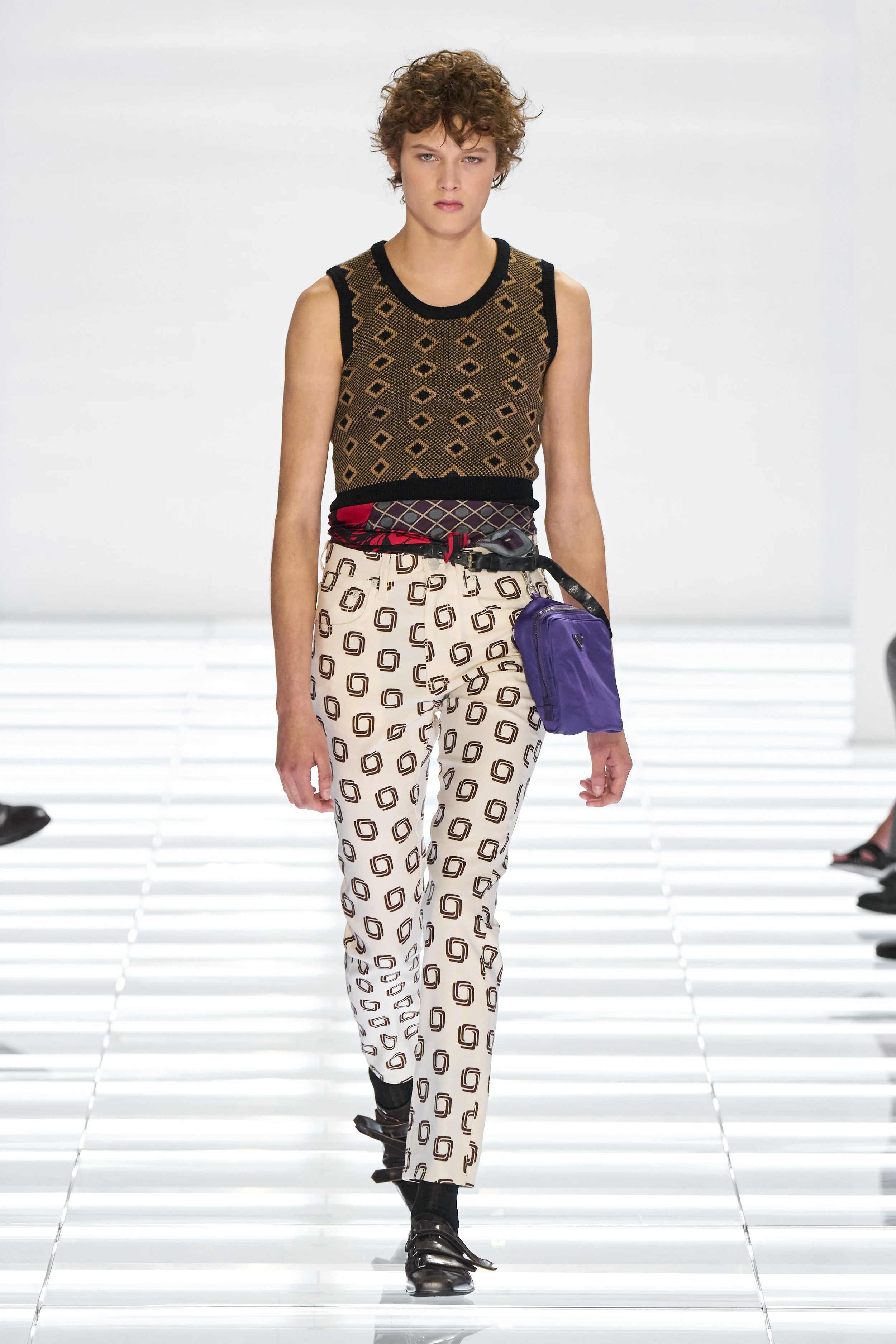
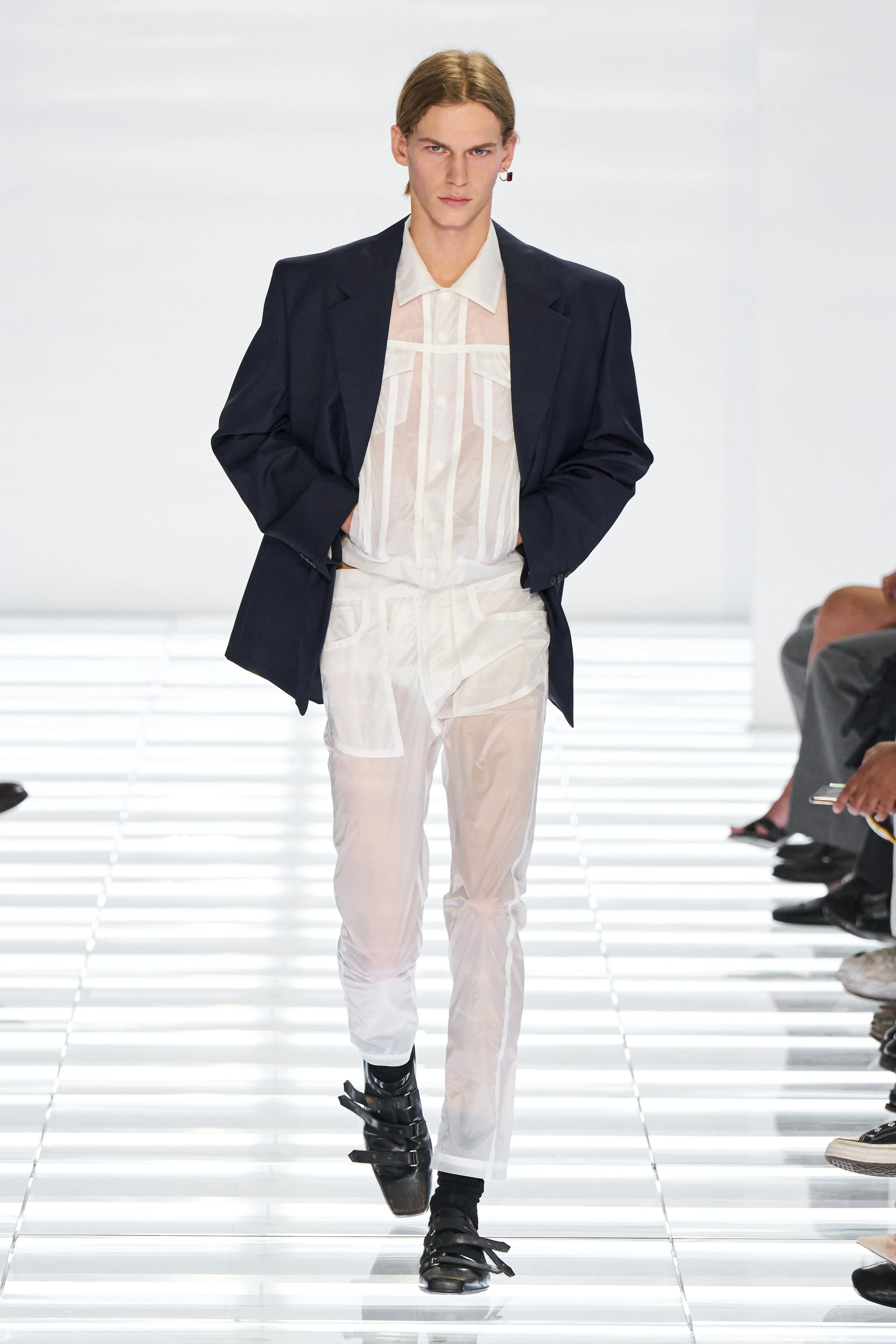
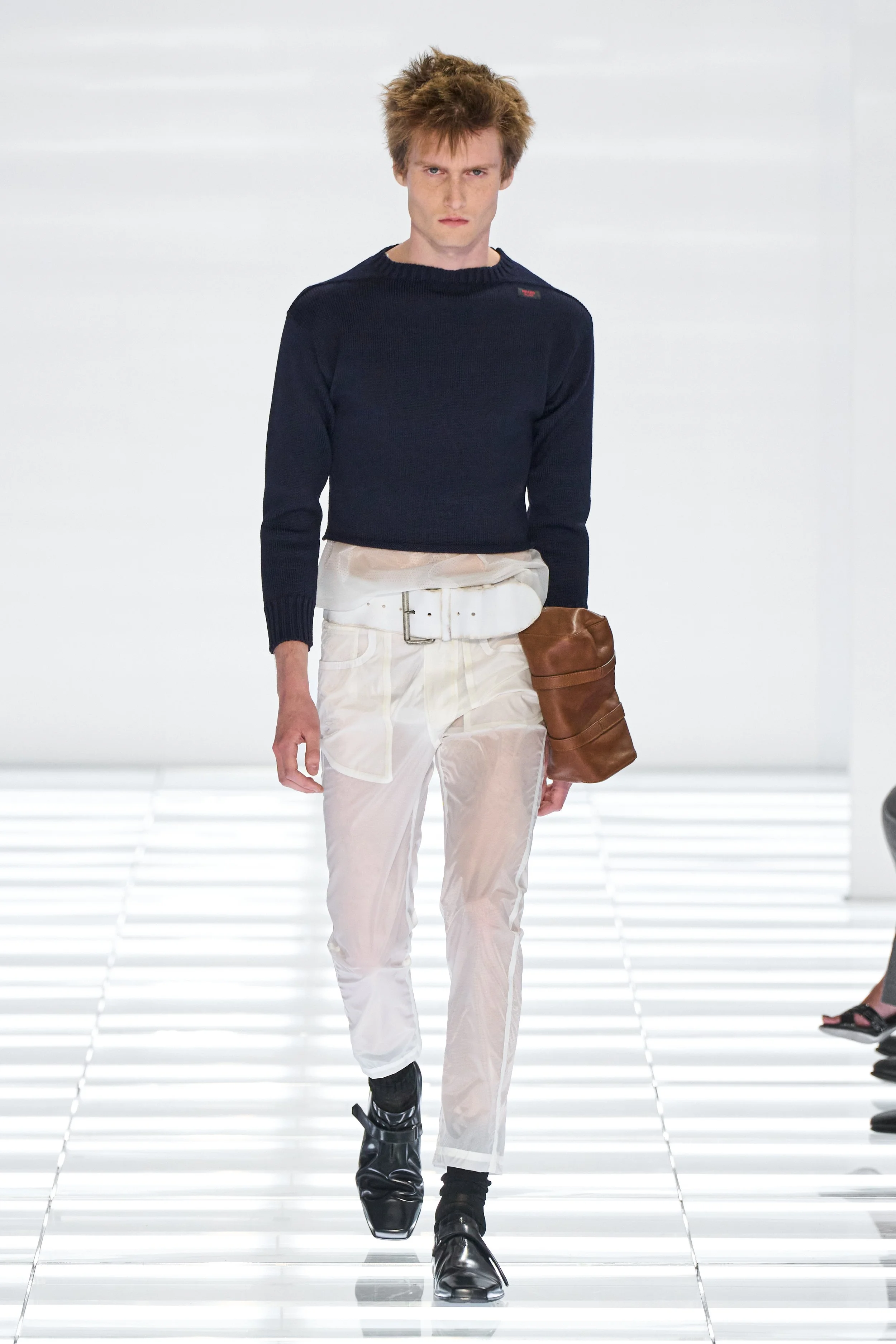
Yet, for all the instant analysis, keyboards poised as each look appears on screen, theories are only truly tested backstage, when the design duo offers its own interpretation of what has just unfolded. This season, above fluorescent lights and along a clear plexiglass runway, came skintight camisoles and oversized belts, cropped jackets and matching leather trousers.

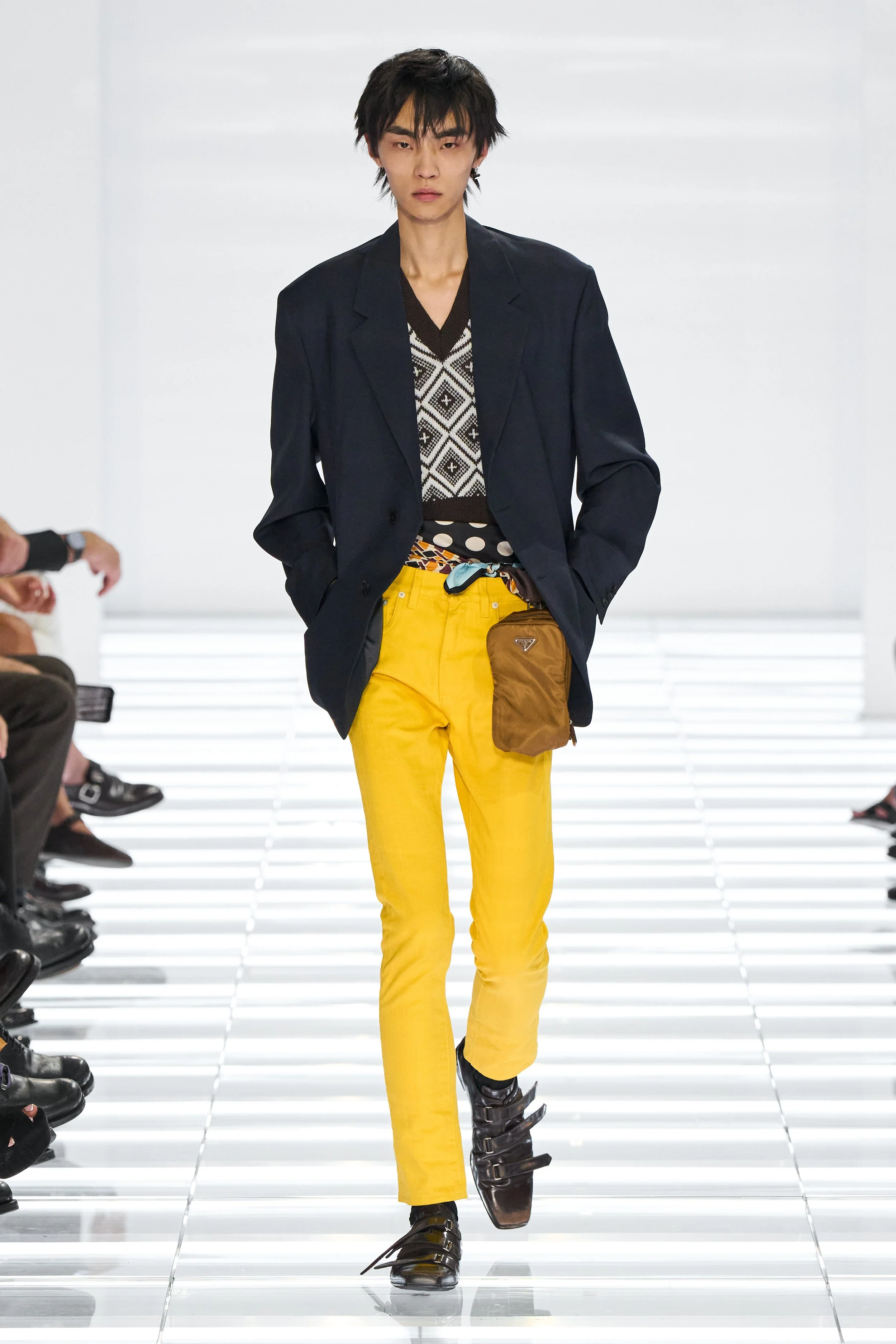
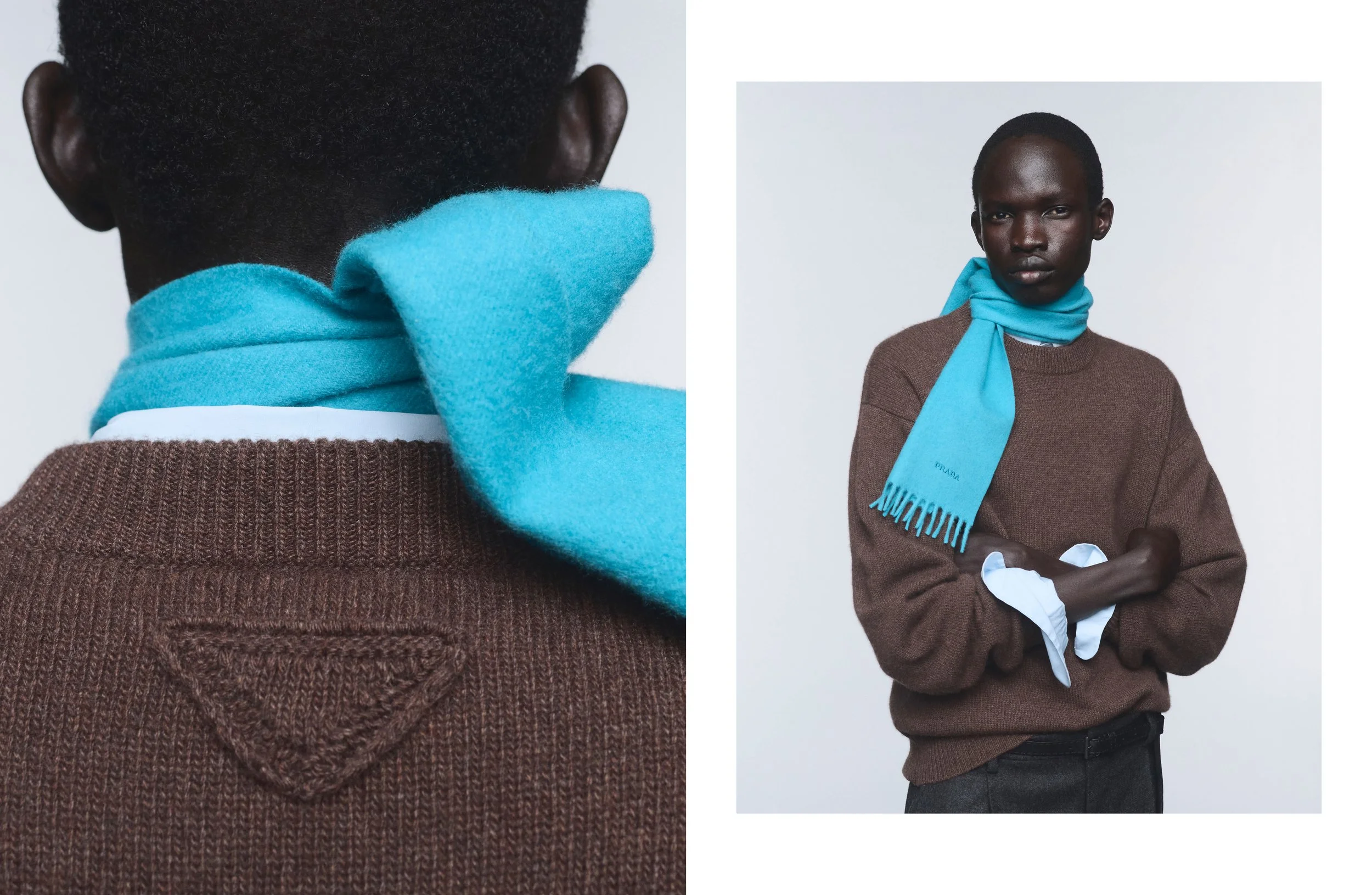
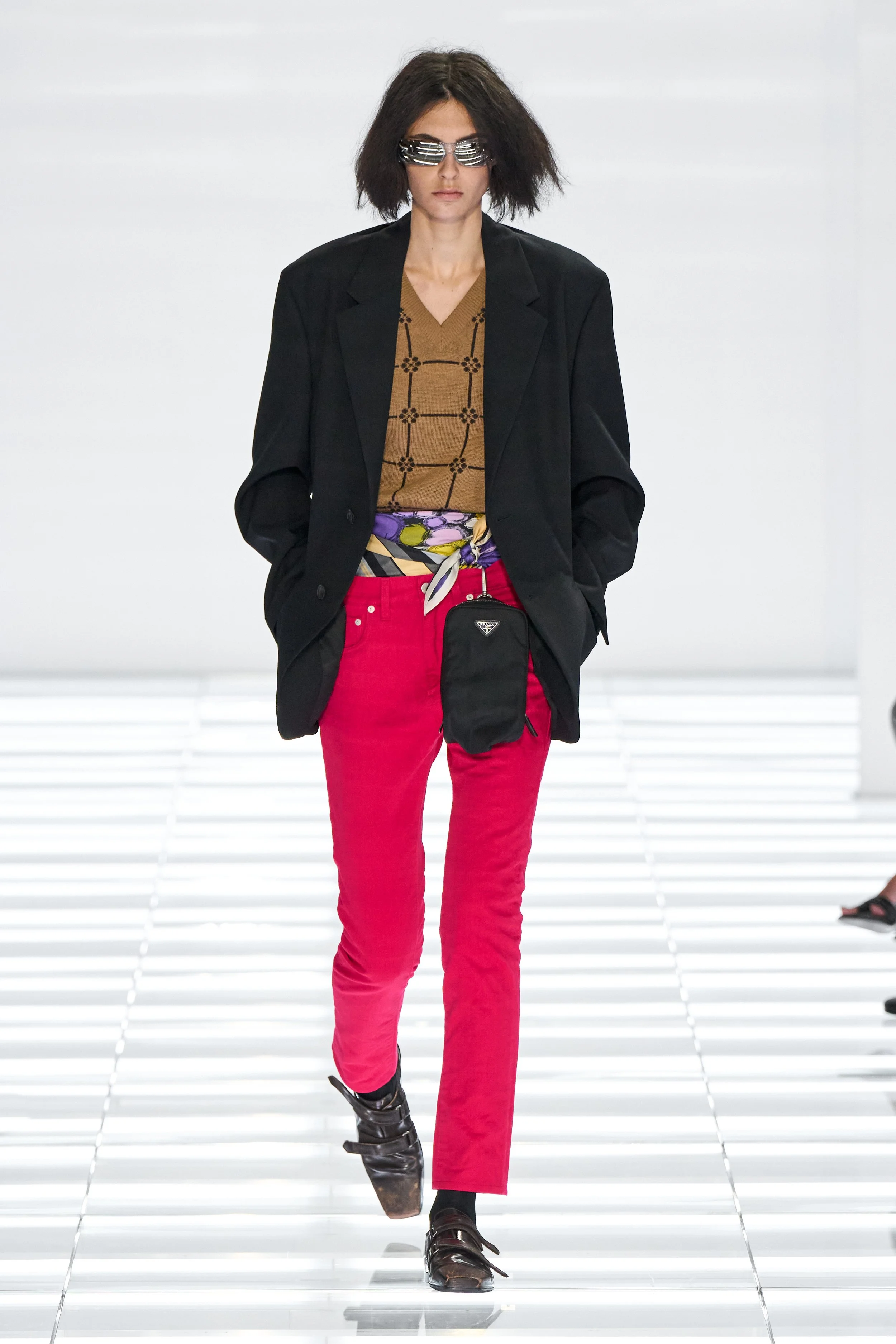
Prada signatures were recalibrated, most notably through silhouette. Knit sweaters, themselves cut close to the body, extended their collars beyond their usual limits, exposing flashes of colourful shirting beneath. Skinny jeans arrived in shades of burgundy, pink, yellow, and white. A Peter Pan collar on a green leather jacket and a pink leather vest felt particularly Prada – here, an adjective.

The Frankenstein sunglasses, asymmetrical and different on each side of the face, were instantly screenshot and dispersed across social media. While their inspiration is still being debated online, Mrs Prada spoke backstage about seeing reality through new lenses, the eyewear serving as a thinly veiled metaphor for that shift in perception.

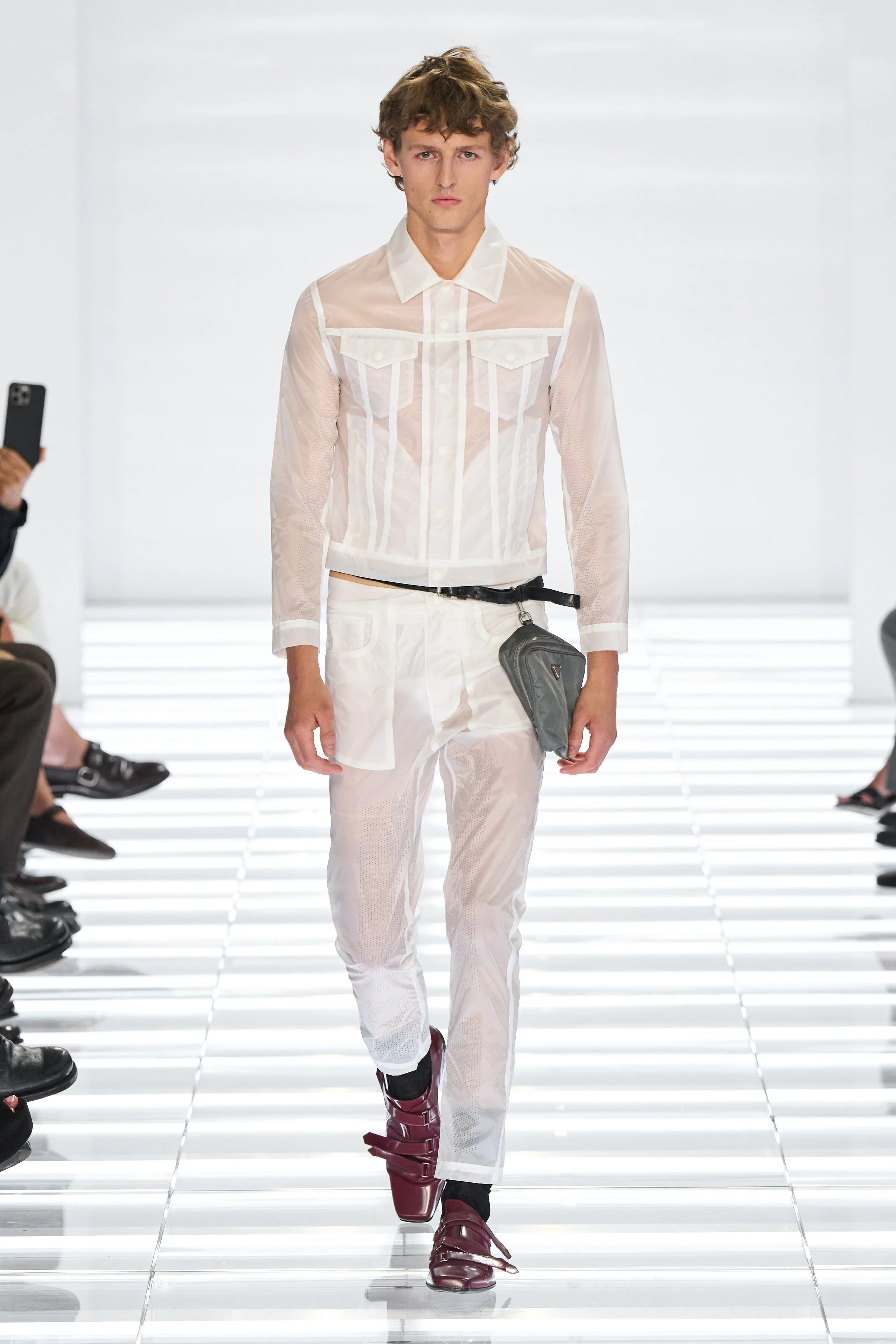
A perforated set echoed the runway on which it walked: translucent enough to reveal what lay beneath. In this case, not only the model's body but also the garment's construction, modelled after a classic denim trucker jacket. Exposure became both an aesthetic device and a conceptual gesture.

Again, as it does almost every season, Prada arrives at ideas that few others would think to pursue, let alone articulate through clothing. The clothes matter, of course, but so does the conversation they provoke. Few brands understand that distinction. Fewer still can sustain it season after season.


Words by Pedro Vasconcelos

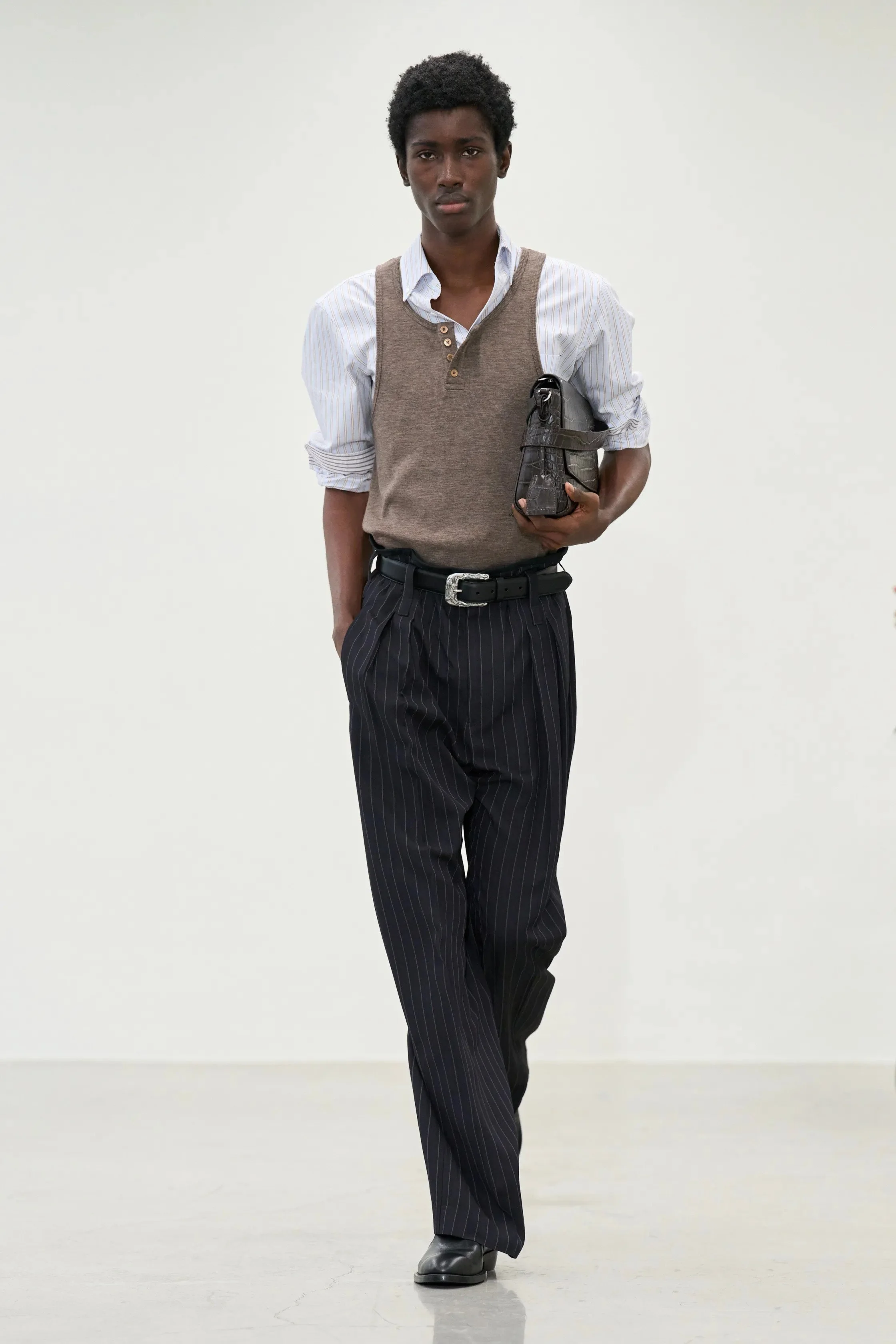
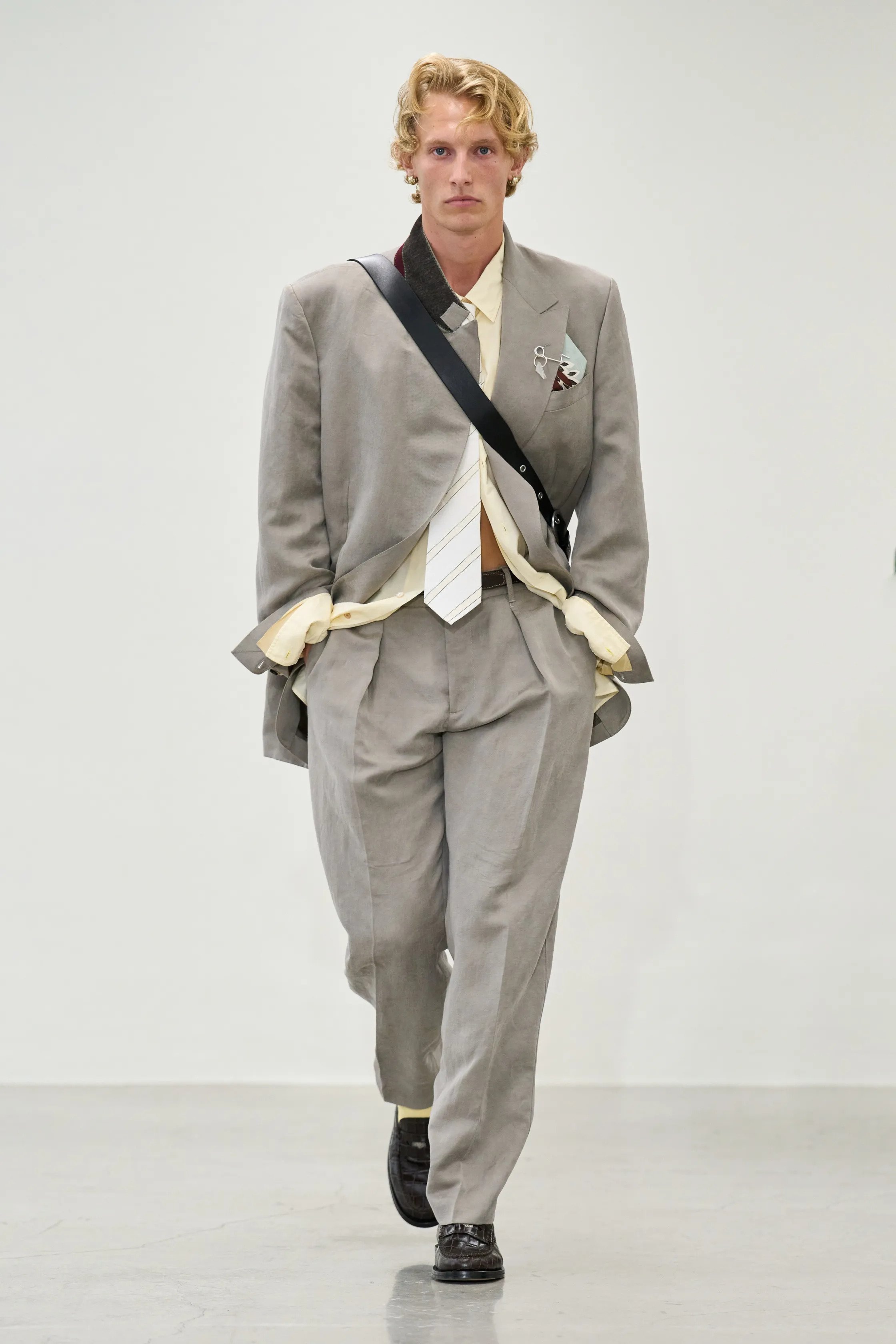
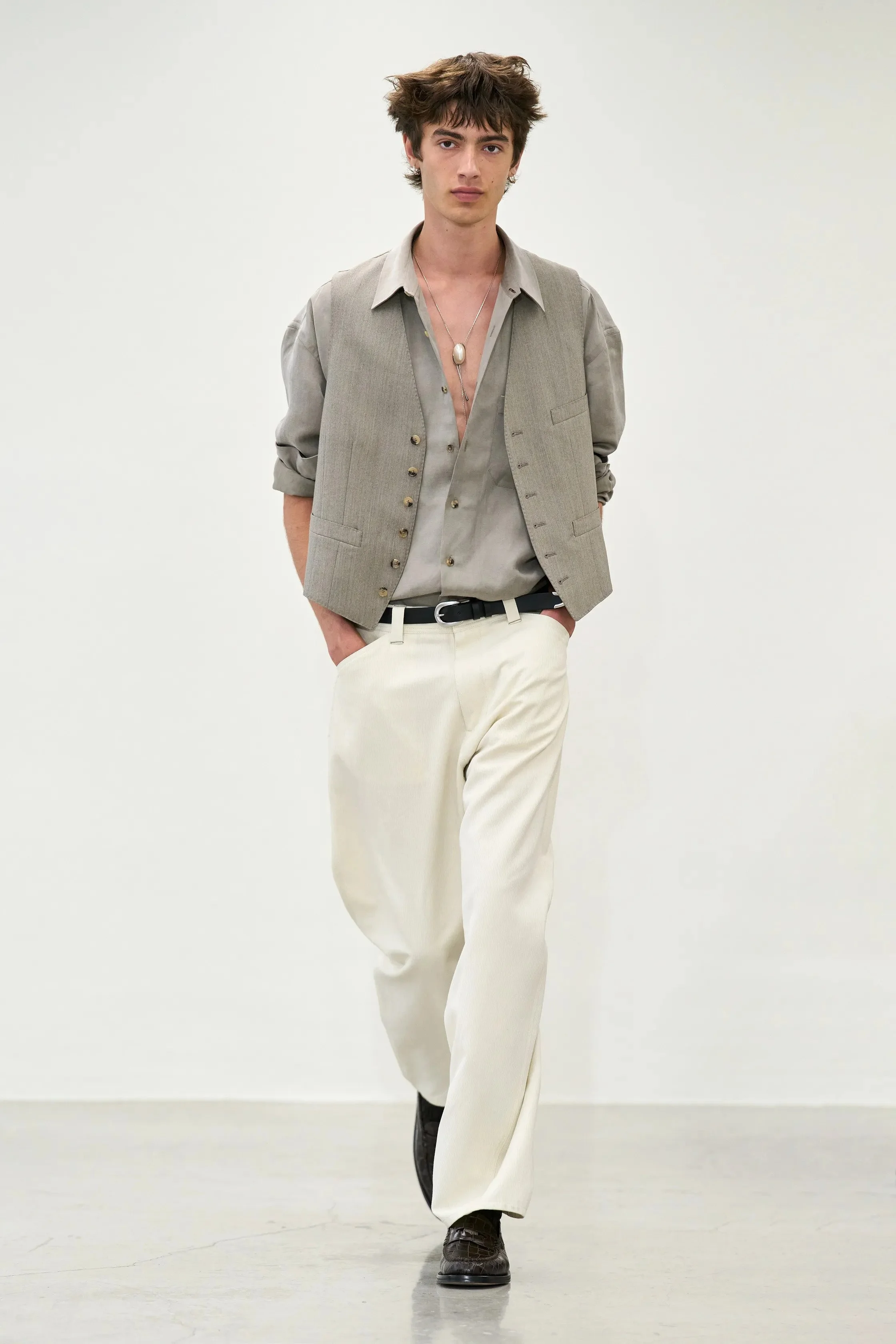
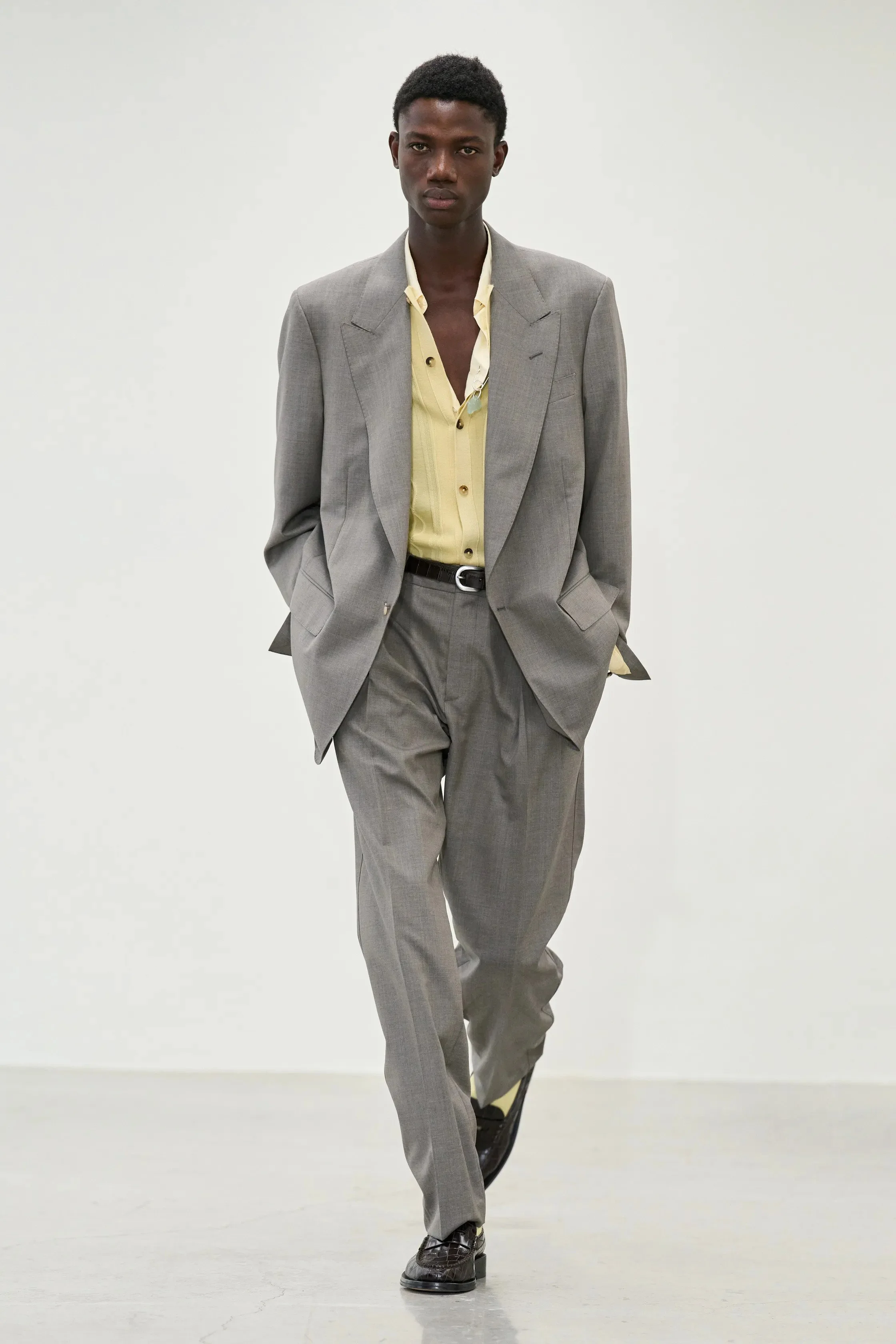
PAUL SMITH SS27

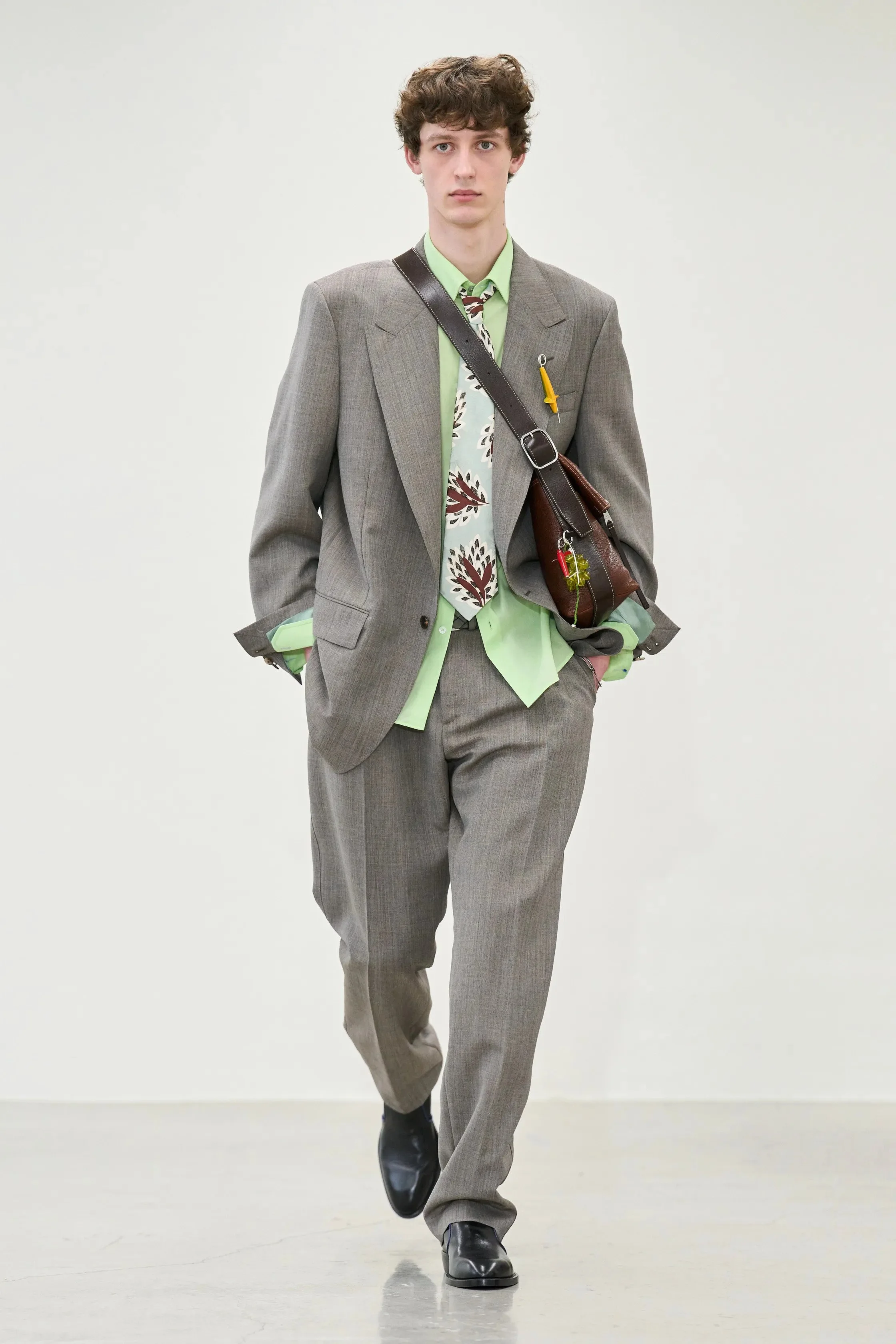
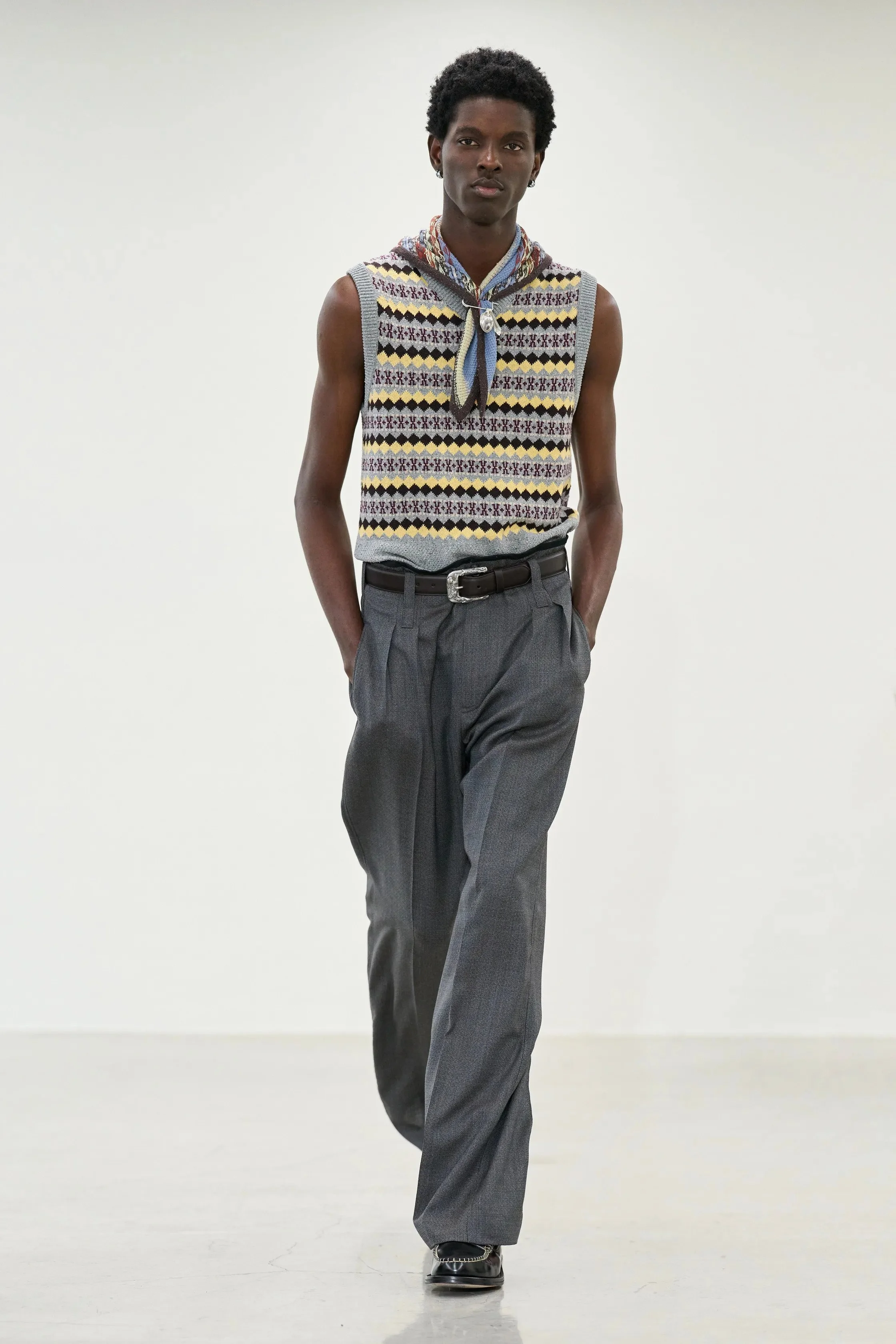
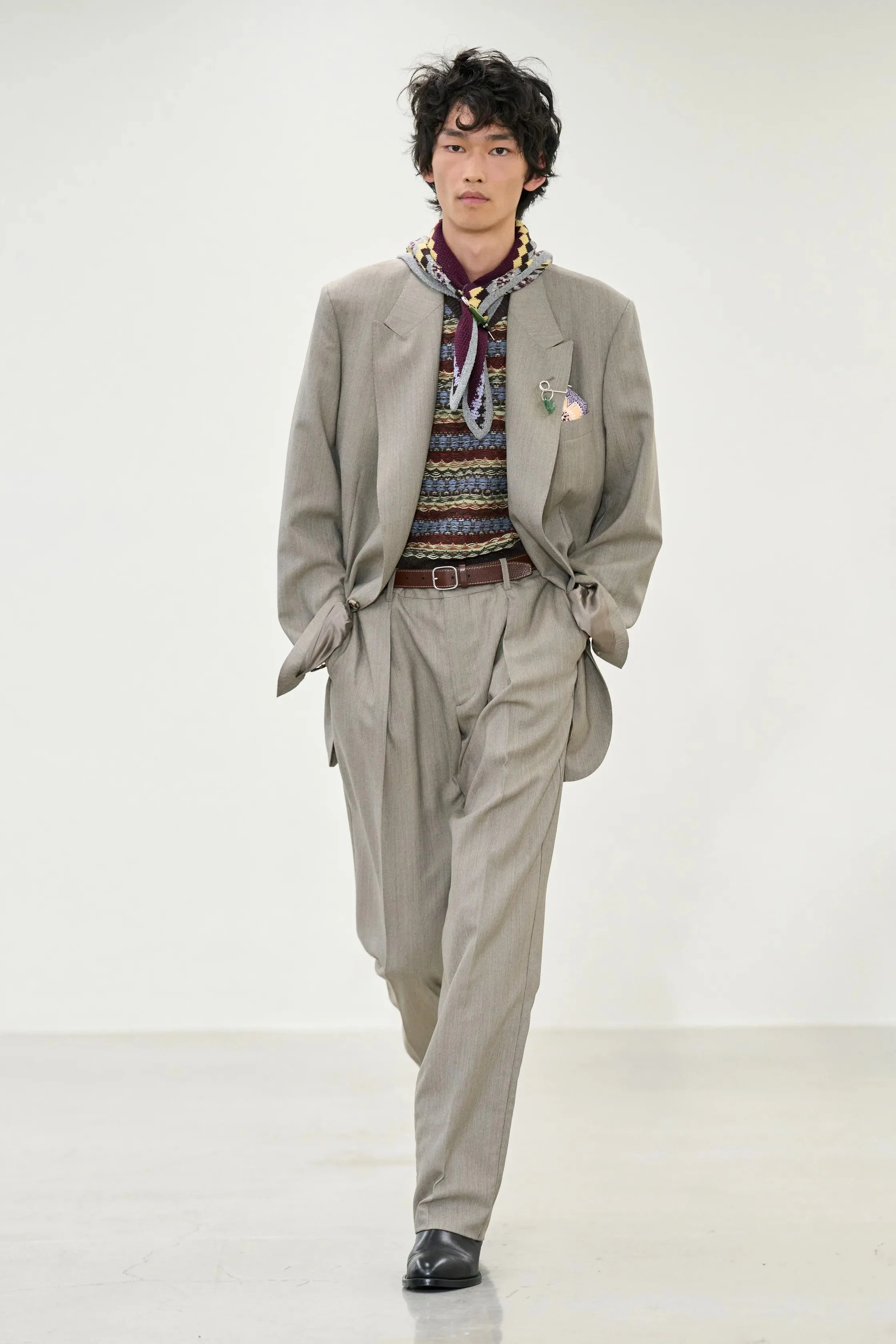
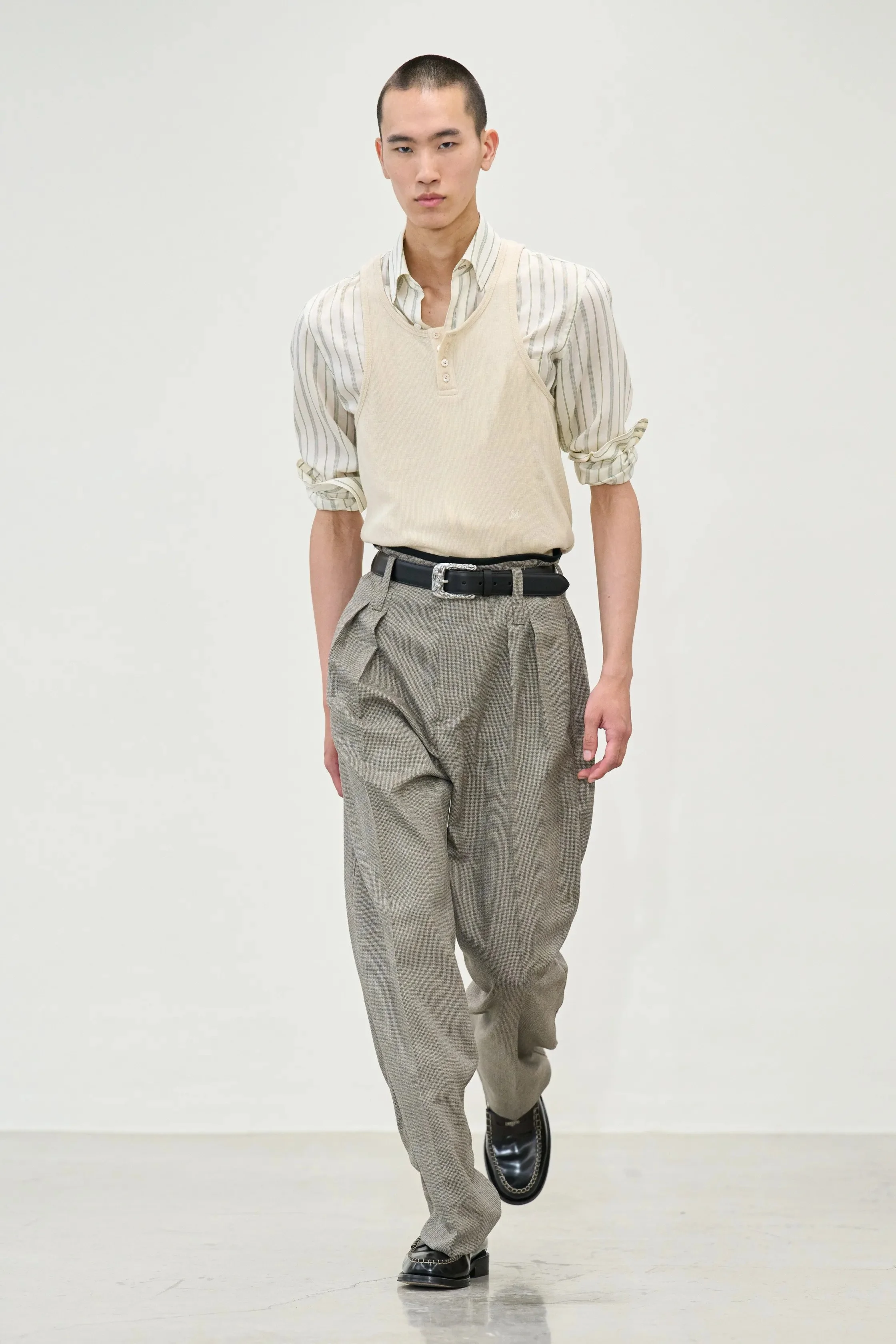
A master in the art of suiting, Sir Paul Smith has been a wearer of the garment for as long as he can remember. Influenced by the dressing habits of his own grandfather, who used to opt for a suit in most scenarios, including going to the beach and standing in the sea, Smith’s Spring/Summer 2027 collection was a celebration of tailoring memories, reinterpreted and adapted to this day under a practical and still refined lens.

Crafting the perfect suit for hot weather often requires a visit to the label’s archives. Inspired by Paul Smith’s softened and deconstructed tailoring, an important shift in menswear emphasised by the British designer's work throughout the ‘80s and ‘90s, design directors Helen Holmes and Sam Cotton revisited the idea this season by experimenting with fully unbuttoned shirts, loose ties, and slouchier silhouettes.

To ditch rigidity a bit further, clothing was placed on the catwalk conveying a slightly worn-in aspect – made to live in, to cherish, to last. Fabrics were airy, lines were gentle, colours were contrasting, like opposites that clash yet still attract.

Along with the classic soft greys and beiges, bright whites, and navy blues, there was plenty of room for mint and forest greens, butter yellow, and darker but tropical florals, as well as deep purple and lemony hues, the latter mostly seen on vibrant socks peeking out of croc-embossed loafers.

Patterned knitted vests and cardigans, printed silk ties, and quirky leather hats added a touch of summer playfulness to the lineup, as did the lapel brooches and bag charms, which resembled beach keepsakes and fishing gear.

Another fundamental premise for the collection included a white linen suit that Paul Smith himself once wore and stained while harvesting grapes in Tuscany to help a farmer. Suddenly, wearing a suit, even under the sun, looks and feels extremely cool again.


Words by Ketlyn Araujo
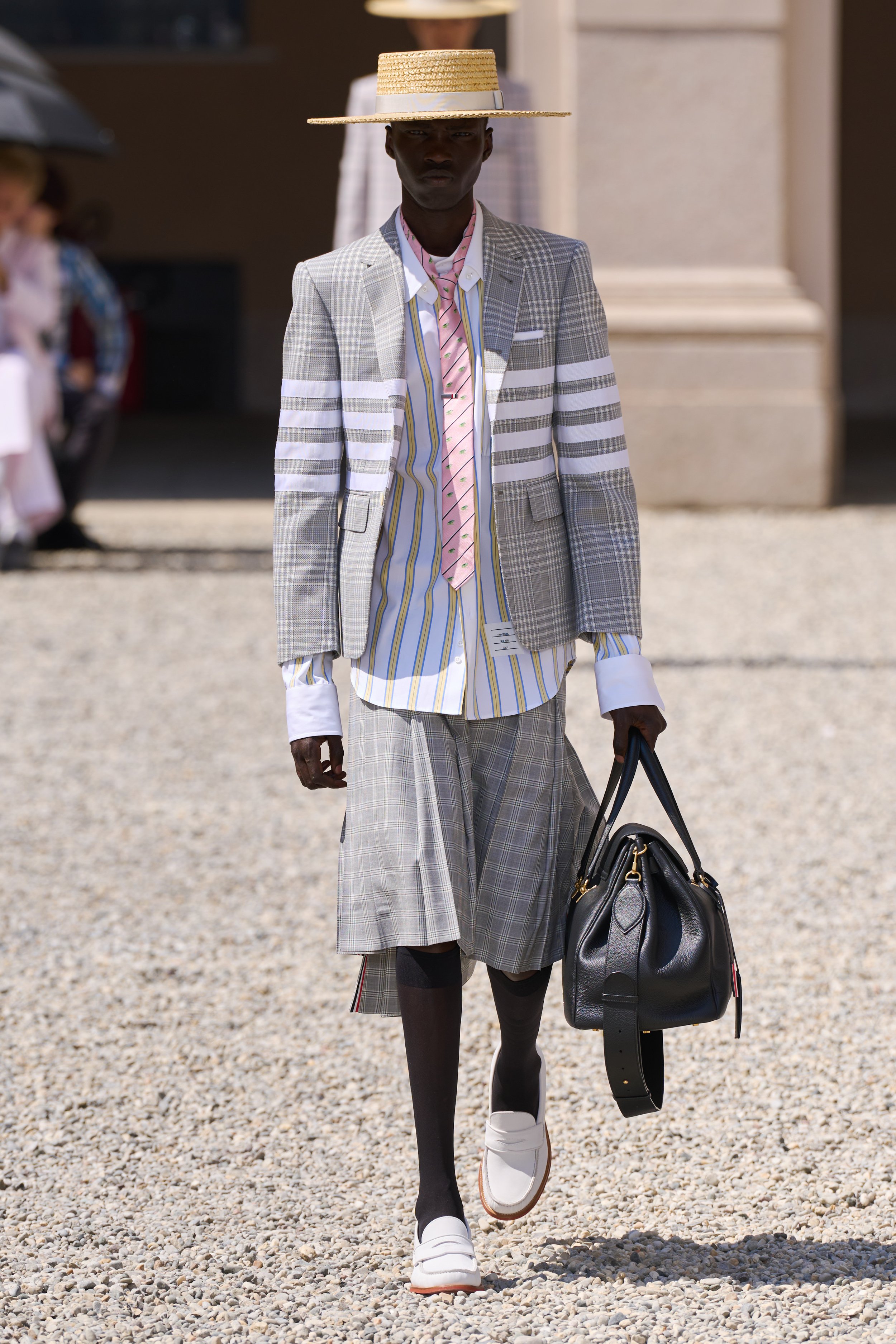
RALPH LAUREN SS27

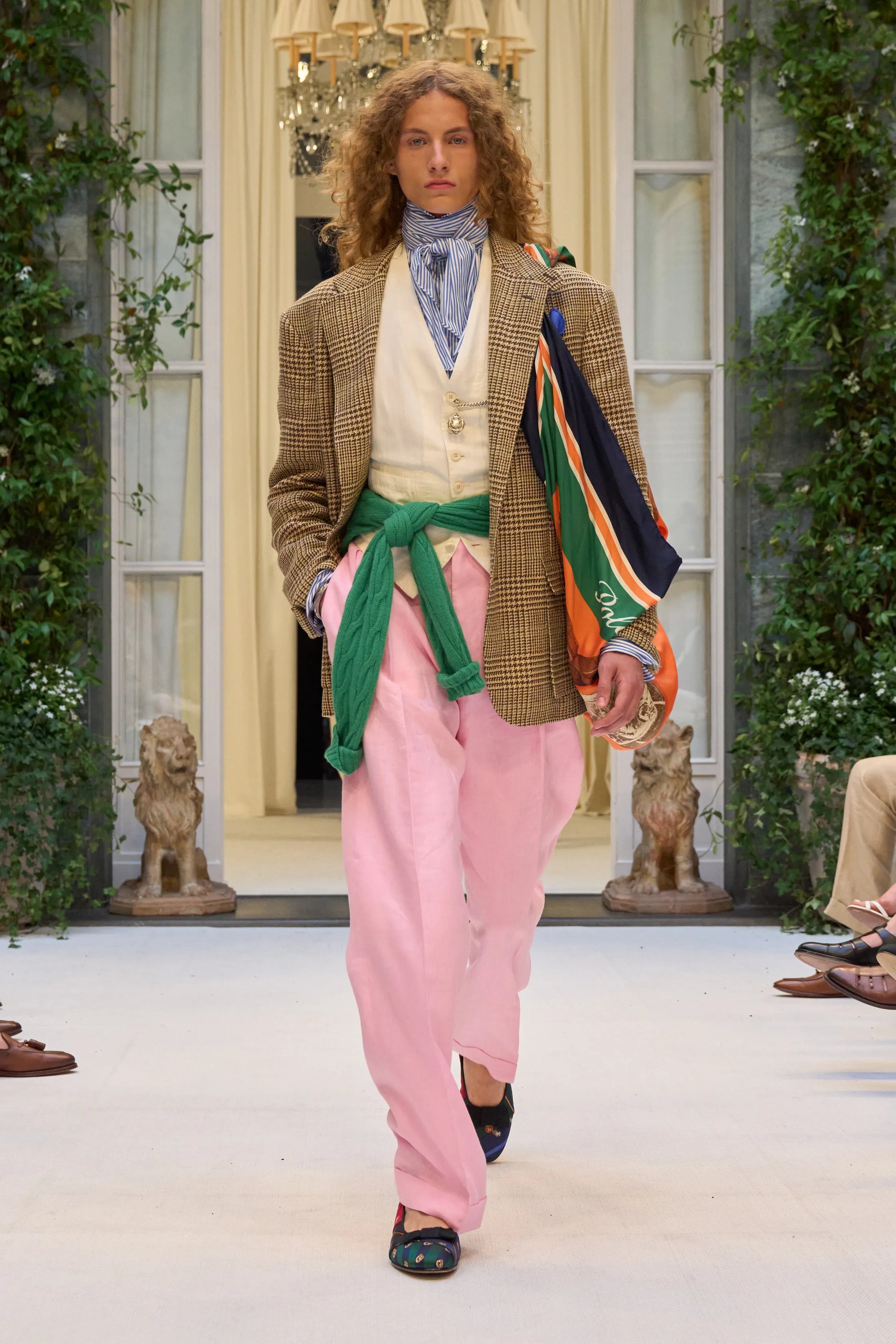
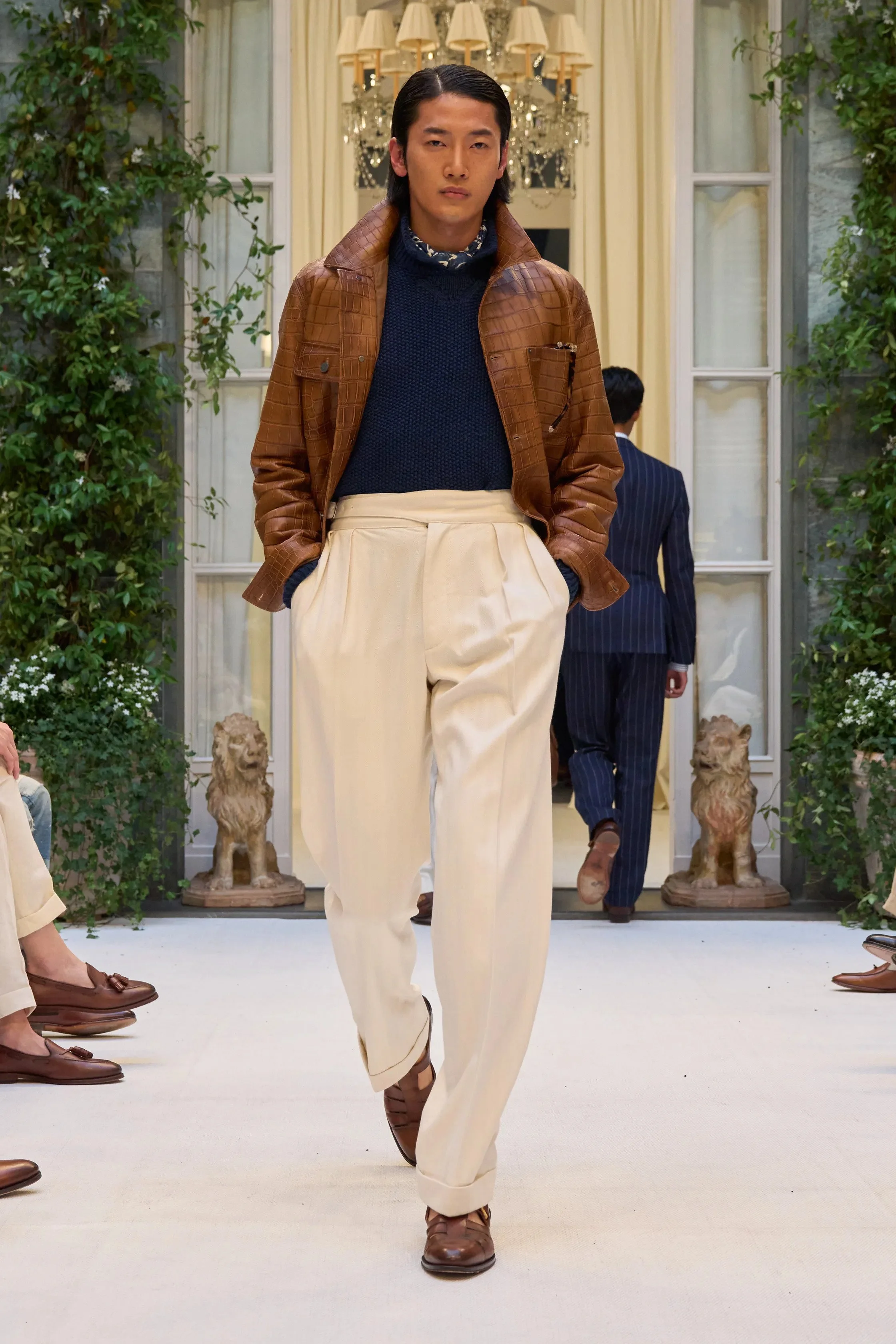
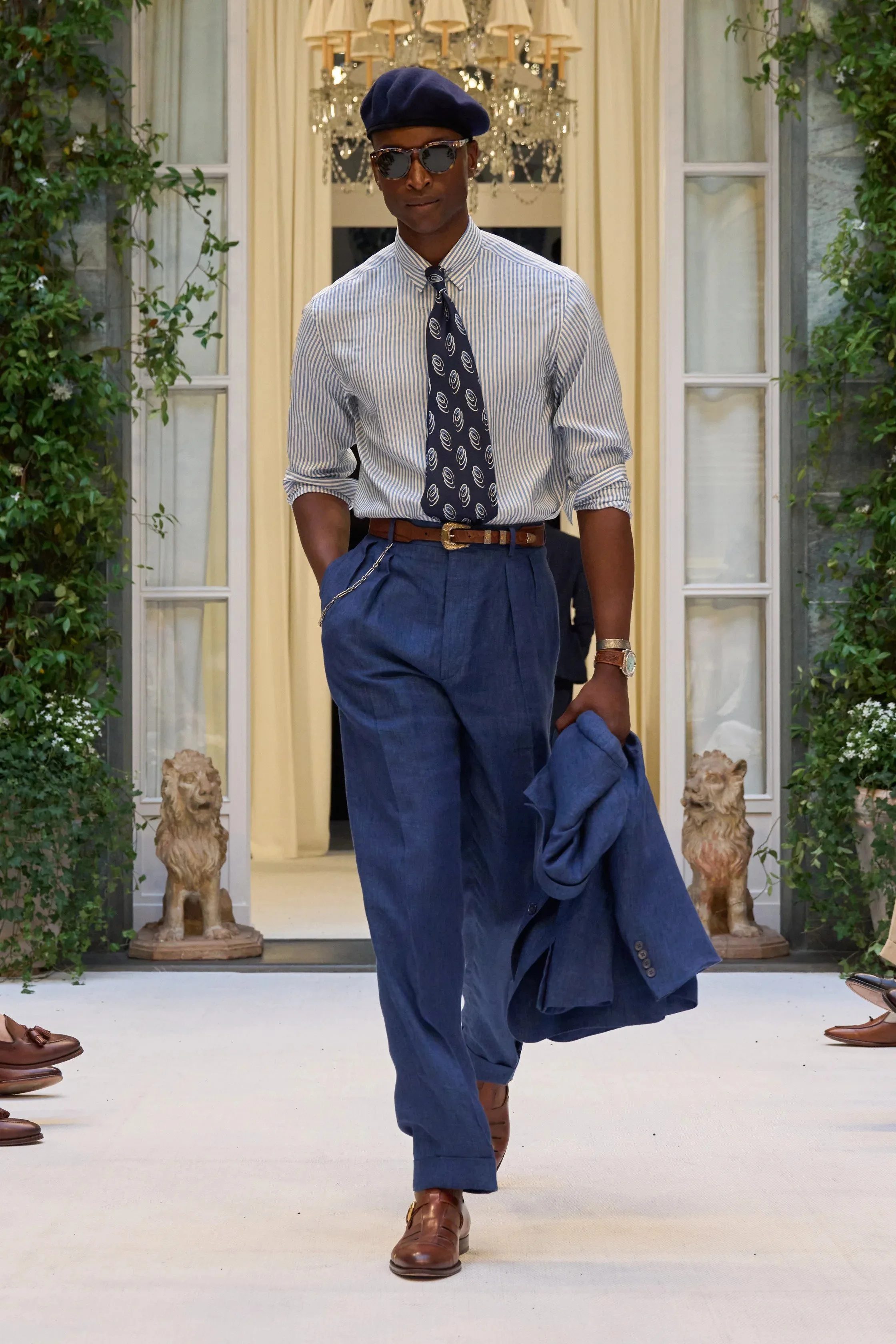
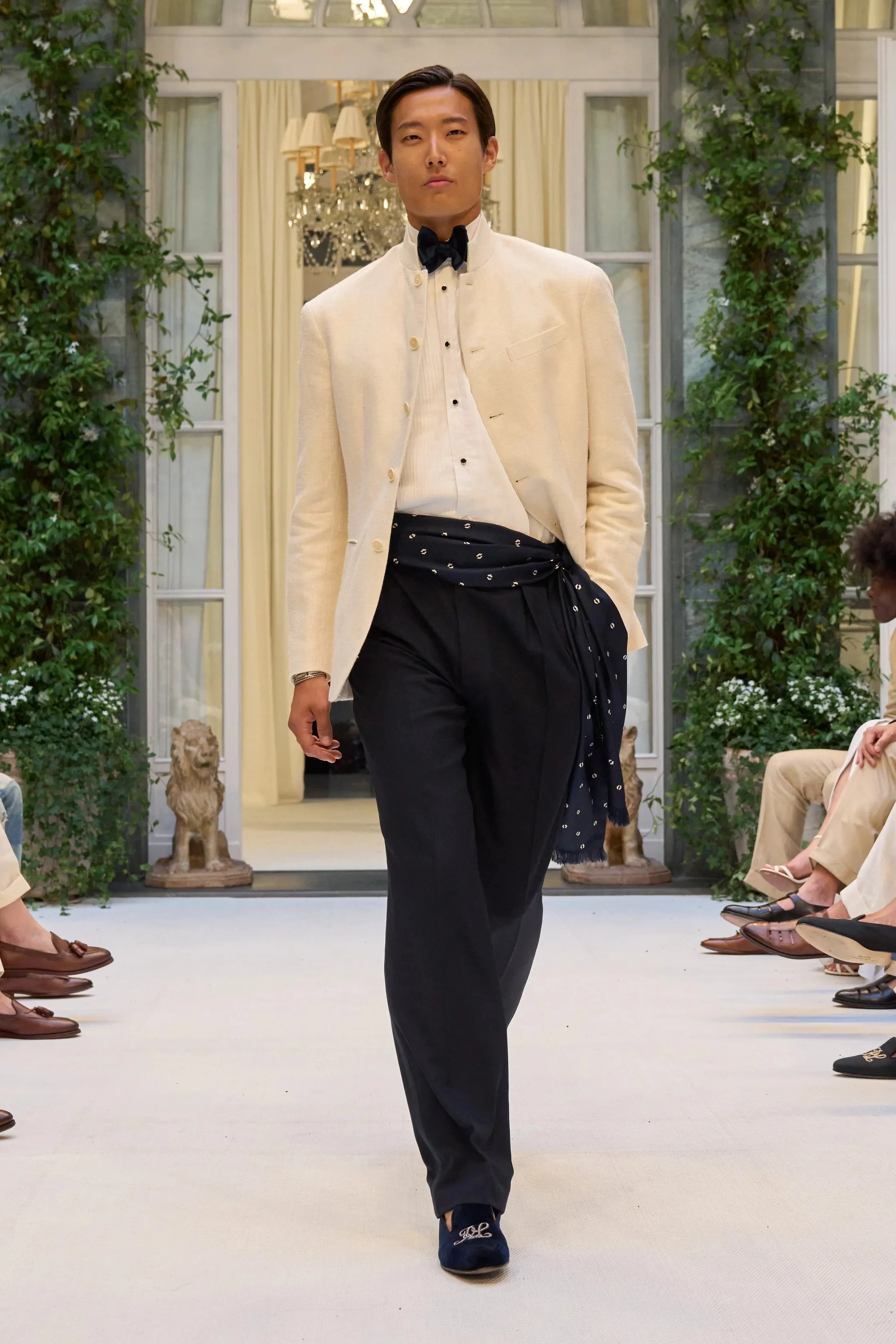
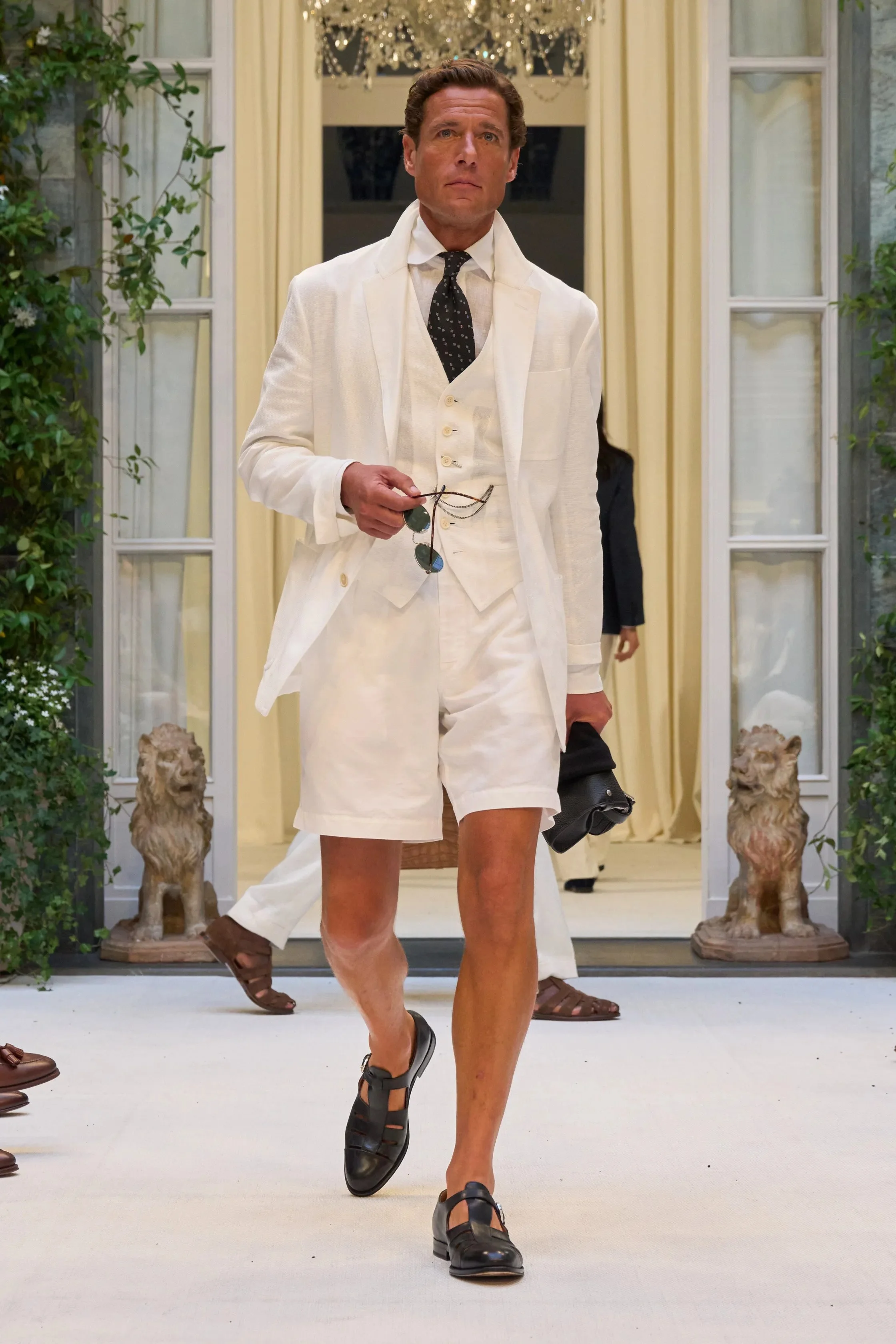
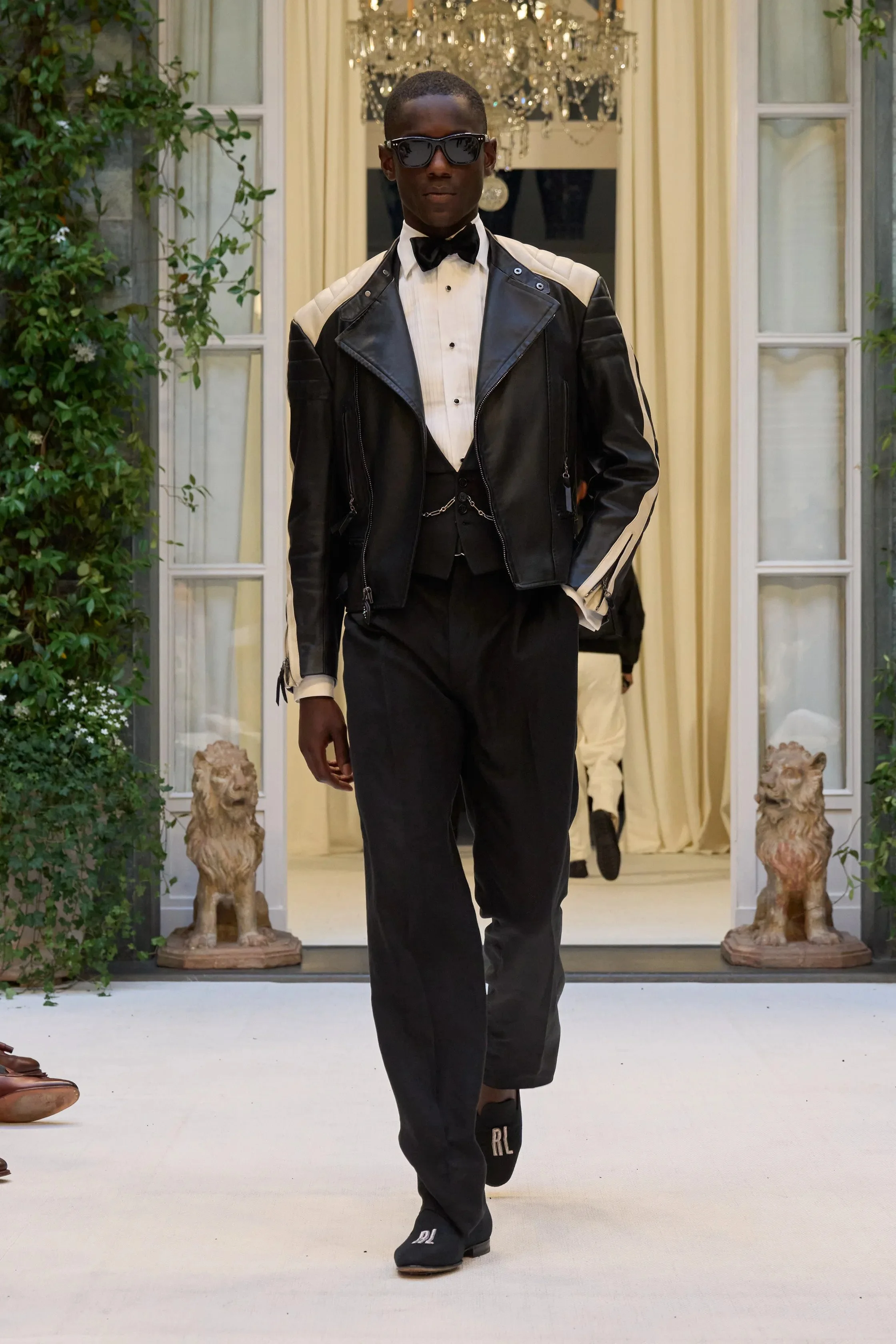
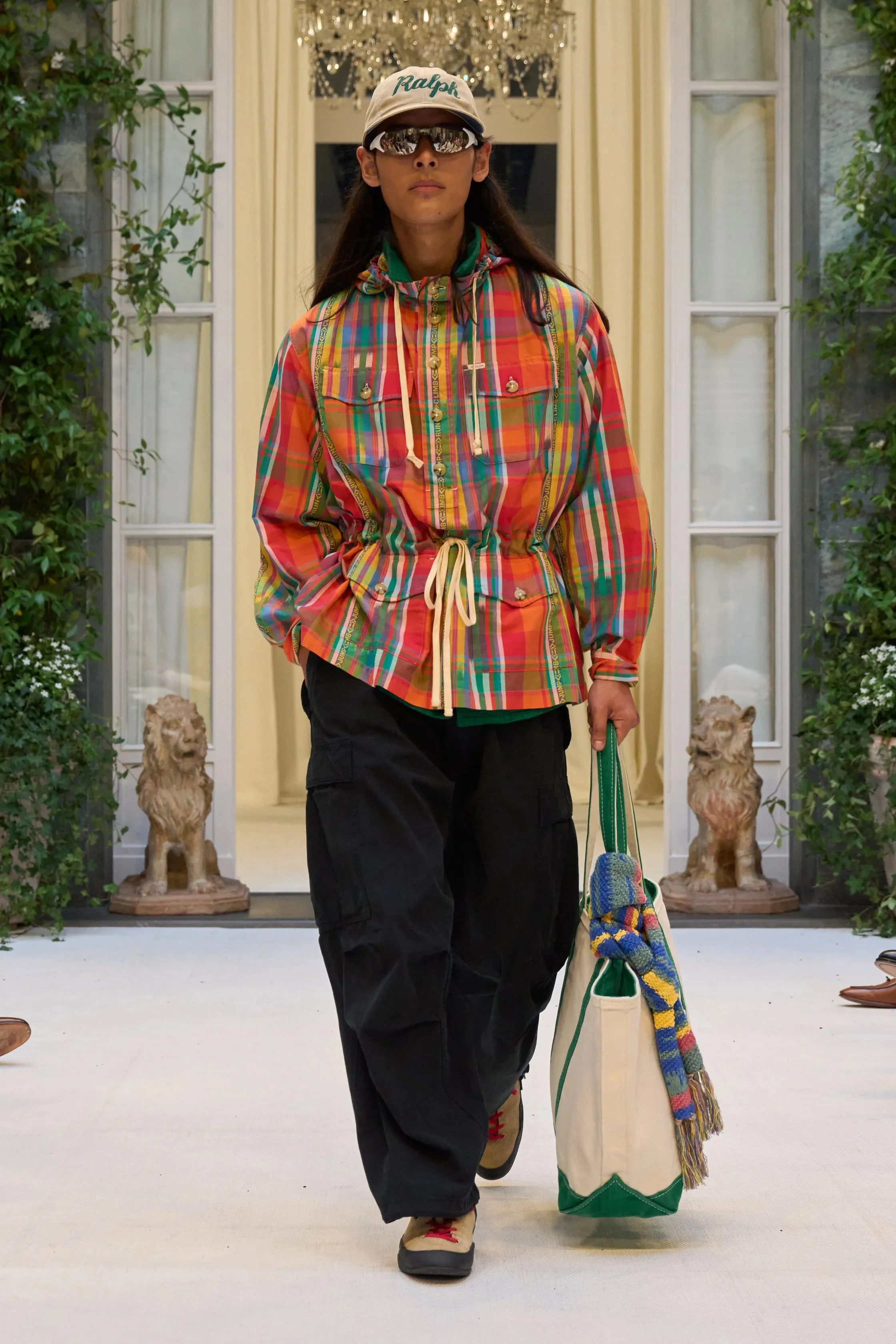
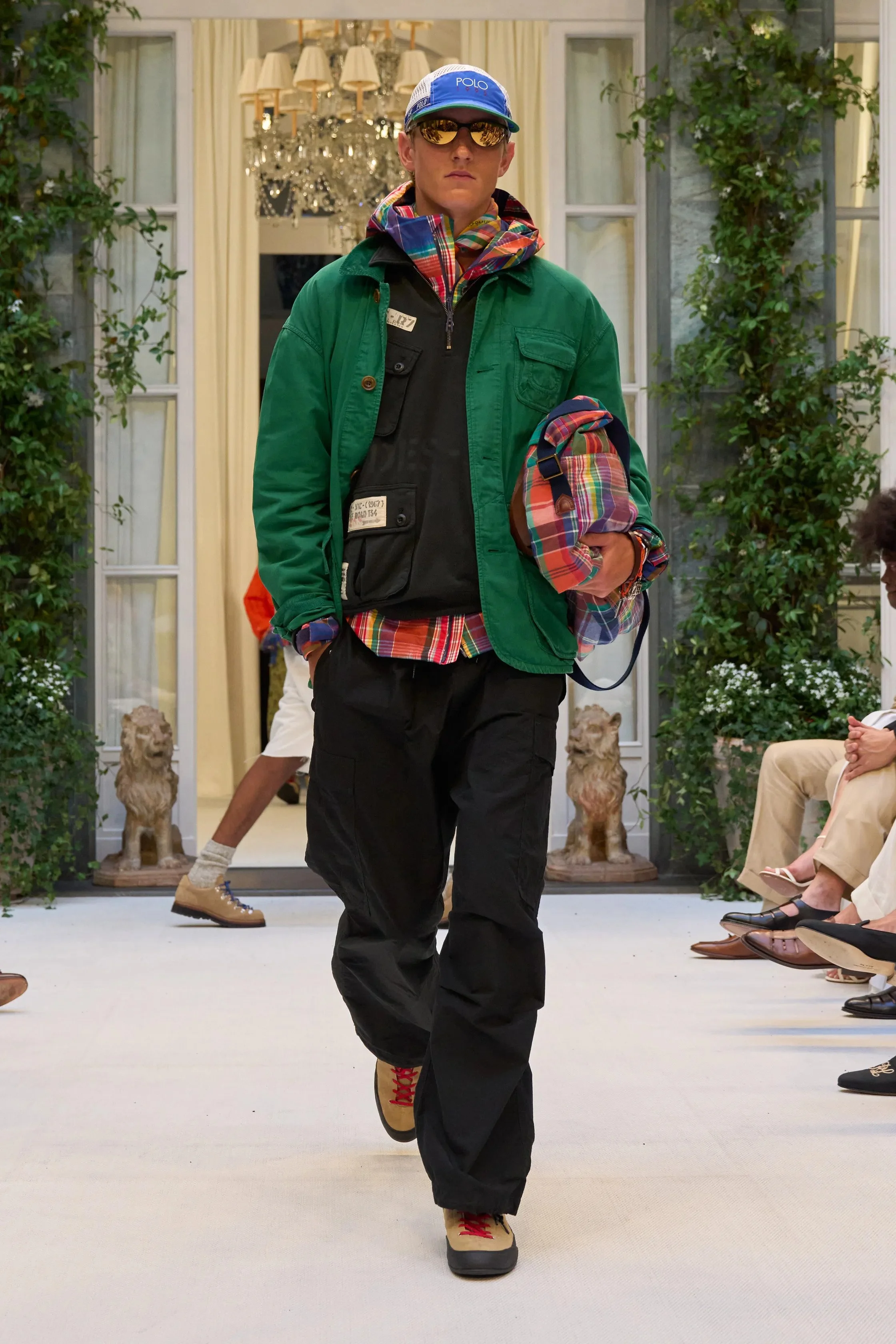
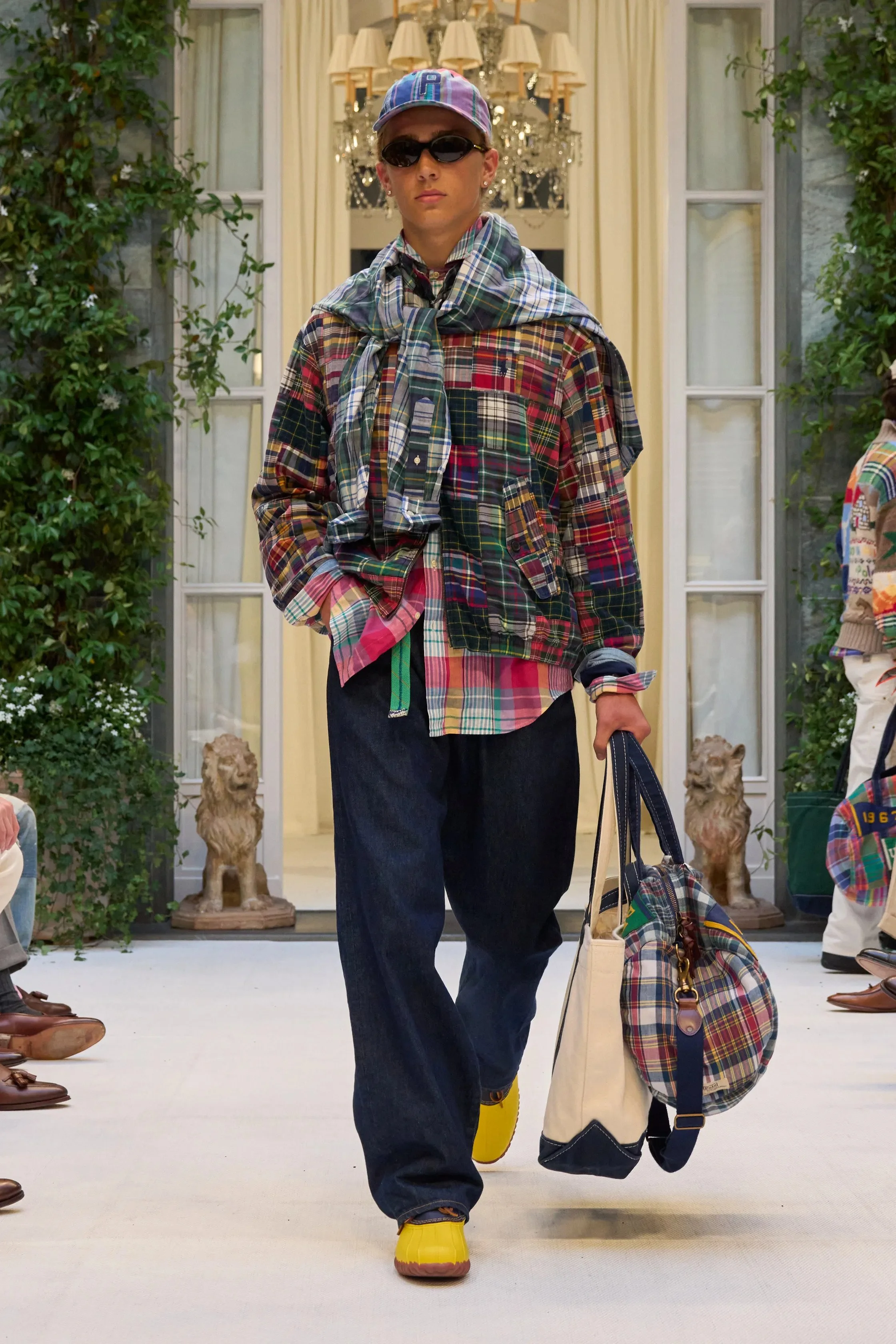
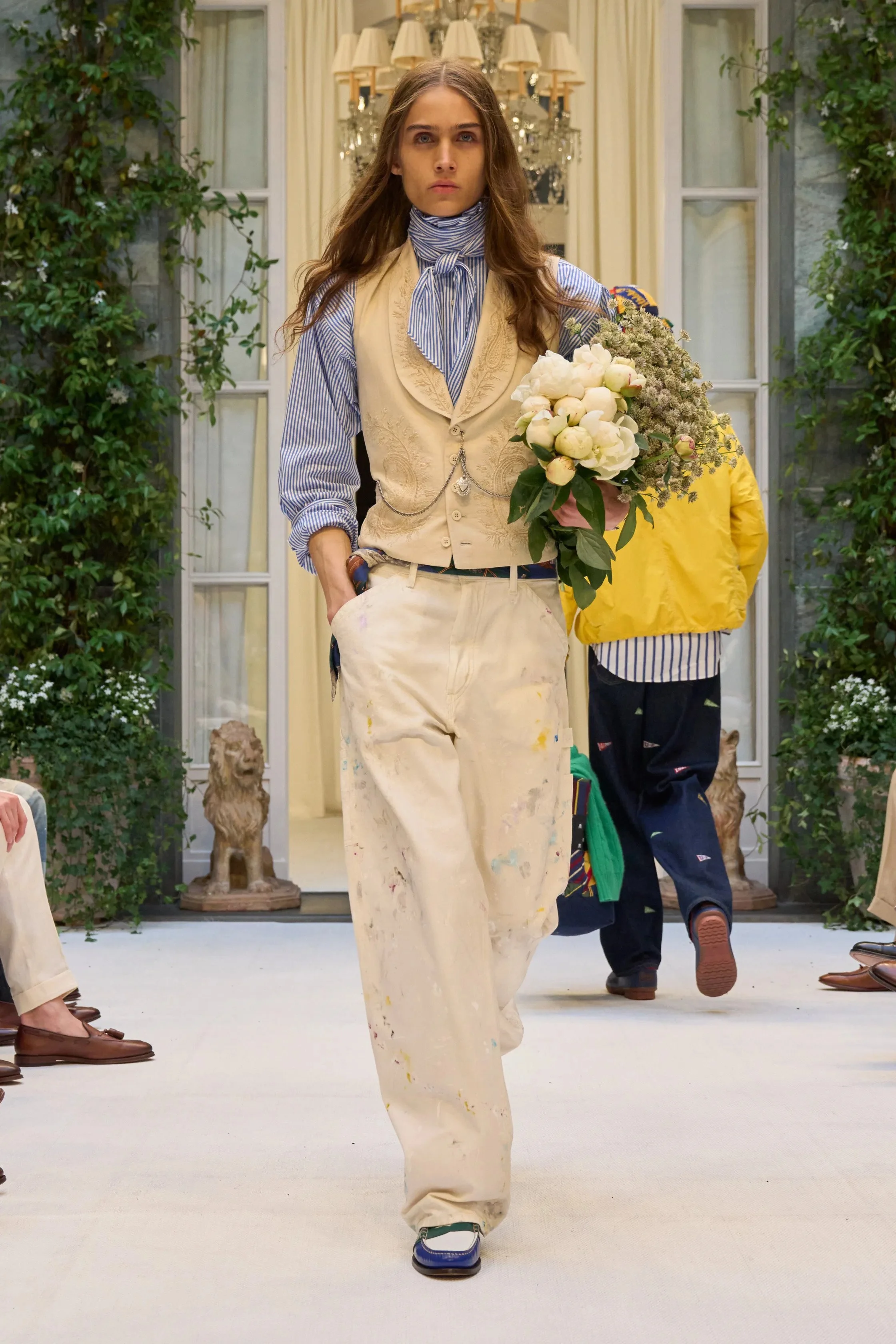
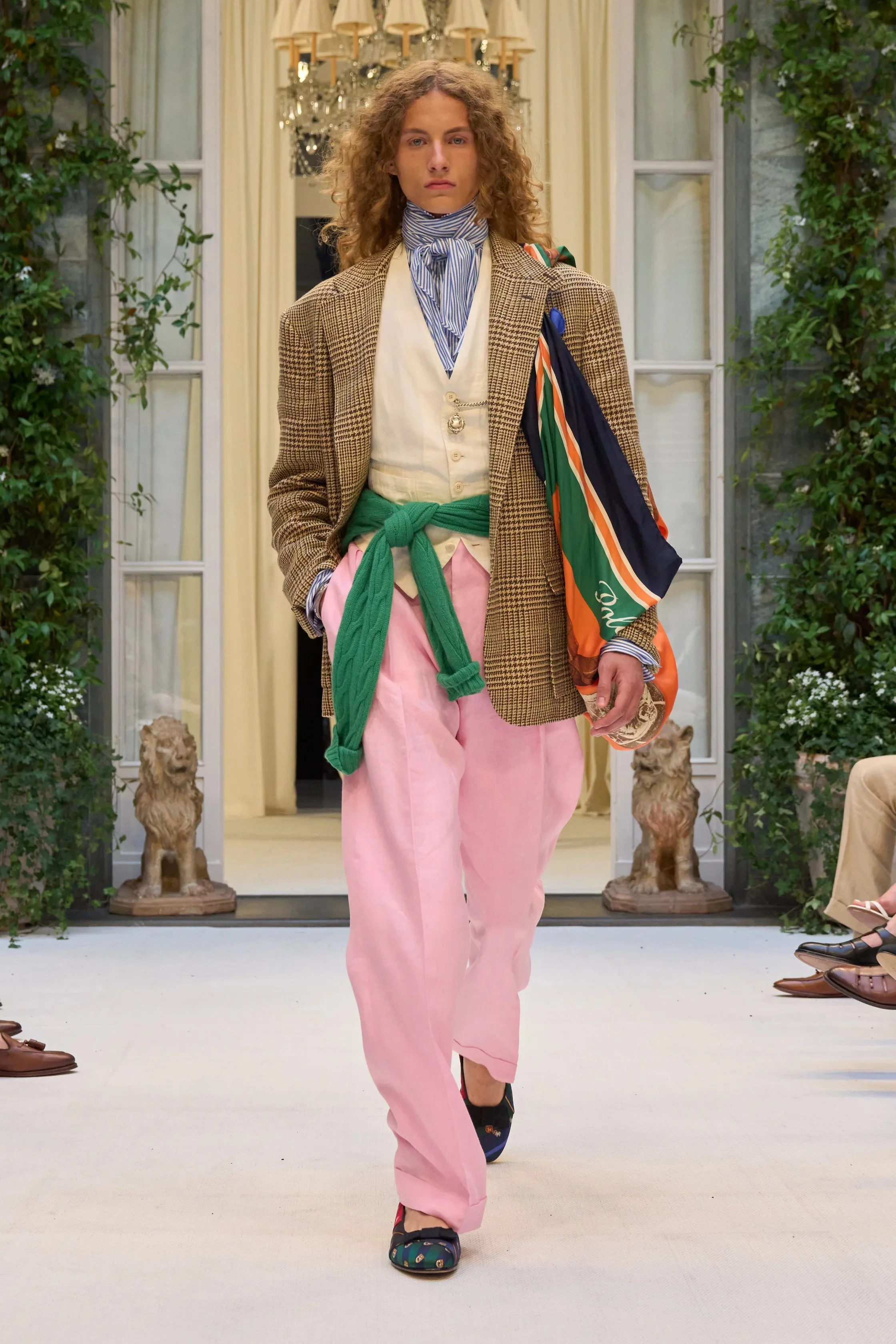
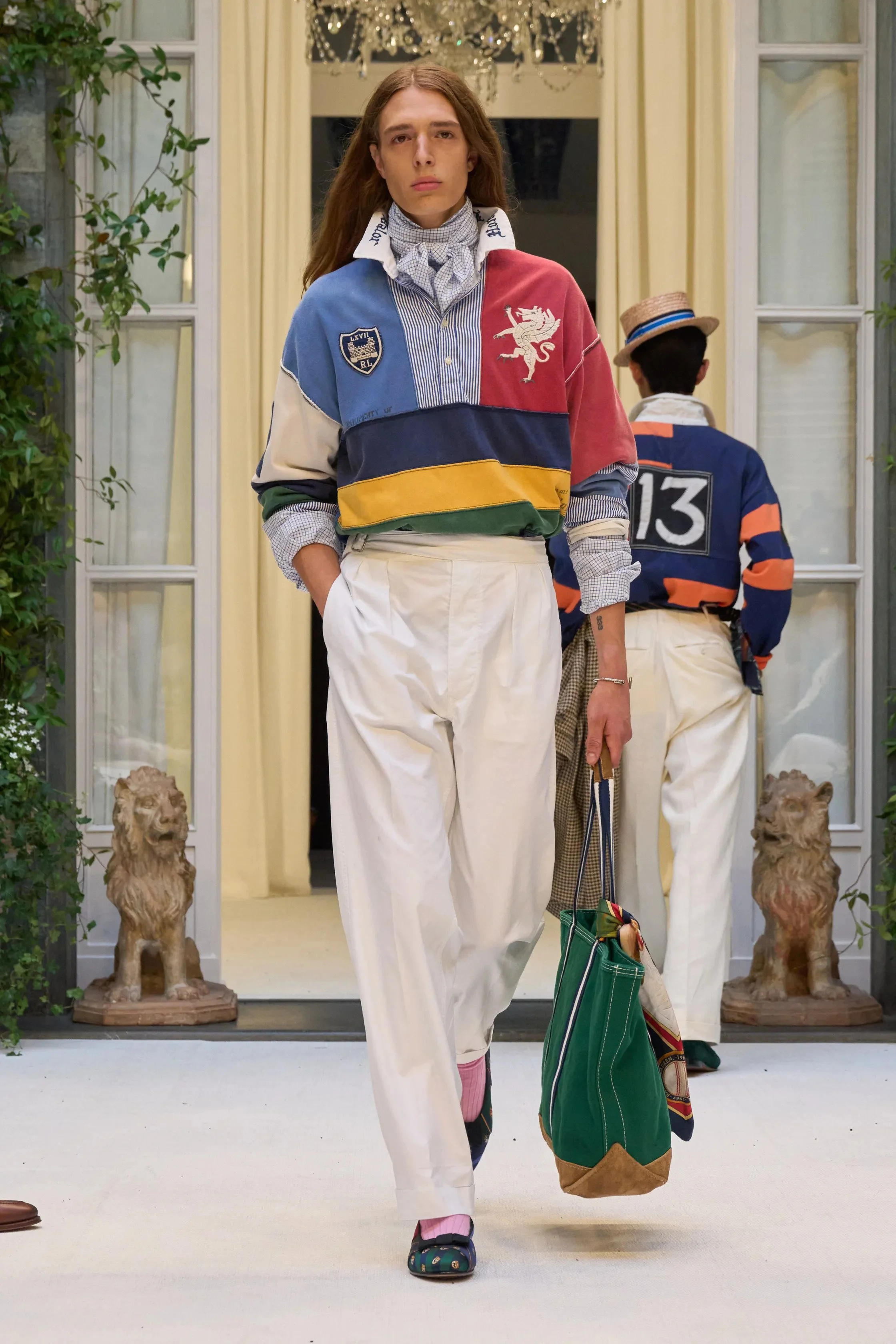
With his latest Milan showcase for Spring/Summer 2027, Ralph Lauren’s collection was a masterclass in classic tailoring and creative, fresh styling.

Tailored pinstripe suits opened the show – a quintessential RL look! Elegance was on point, and the stylish silhouettes reminded us of the true essence of effortless sophistication that the American designer is a master of. Delivering garments for different moments in a man’s life, light fabrics and easy-going tuxedos captured the spirit of a European holiday voyage.

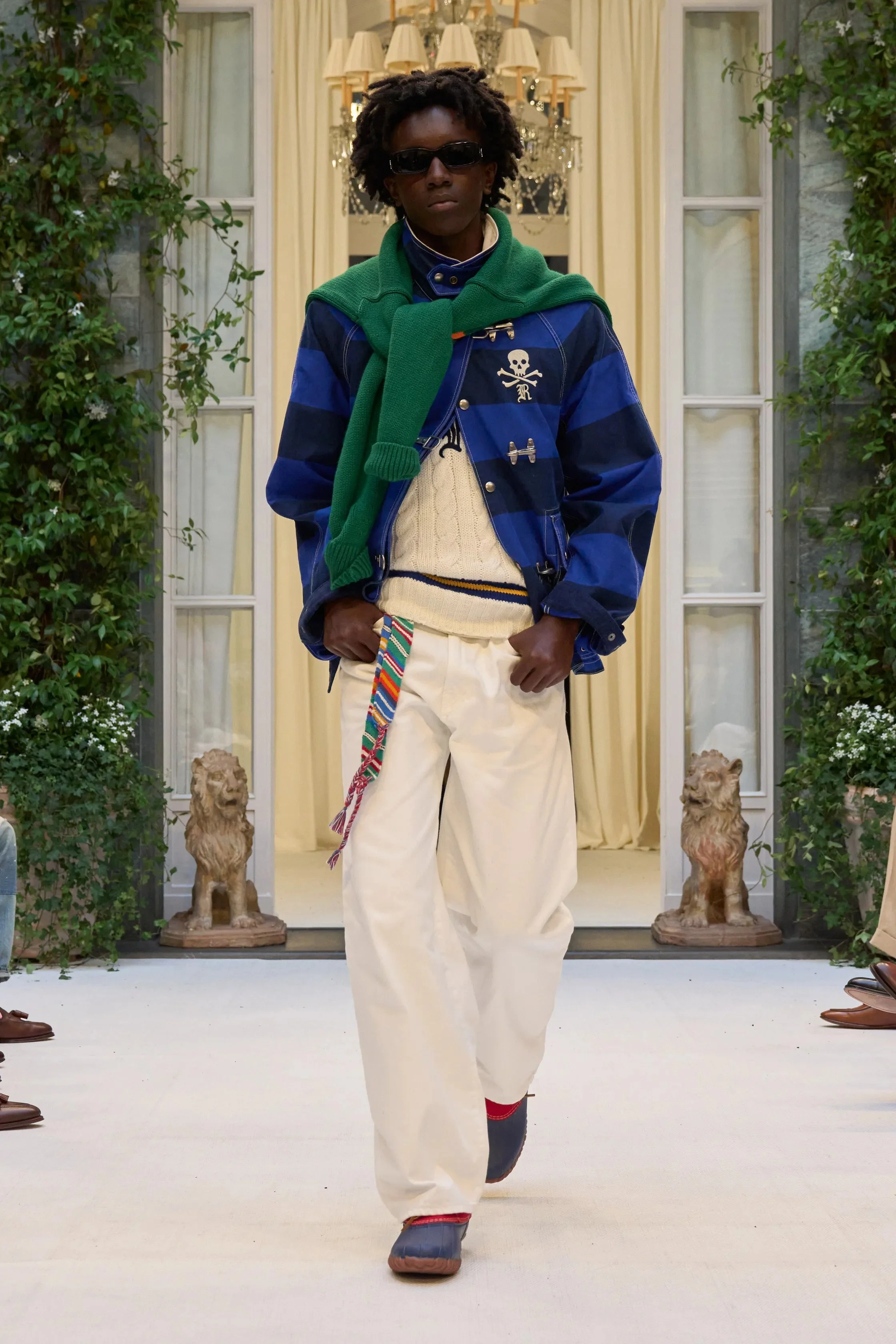
Leather jackets evoked a tougher aesthetic, giving each look a more informal take on the brand while maintaining its signature essence, while espadrilles and loafers referenced the unmistakable Milanese flair. Nautical references were present throughout the collection: Breton stripes, sailor-inspired scarves, cricket sweaters, maritime knitwear, and relaxed resort silhouettes fit seamlessly with the atmosphere of the Mediterranean summer.

The Polo Ralph Lauren looks presented after were more eclectic. Cargo pants, blue sneakers, polychromatic preppy flannel shirts, chunky knits, and cricket jackets were all part of the showcase. Outstanding layering created a fashion-forward proposition, while Bermuda shorts brought a laid-back aesthetic. Patchwork appeared across sweaters, pants, and jeans. Ruffled shirts added a vintage touch, contrasting with the more modern spirit of the collection.


Words by Carolina Benjumea

LOUIS VUITTON CRUISE 2026/27

Nicolas Ghesquière doesn’t worship at the self-referential altar of the maison he leads. He tends carefully to the legacy of Louis Vuitton, of course, but rarely feels compelled to extrapolate from it. The house’s history — simultaneously one of the oldest in fashion and one of the youngest when it comes to ready-to-wear — affords him such freedom. Louis Vuitton’s Resort 2027 is resonant of this privilege.

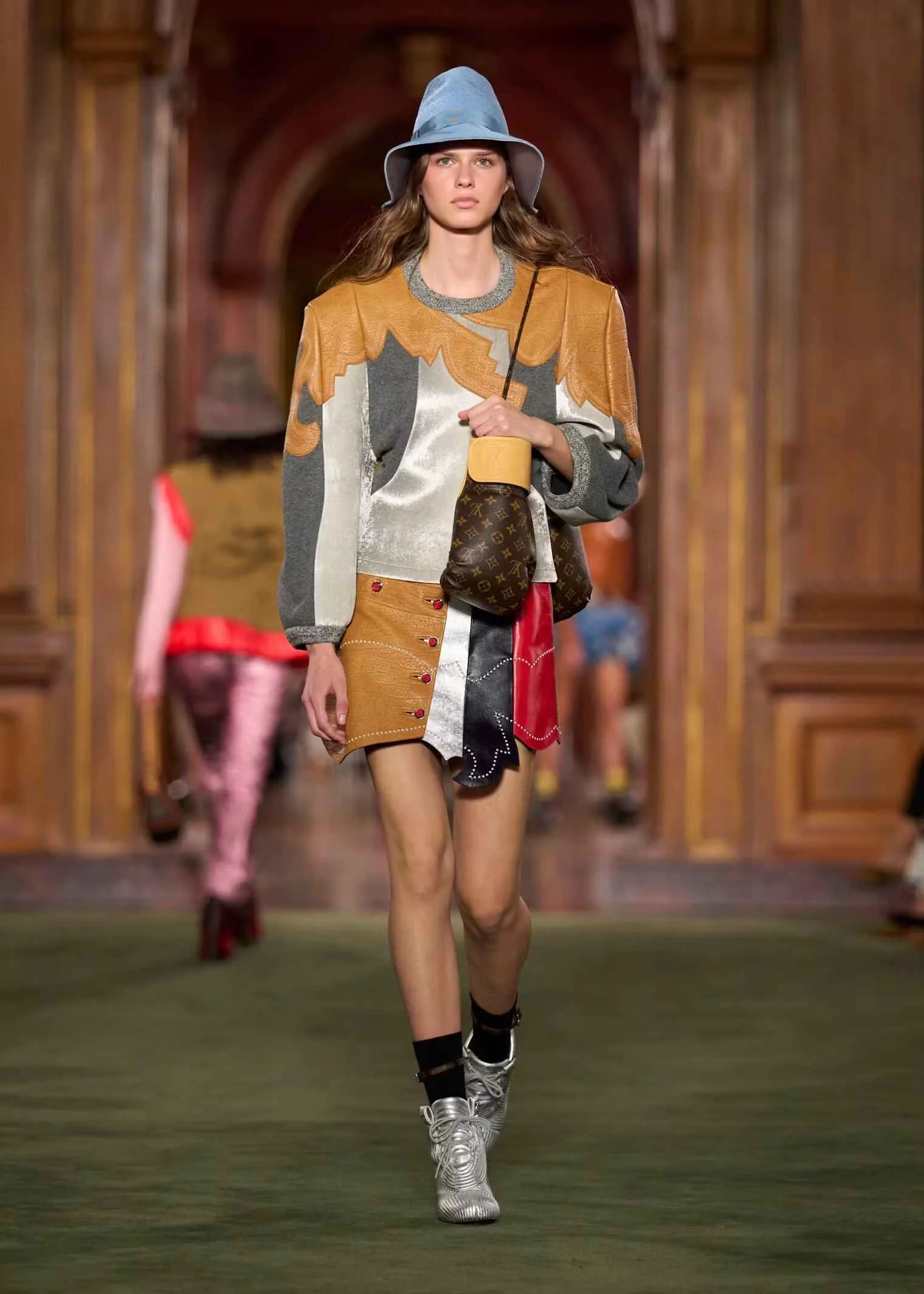
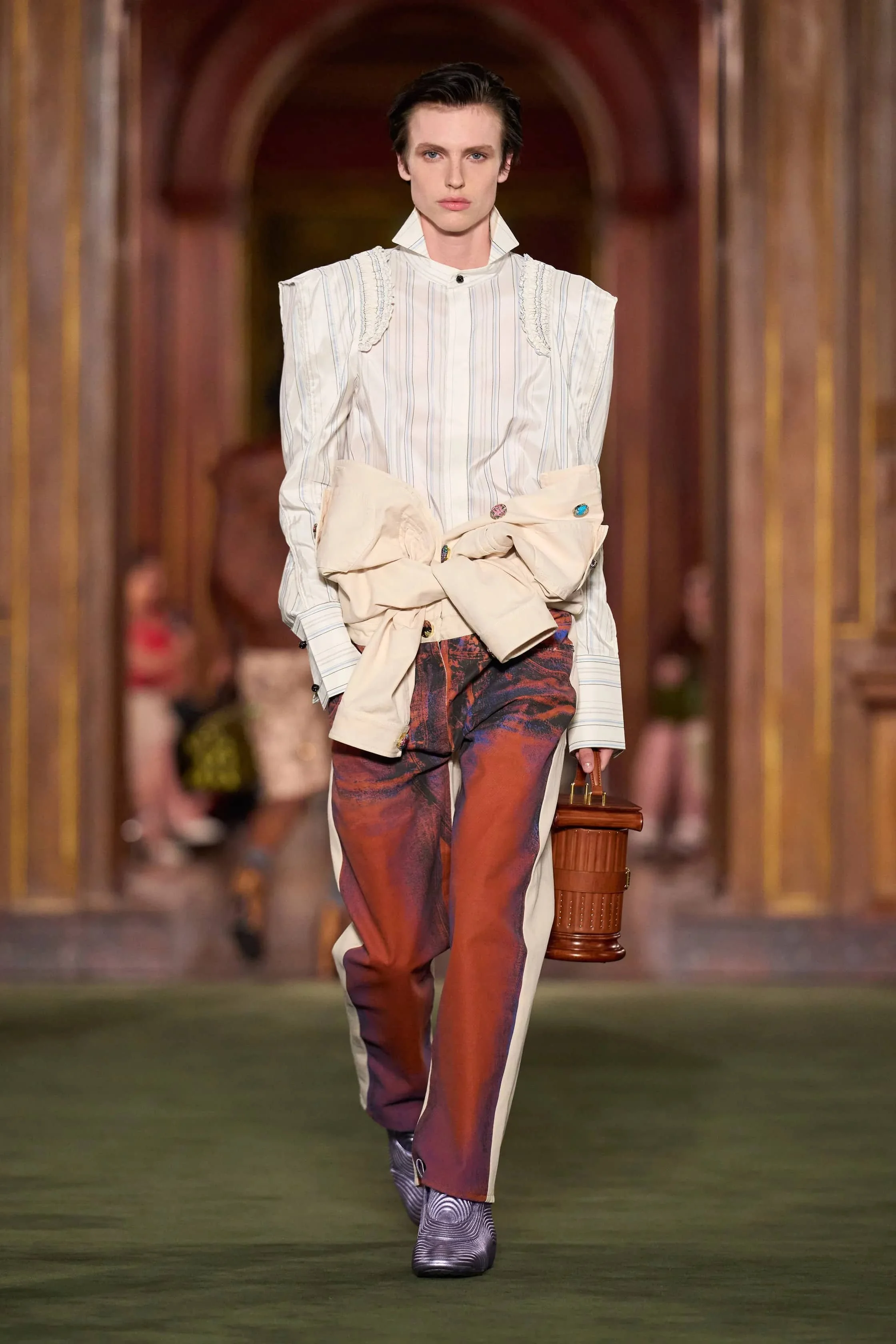
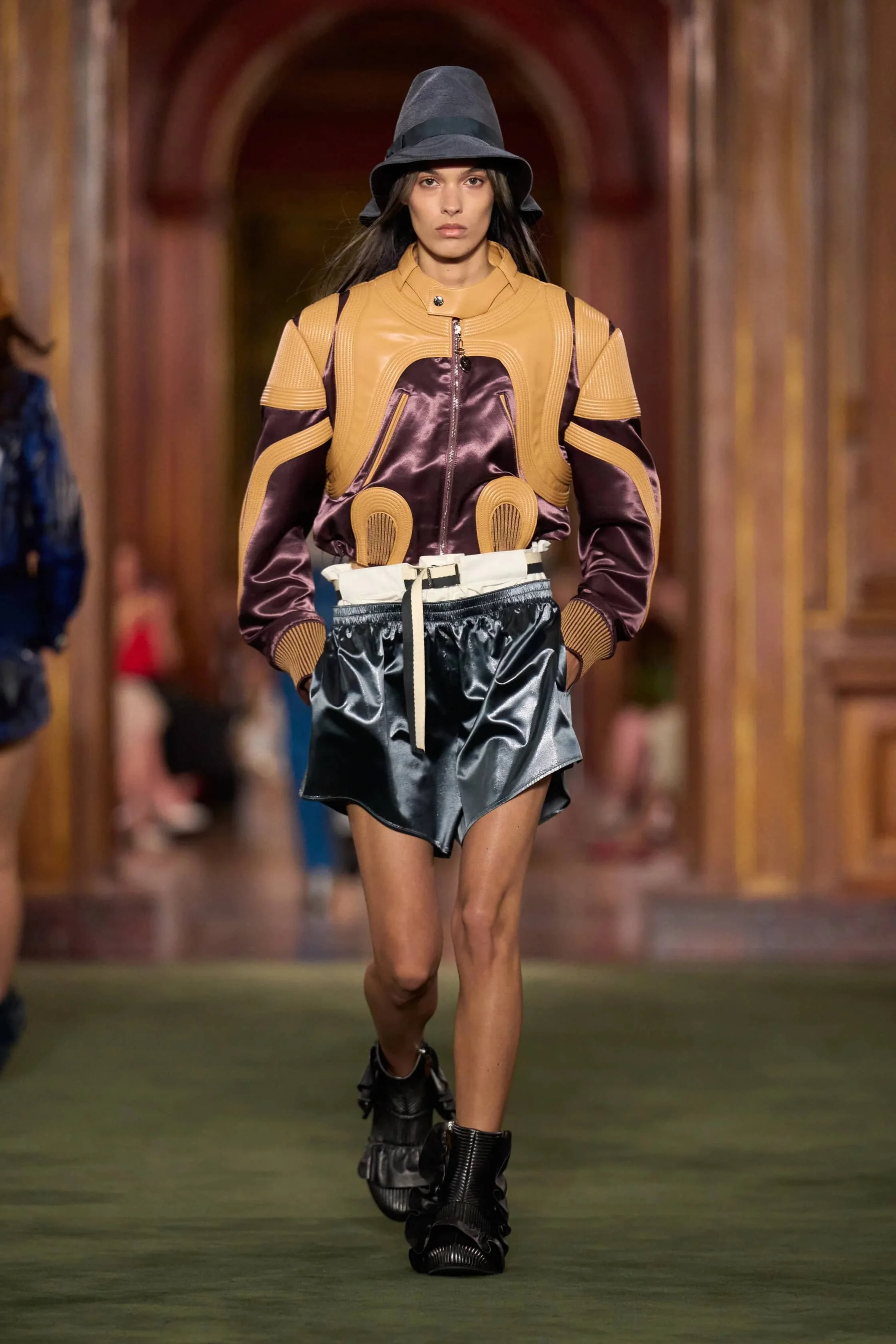
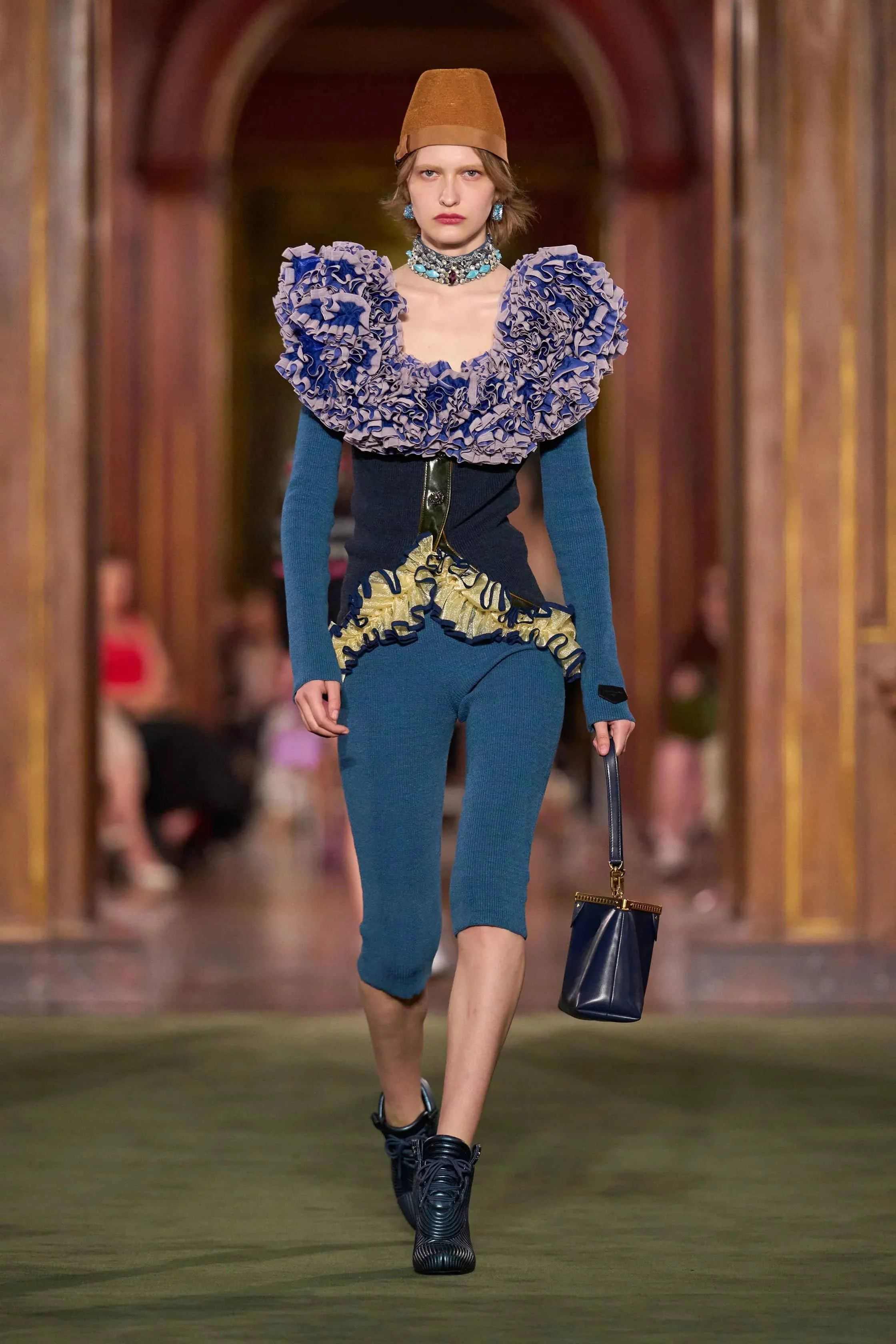
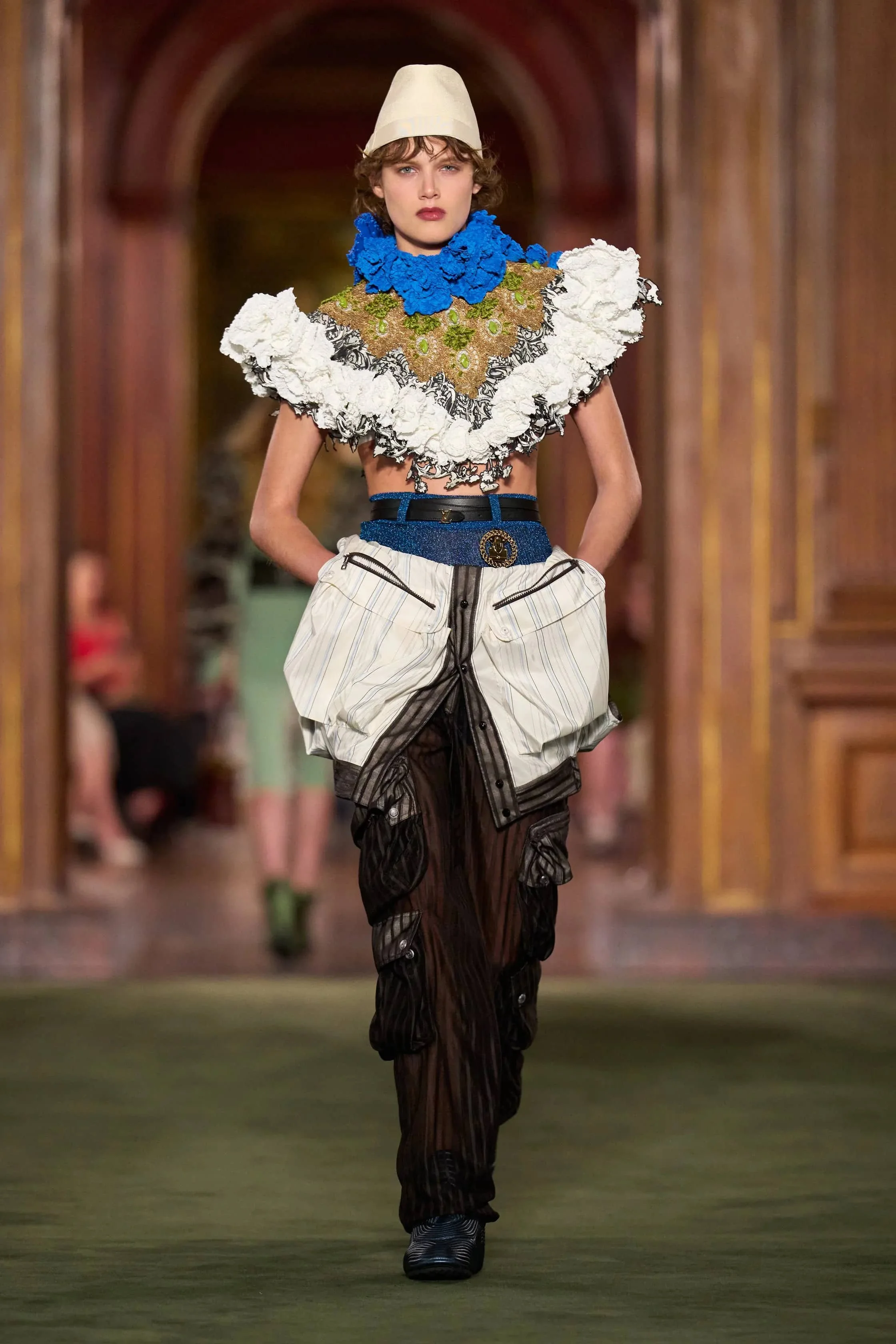
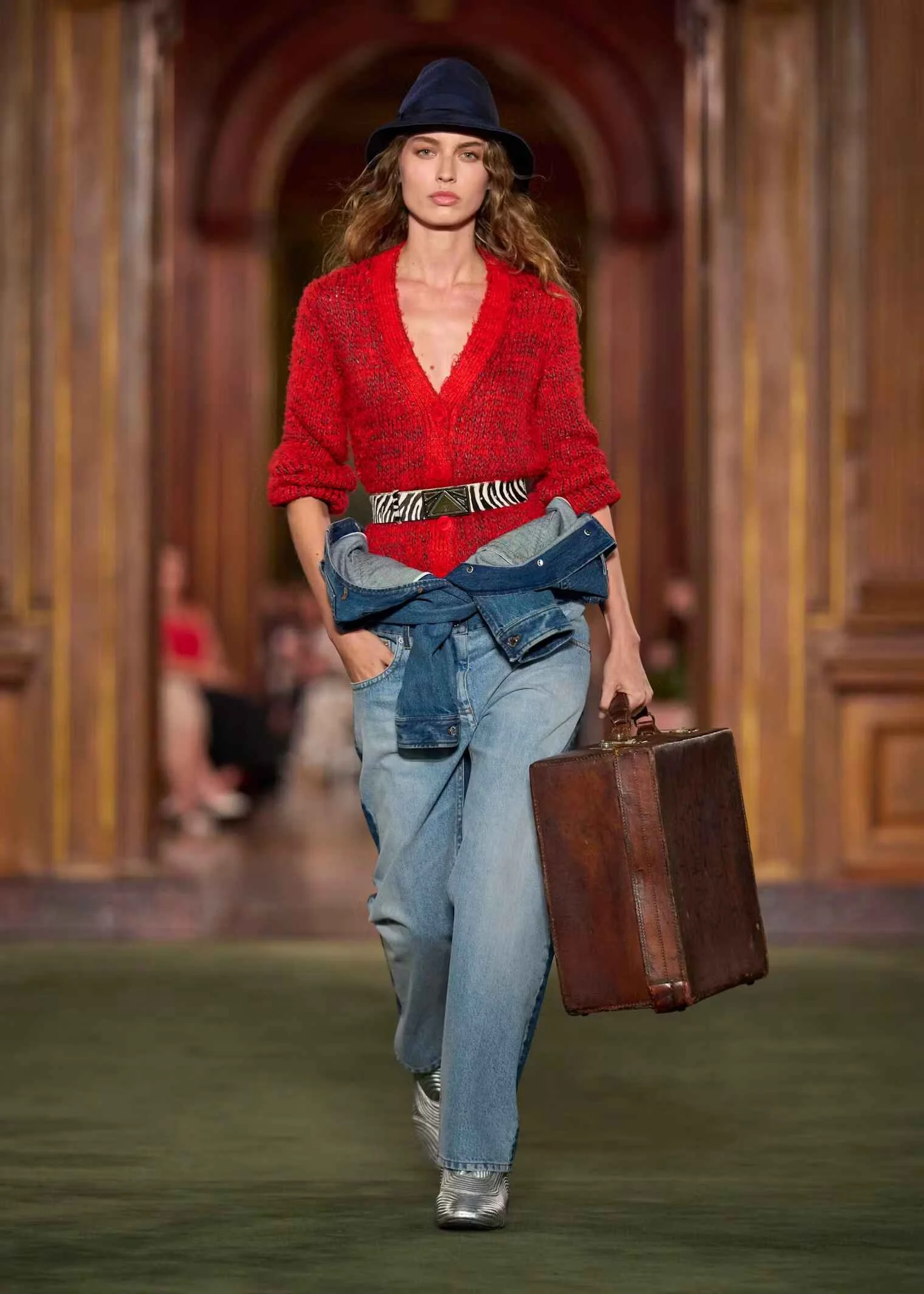
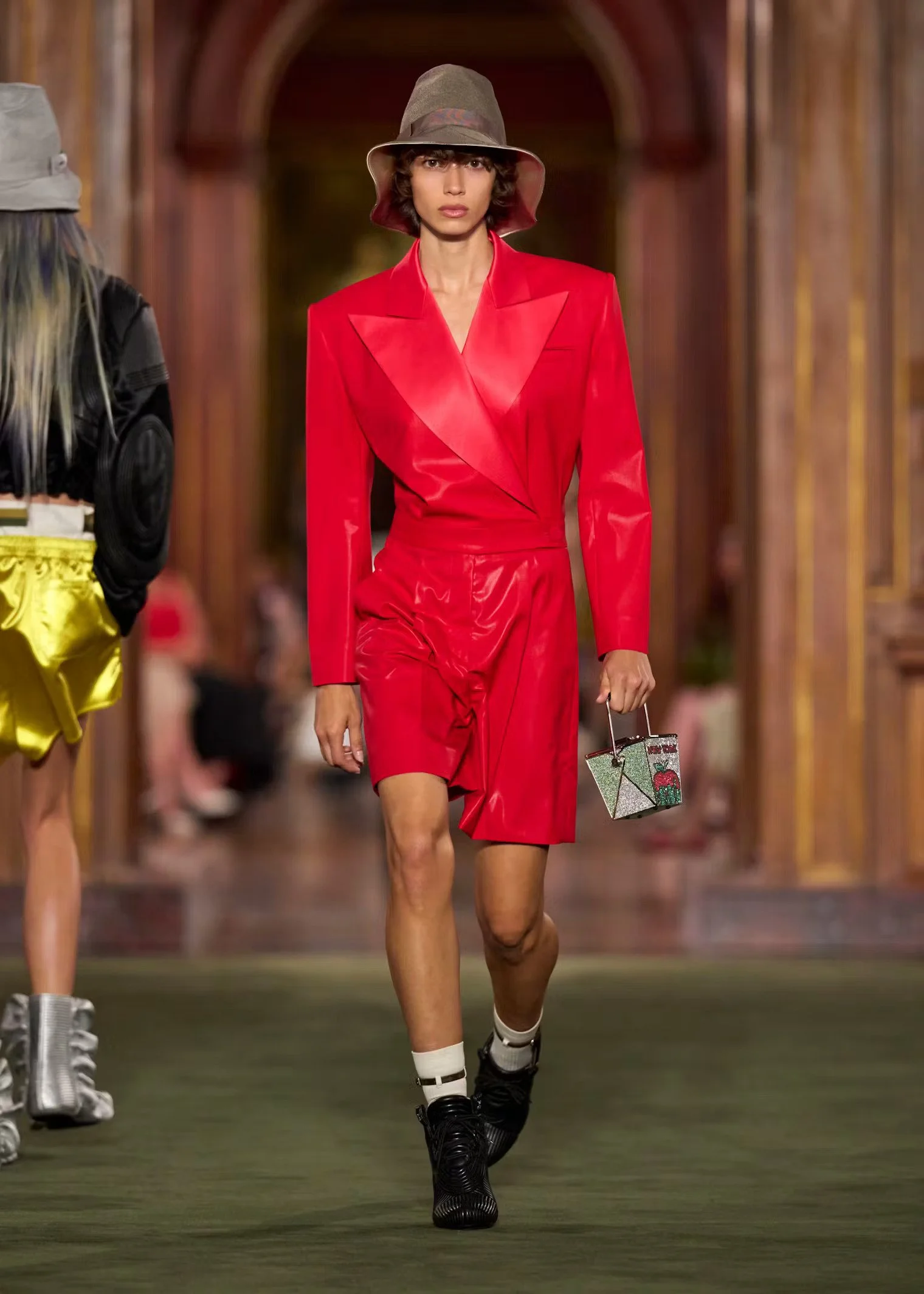
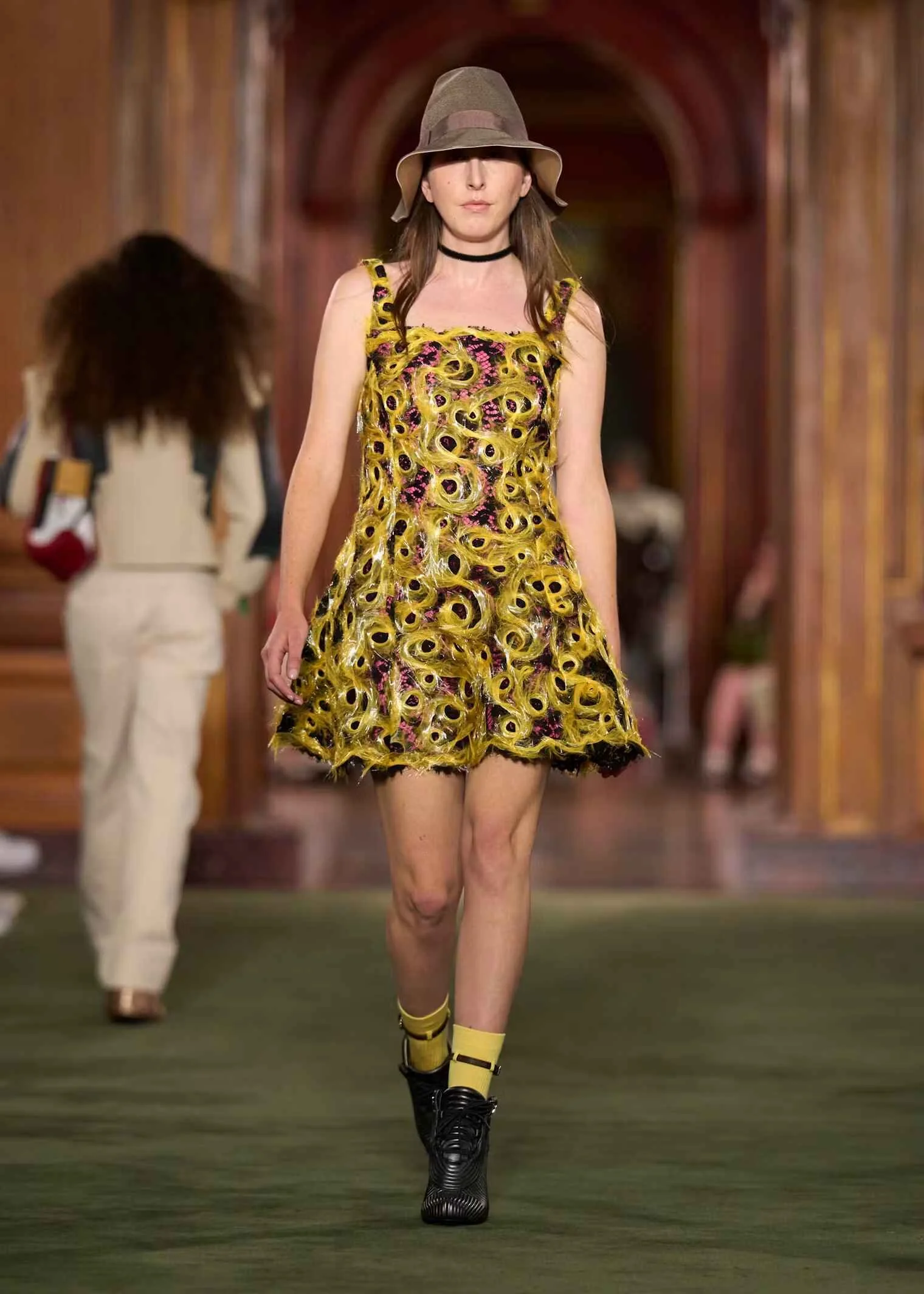
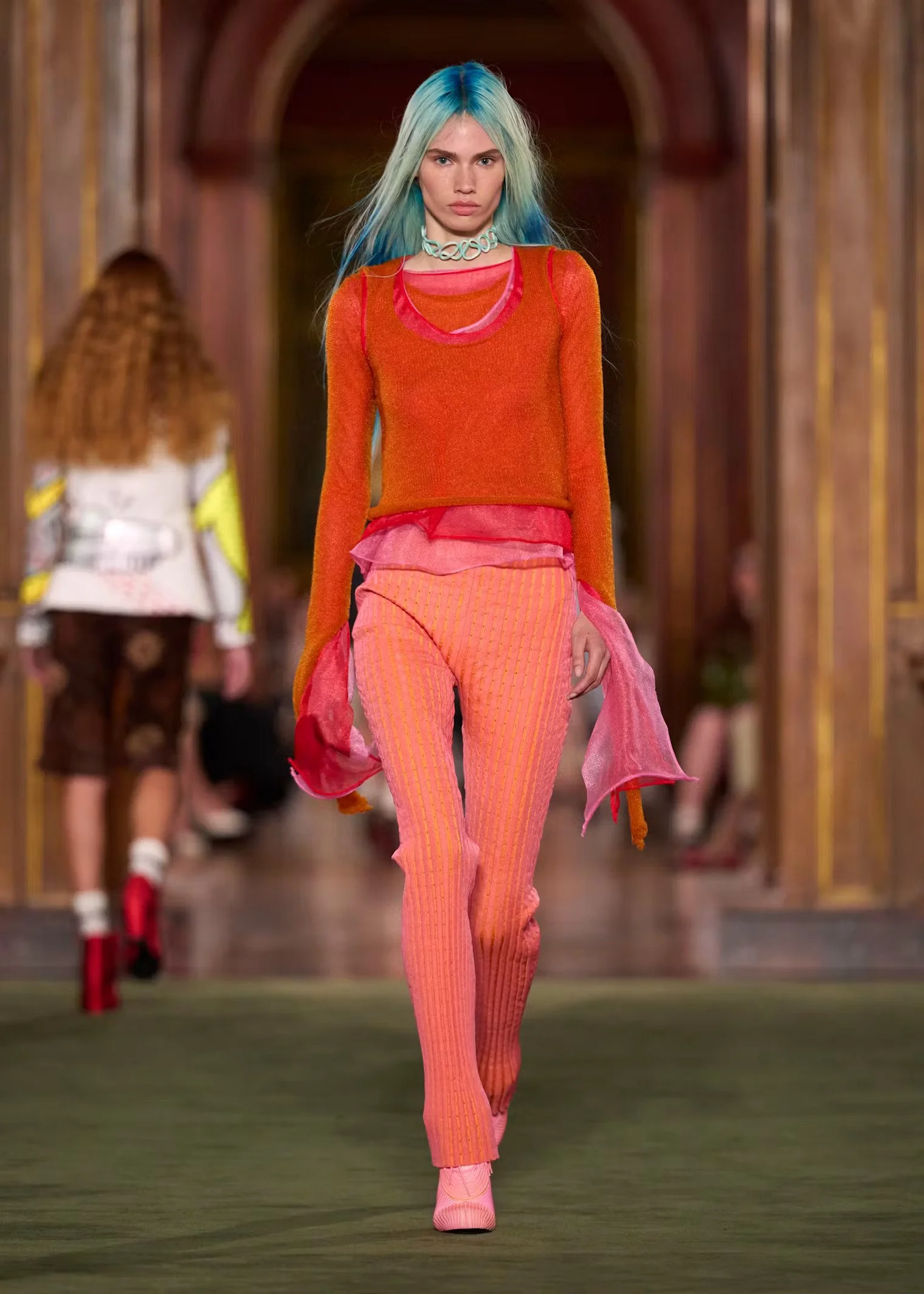
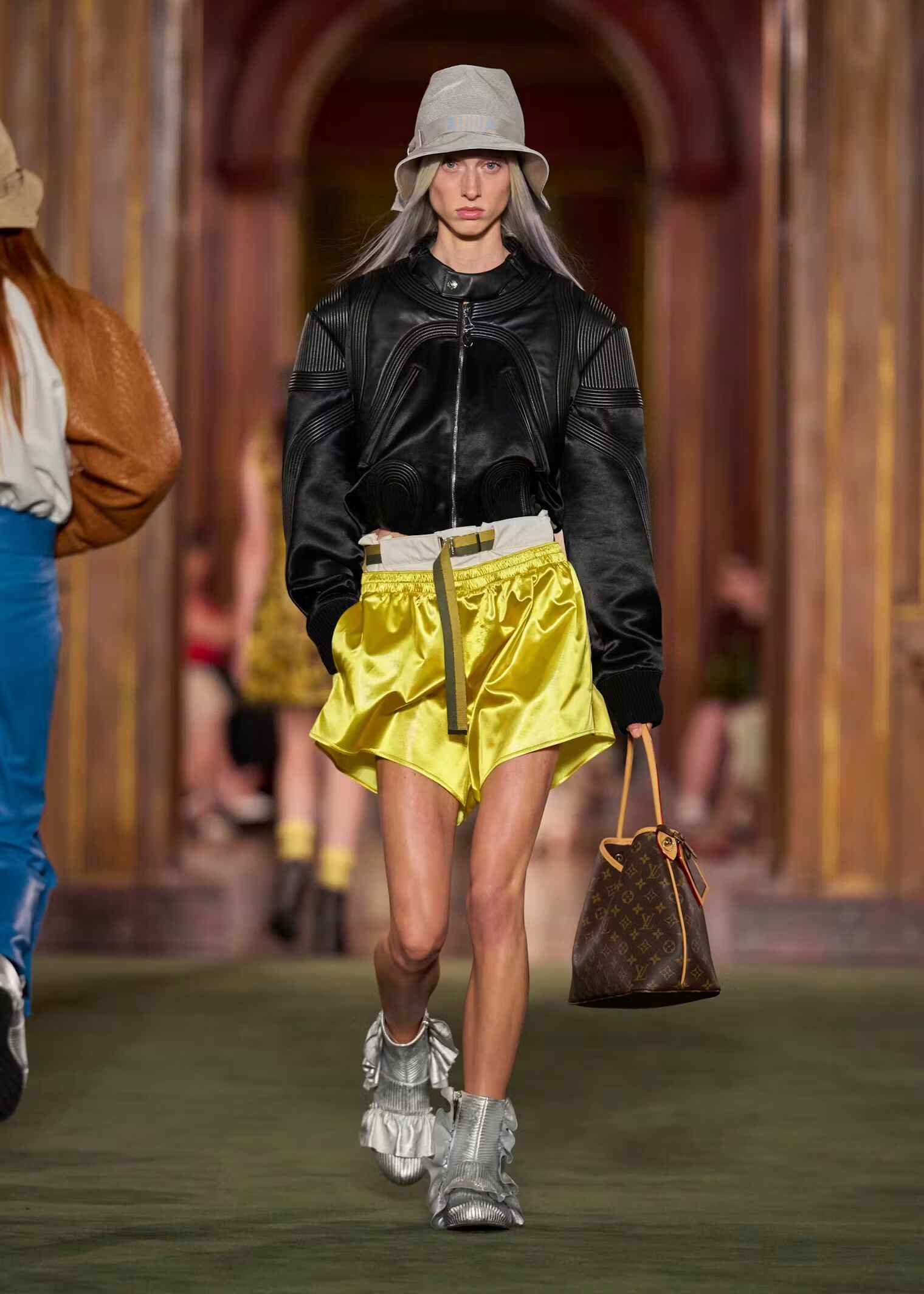
Held at The Frick Collection, a recently renovated museum on Manhattan's Upper East Side, the show was an exercise in contrast. Ghesquière, a Frenchman in New York, utilised the friction between uptown and downtown as a basis for the collection. The first was embodied in exaggerated frills on shirts, protruding organic shoulders, and ruffled hems. Flowy, layered camisoles, ribbed leather jackets, and satin shorts illustrated the second.

The latter was further embodied by the mythology of art in the city. Keith Haring was made the muse. The choice is justified by the artist’s connection to Louis Vuitton. In 1984, Haring graffiti-ed one of the maison’s suitcases for a friend. The opening look — a chunky knit cardigan with jeans — was paired with that same piece of history (or art, or both). Further references to the artist were seen in hand-printed leather jackets, brightly colored sleeveless tops, and an origami-like folded white dress.

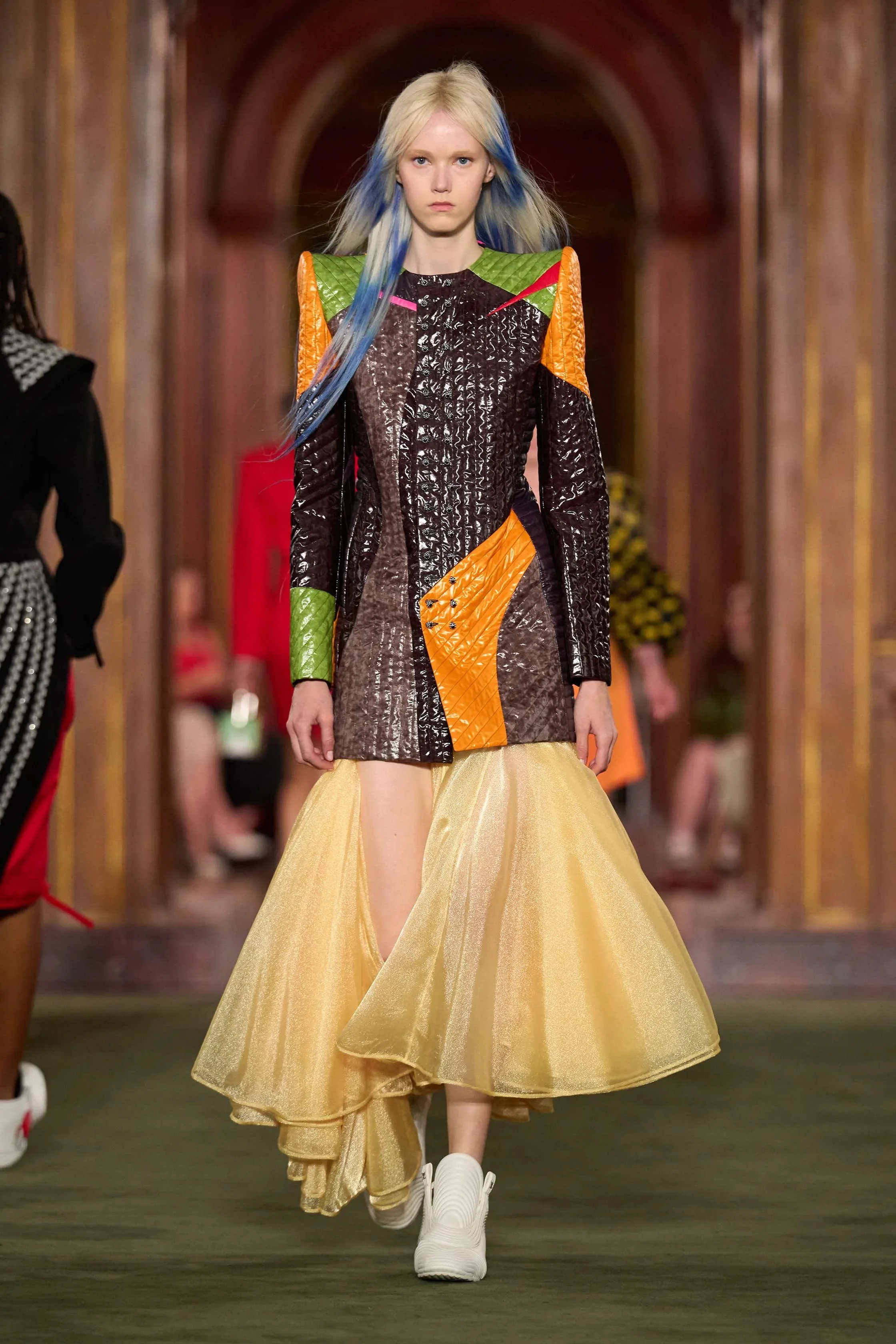
Throughout his tenure at Louis Vuitton, Ghesquière has grown interested in pushing the body outward, sculpting silhouettes that protrude, curve, and resist natural movement. Here, his experimentations were a bit more tame than, say, last season, but even so, rigid leather dresses with villainous shoulders exploded into asymmetrical skirts past their hems.

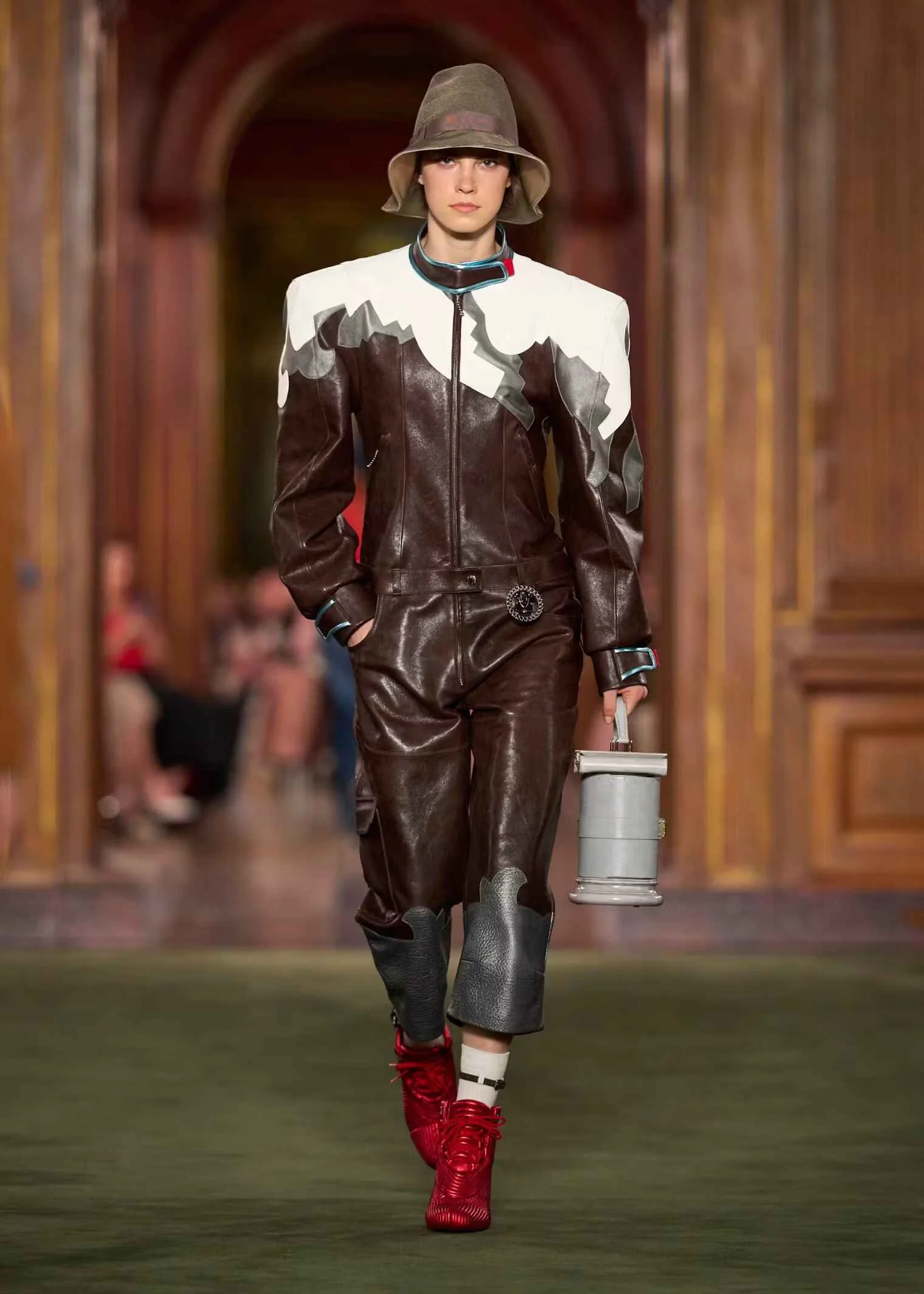
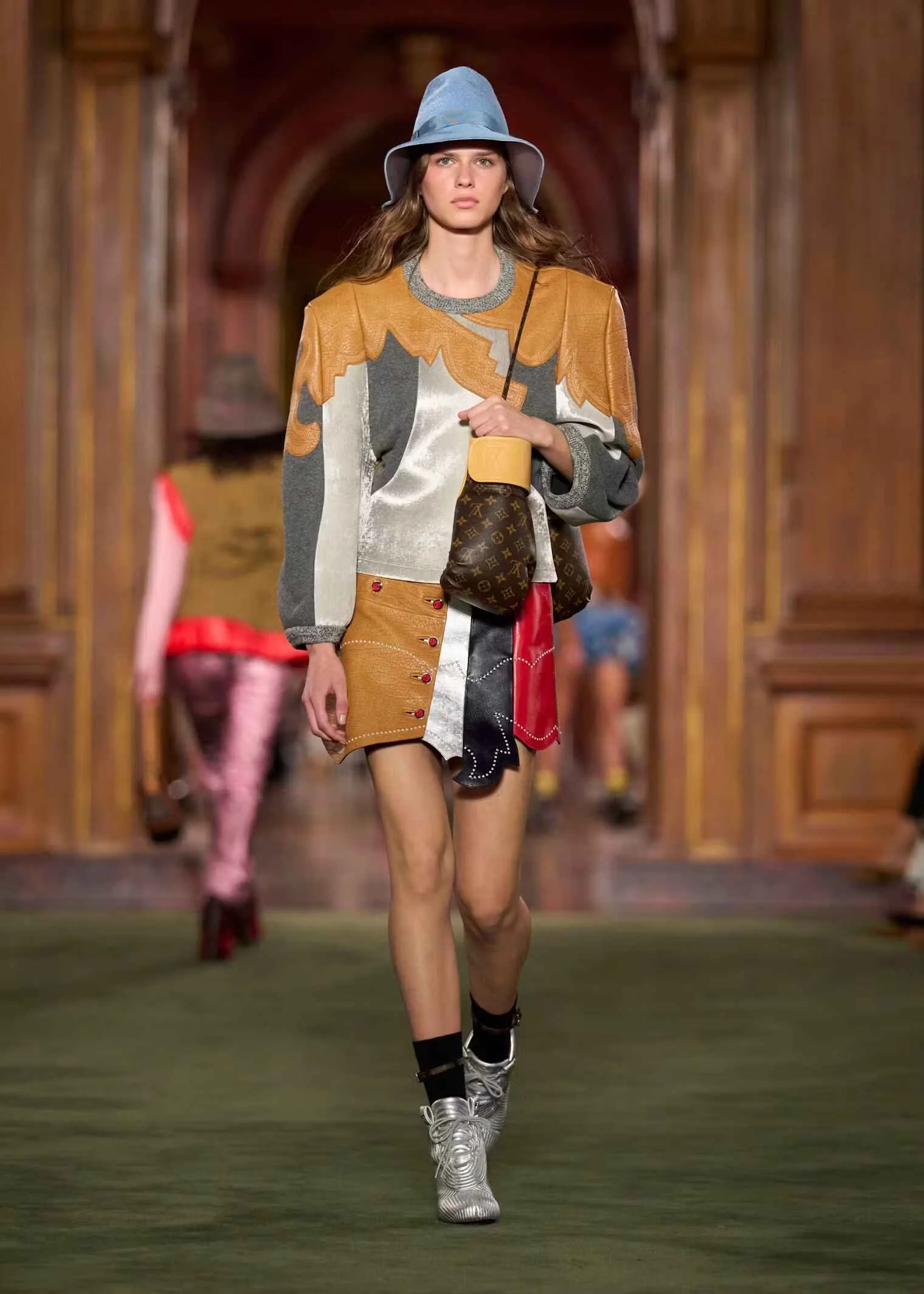
It wasn’t just New York; Americana as a whole was taken on as a guideline. Strong-shouldered leather bodysuits and patchworked skirts in red, brown, and silver leather spoke to a futuristic fantasy of American nostalgia. That is where the designer shines brightest – Ghesquière’s ongoing project is one that constructs wardrobes for lives that do not yet fully exist.


Words by Pedro Vasconcelos

GUCCI CRUISE 2026/27

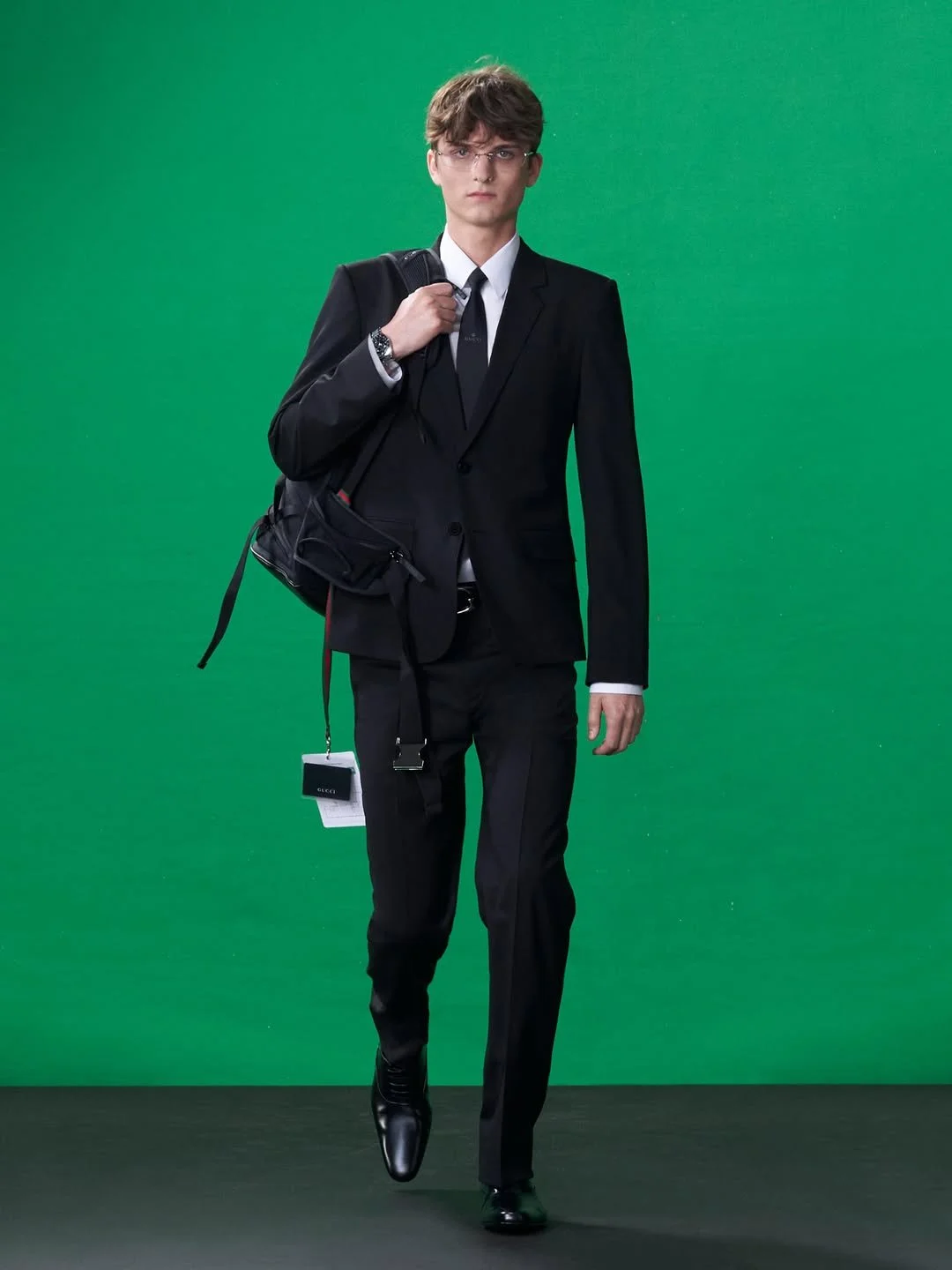
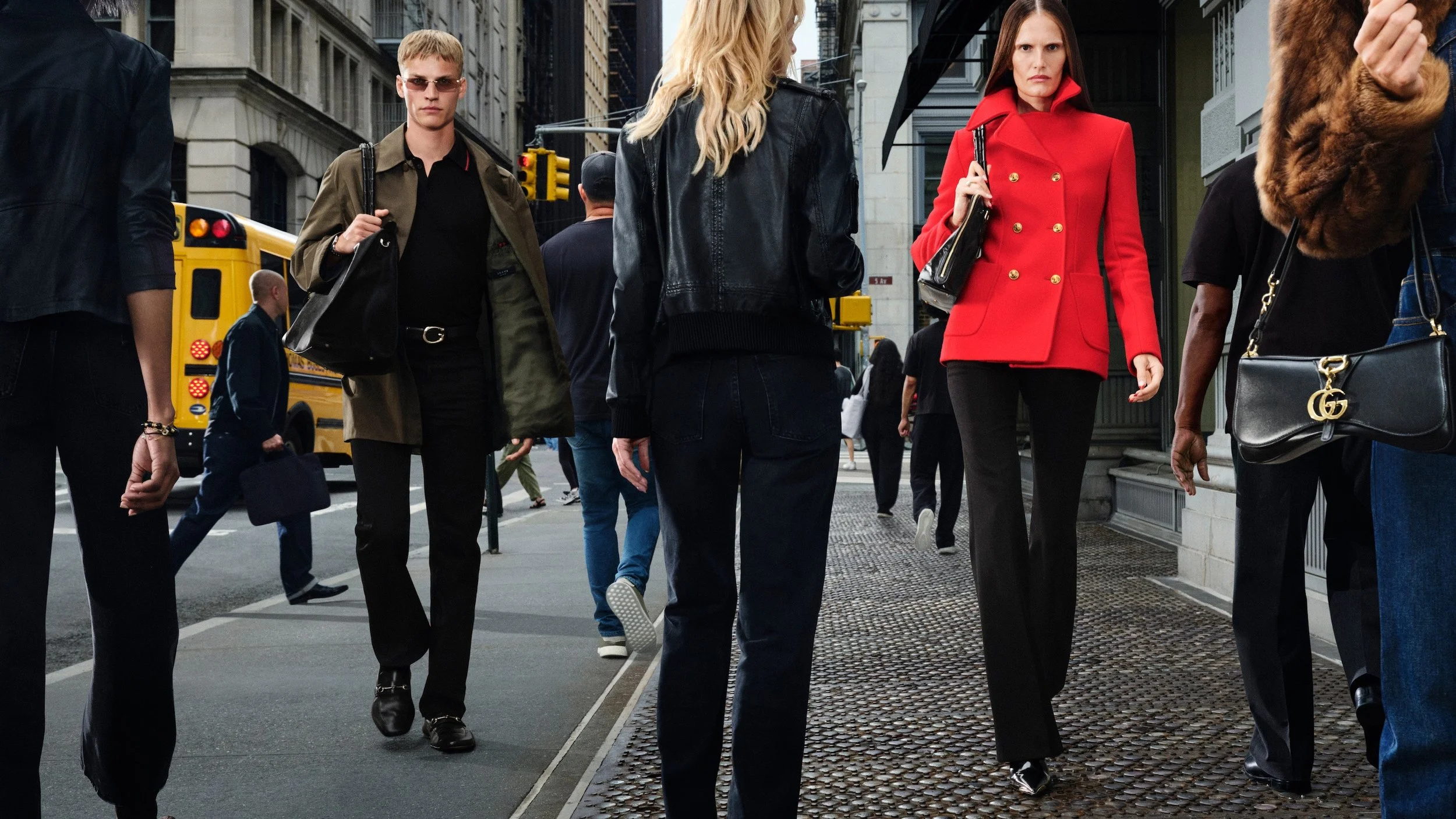
For its Cruise 2026/27 collection, Gucci handed the keys to New York City over to Demna, who went on a cinematic exploration of the metropolis and its endlessly compelling cast of characters. From backpack-clad Wall Street bros to fur-wrapped downtown 365 party girls and jewel-laden Upper East Side socialites en route to charity galas, the collection captured the city through a sharply exaggerated yet deeply observant lens.

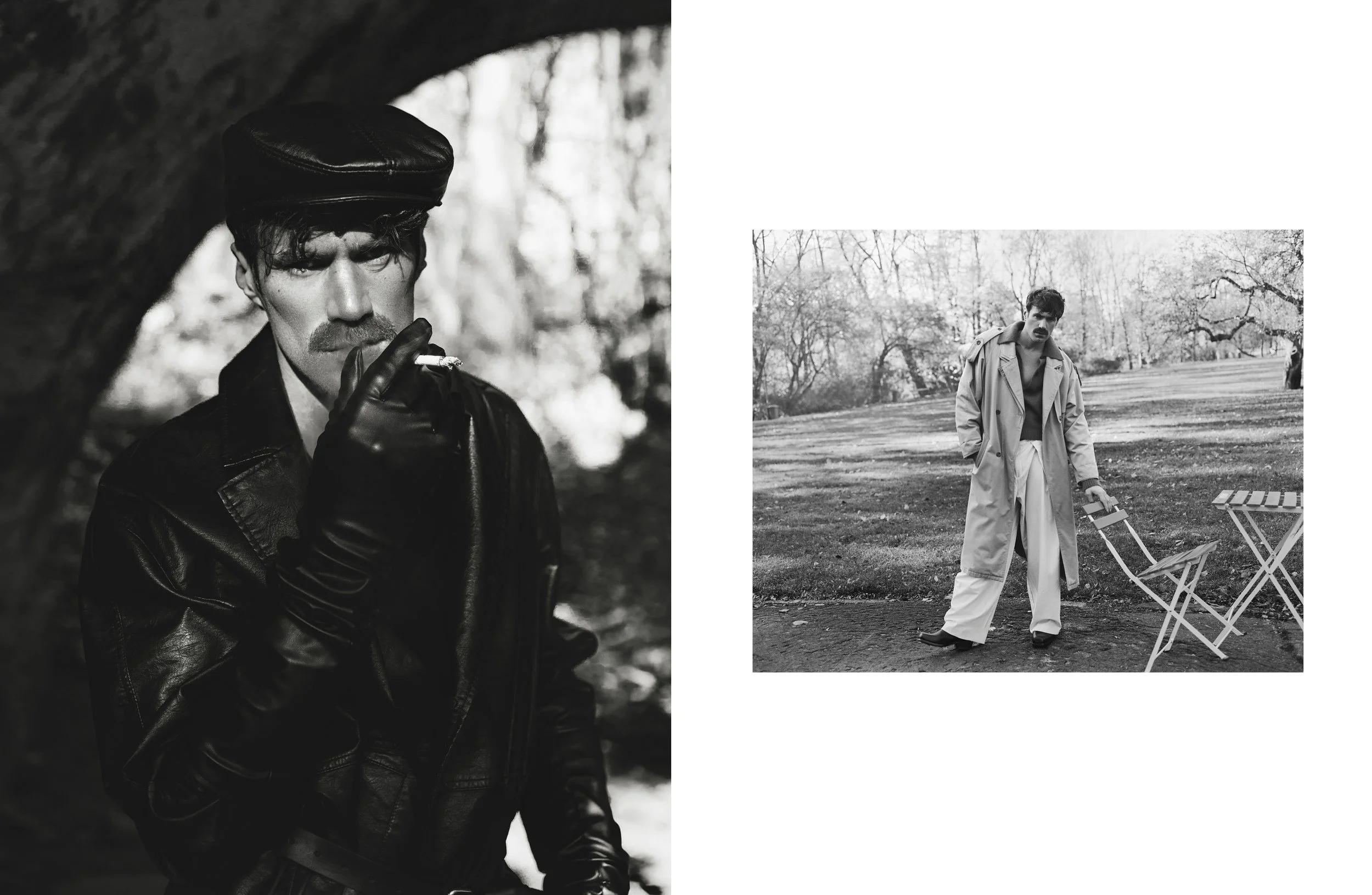
Set against the grand backdrop of Times Square, the show unfolded as a full-scale fashion spectacle, amplified by a headline-making cast. Paris Hilton delivered a nostalgic moment in a pussy-bow silk shirt dress and brunette wig, revisiting her unmistakable runway strut with playful self-awareness. Meanwhile, sports superstar Tom Brady embraced a darker, naughtier aesthetic in head-to-boot black leather inspired by the Tom of Finland fineries (did he go to a leather bar after the show?). Model-du-jour Amelia Gray further cuntyfied the runway, elevating a jangling set of keys into a statement accessory through her fierce walk.

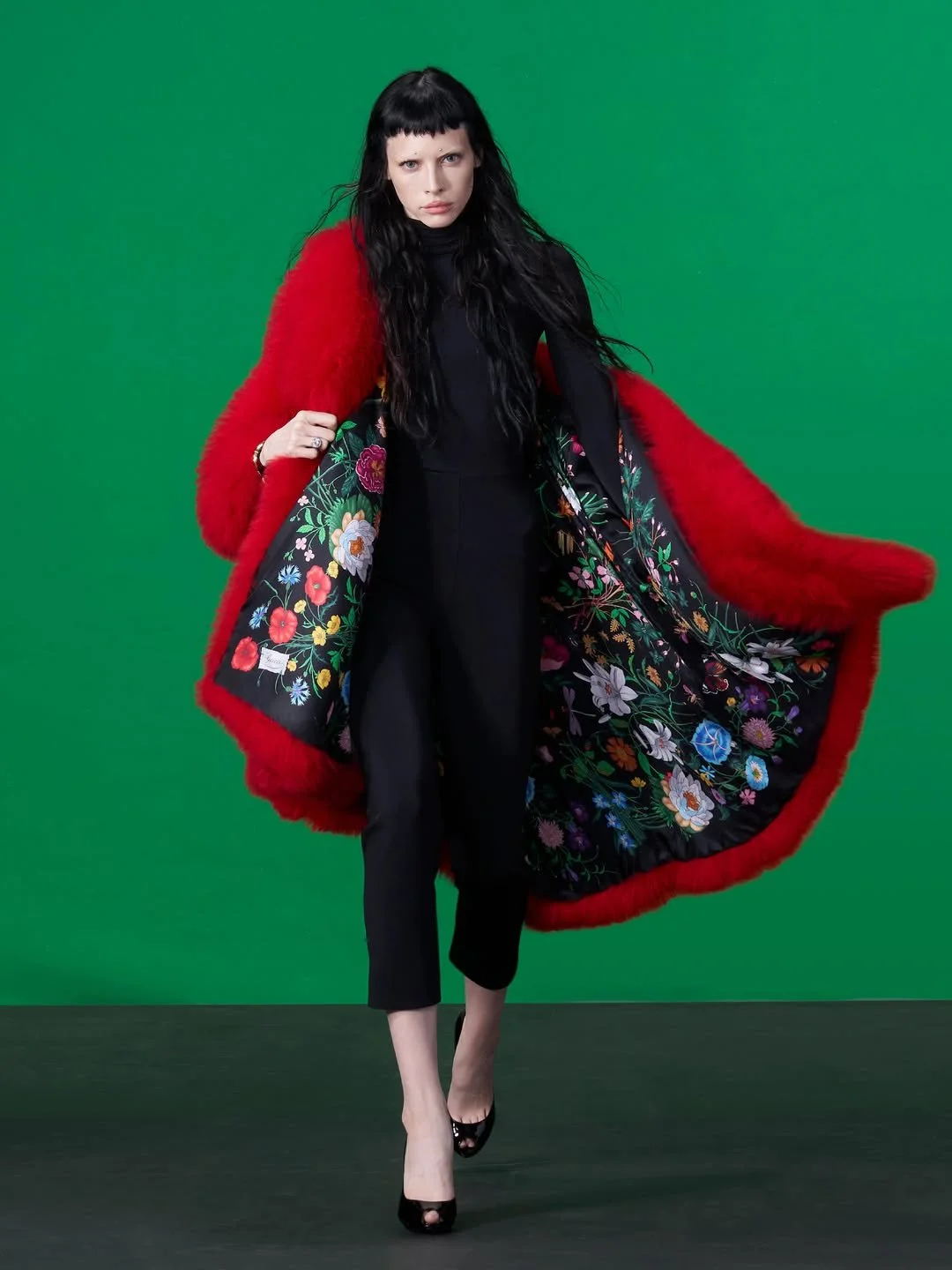
As expected from Demna, the collection rejected convention in favour of exaggerated silhouettes and provocative styling. Outerwear emerged as a central focus: a vivid red fur revealed a striking Flora-print lining, while a sharply tailored coat offered the white interpretation of the motif. Structural peacoats in navy and red matched the energy of sharp, tailored trousers and even sharper, spiky heels. Tailoring itself proved to be another standout category. Traditional suiting was reimagined through both masc office-fantasy cuts and dramatically cinched double-breasted silhouettes that injected theatricality into formalwear.

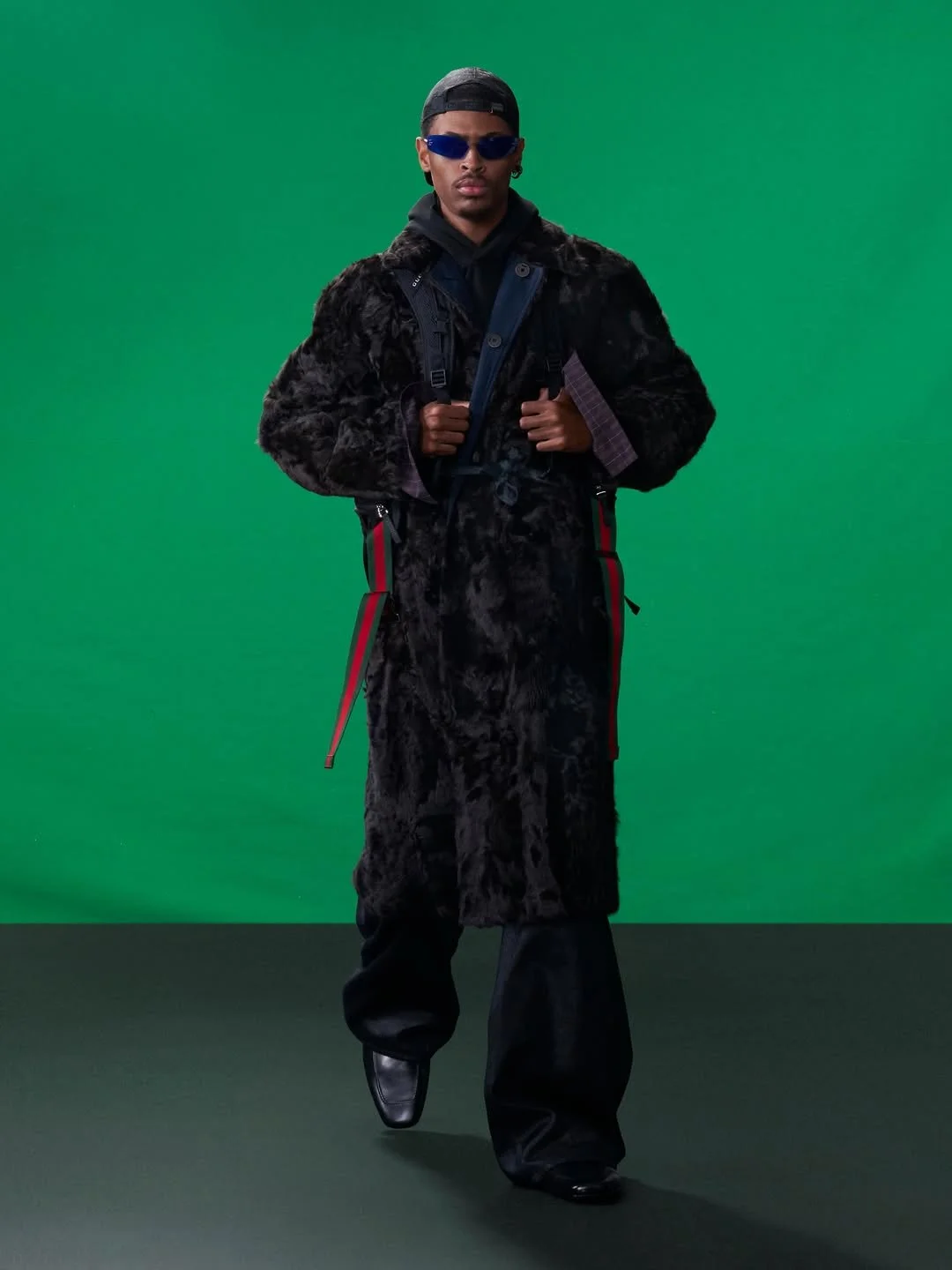
Although unmistakably filtered through Demna’s aesthetic, the collection remained rich with instantly recognisable brand’s signatures – after all, it was titled GUCCICORE! Horsebit hardware appeared across black heels, while the house’s iconic green-and-red stripe was transformed into lanyard details on backpacks and binder-inspired chest accessories. The result? A collection that fused irony, luxury, and urban character study into a distinctly contemporary vision of Gucci.


Words by Martin Onufrowicz

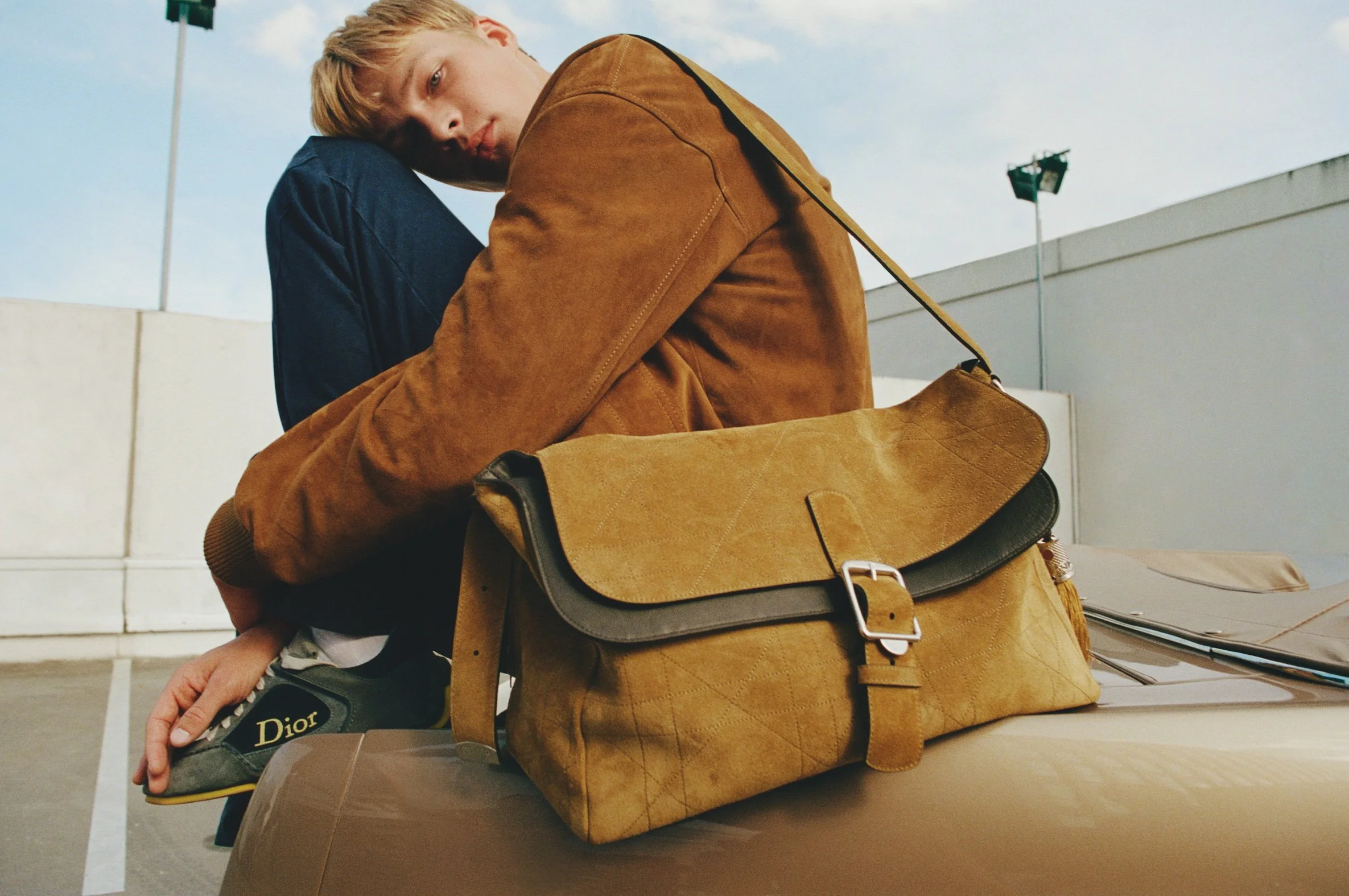
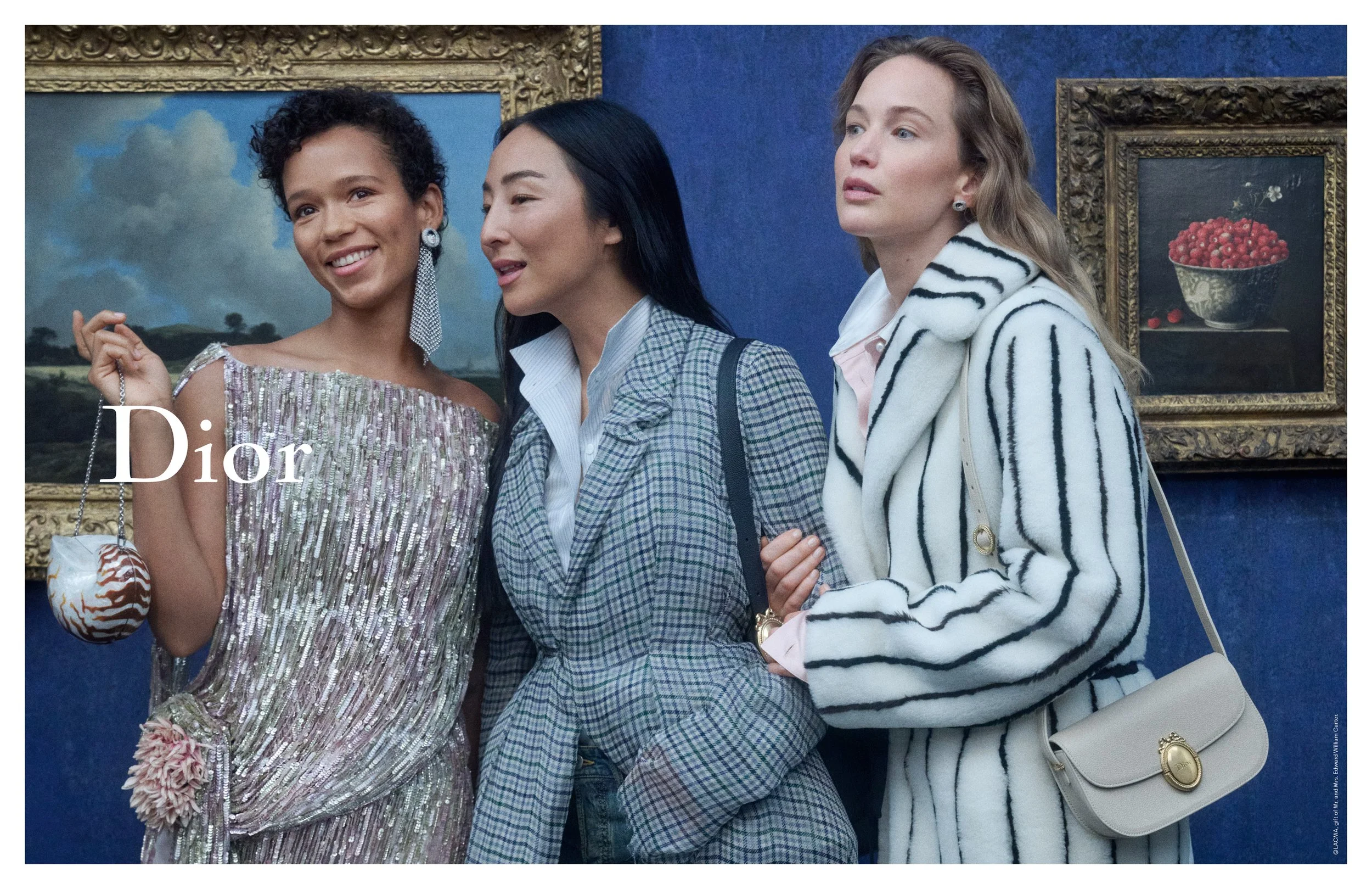
DIOR CRUISE 2026/27

“There’s no Dietrich without Dior.” In 1950, Marlene Dietrich refused to star in Alfred Hitchcock's Stage Fright without a Christian Dior wardrobe – the better part of which she conveniently kept after production wrapped. Dietrich was but one of a clientele that reads as Olympian rather than human: Marilyn Monroe, Grace Kelly, Sophia Loren, Elizabeth Taylor, Audrey Hepburn. Dior’s myth itself is intertwined with that of the golden age of Hollywood.

It makes sense, then, that for his first Cruise show, Jonathan Anderson chose Los Angeles as his location. In the recently inaugurated David Geffen Galleries at LACMA, the Northern Irish designer projected the seductive effect of the city of angels. Not that Anderson is not privy to such magnetism. Since 2022, his collaborations with Luca Guadagnino have birthed films like Challengers and Queer – and there are more to come. Anderson revealed he’ll be collaborating on another three movies in the near future. The point is: he’s no stranger to the intersection of cinema and fashion. And therefore, here, a show dedicated to Hollywood was made into a story, a narrative of different characters and stories. It’s a creative strategy that has become quite popular in recent seasons but, under the thematic guideline of Hollywood, has found its most appropriate interpretation.

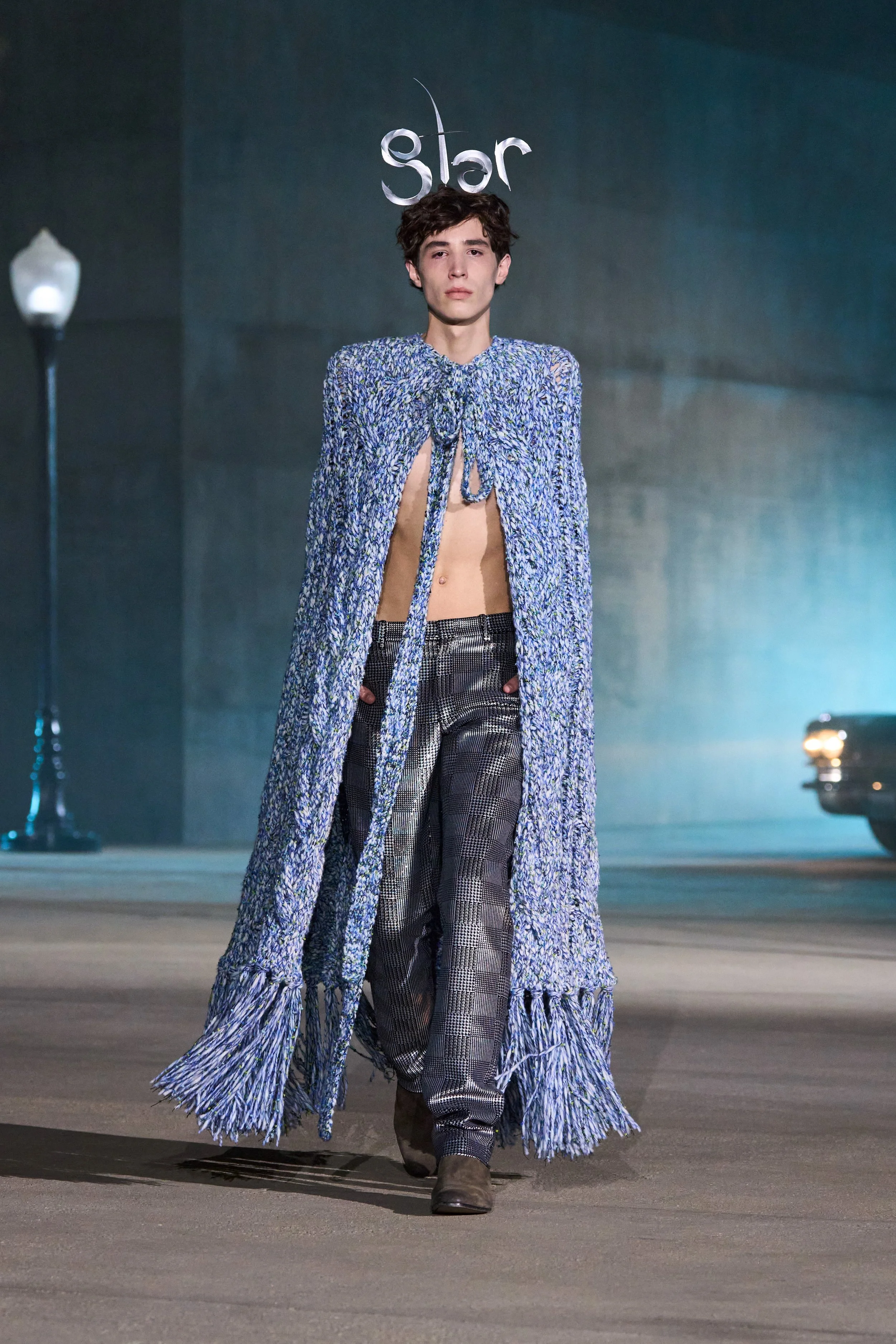
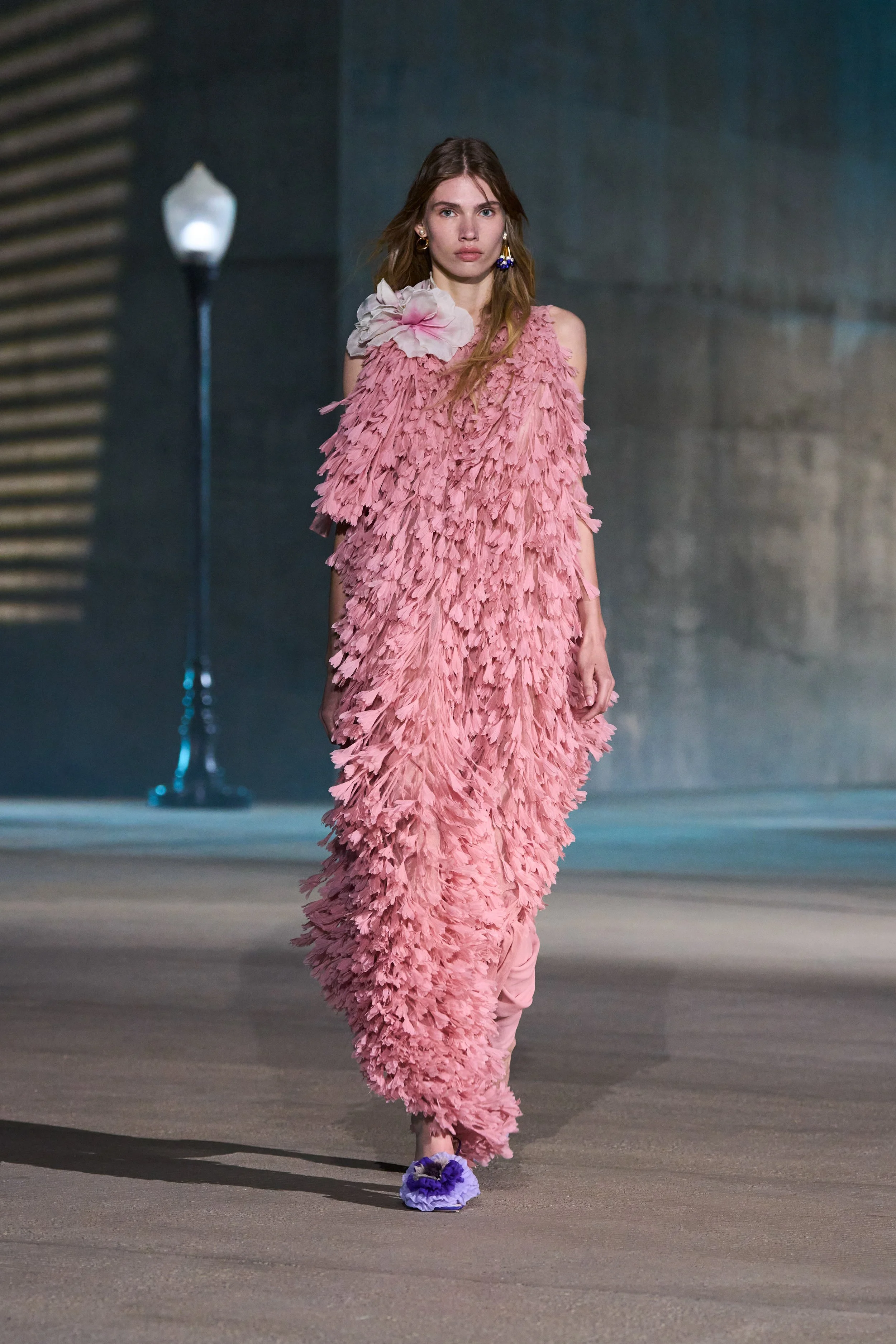
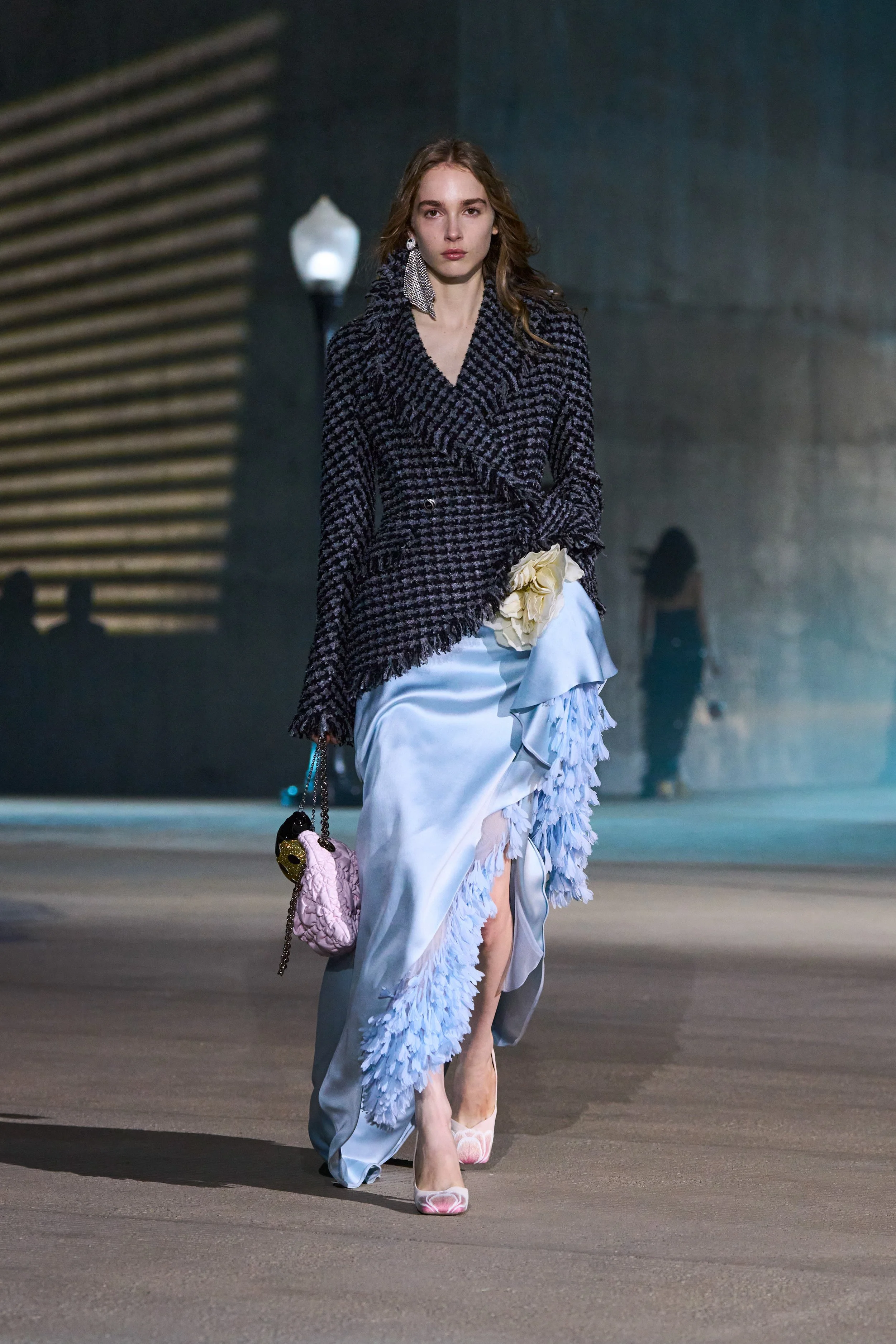
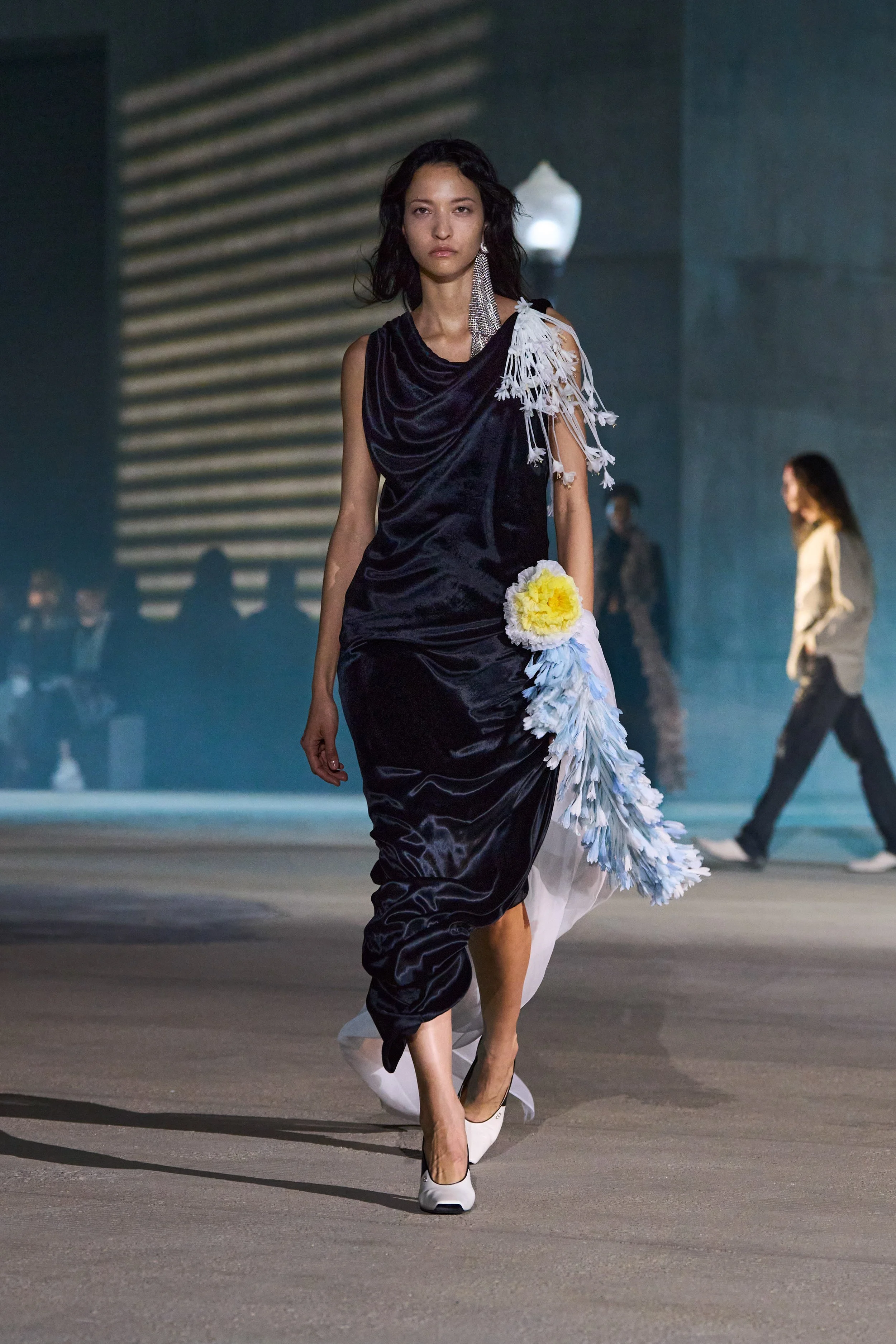
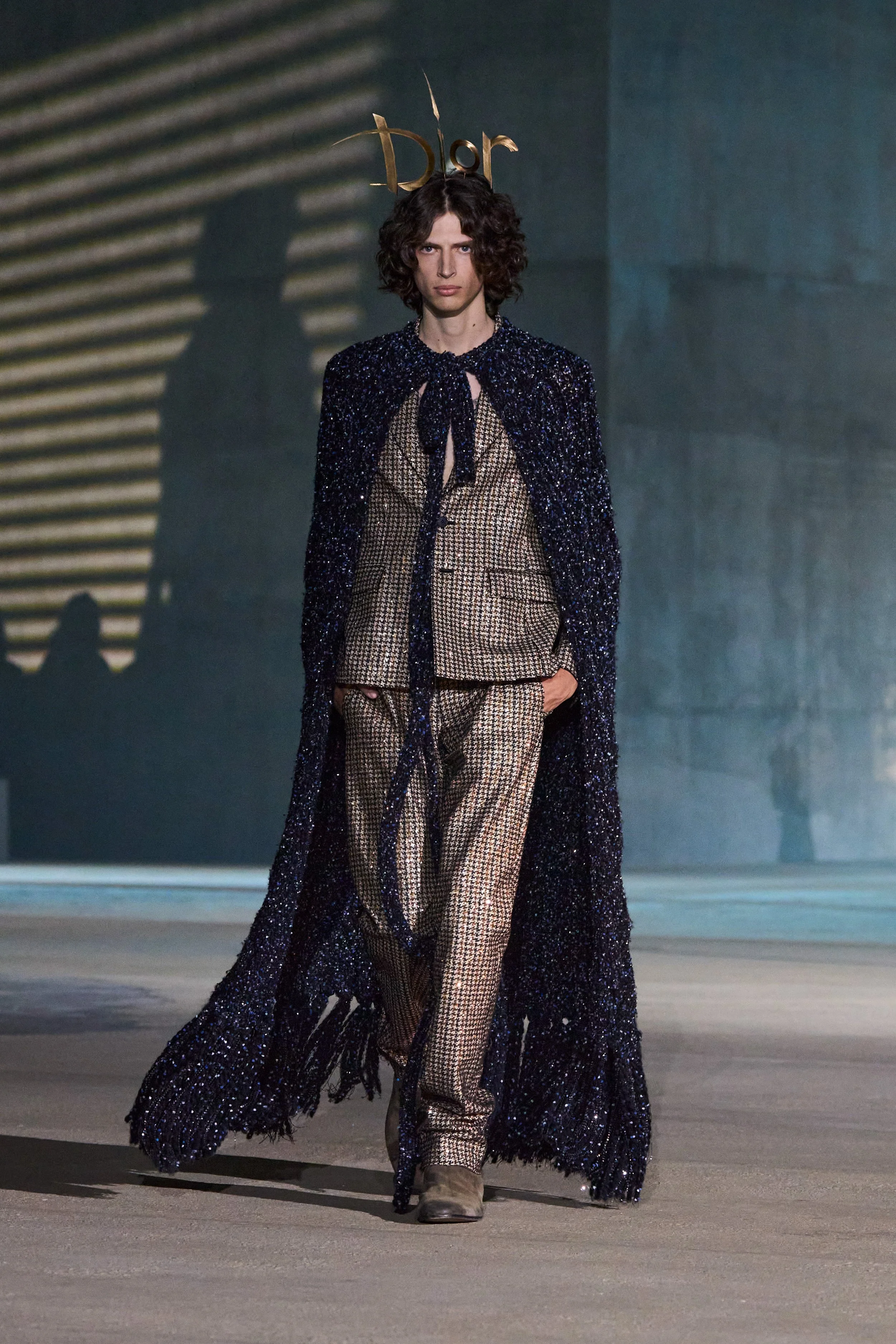
There were some recurring characters, flashes of the body of work the designer has spent the better part of the last year building. The dramatic and colourful flowers on the shoulders flounced similarly to those in the couture show. Tasselled capes worn with nothing but jeans were reminiscent of the latest menswear offering. The Bar jacket remains a protagonist in Anderson’s Dior, this time in frayed versions that untangle at the hems and cuffs.

It wasn’t all new characters, though. John Galliano’s bias dresses and Marc Bohan bags made cameos. Elsewhere, milliner Philip Treacy recreated his feather headpieces, most recognisable from Isabella Blow’s iteration – a timely reference with the news of a movie about the stylist’s relationship with Lee McQueen, the latter played by Behind the Blinds current cover star, Russell Tovey. But no Blow was in sight; here, the milliner spelt Dior, Buzz, or Star atop the heads of male models.

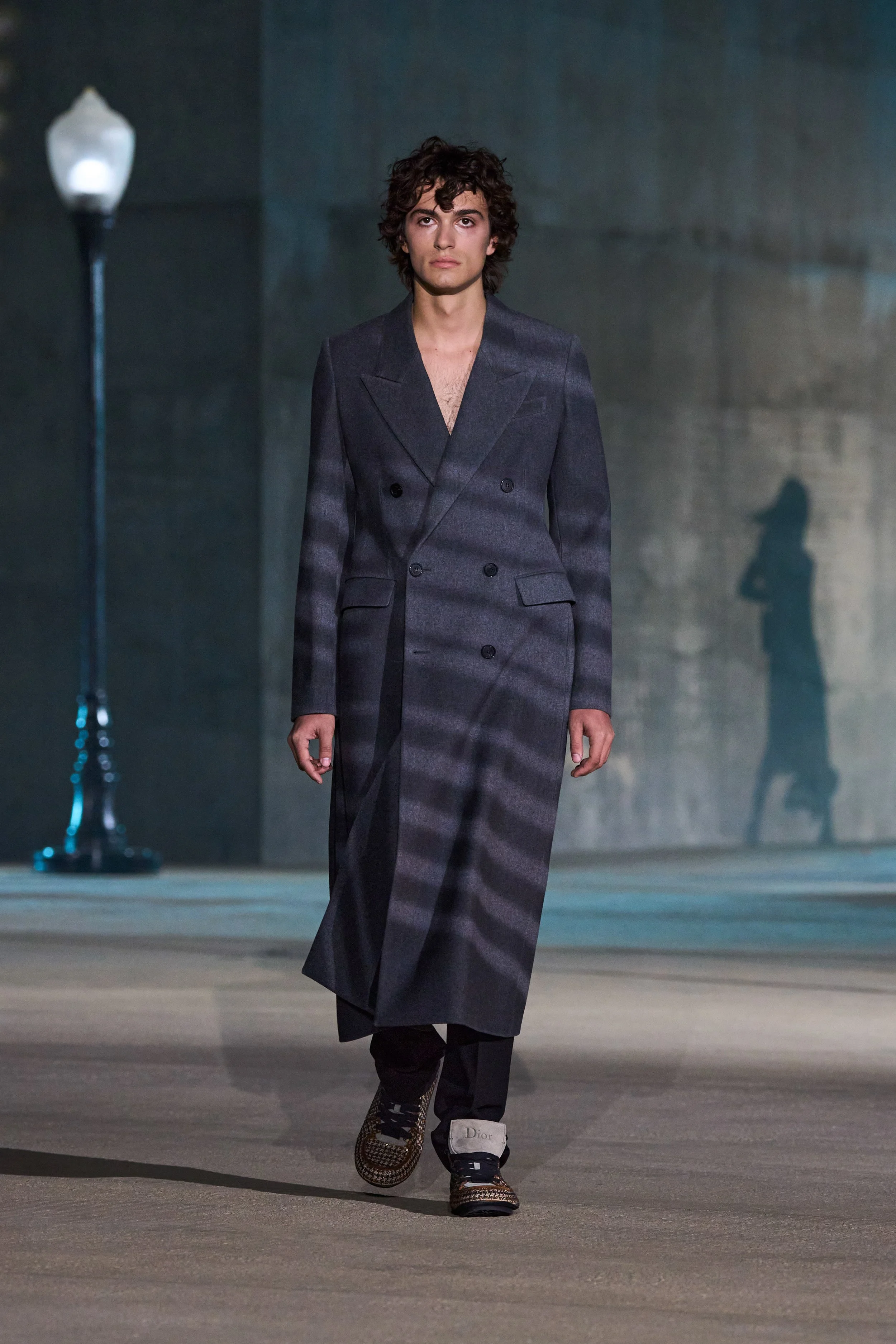
Whereas the womenswear was an array of characters, the menswear presented a tighter vision. Artist Ed Ruscha collaborated with Anderson to create graphic shirts. A particularly impressive wool coat replicated film noir lighting in angled stripes. Perhaps nowhere more than here was Anderson’s perspective concise. Hollywood is an illusion, a machine built to manufacture emotion.

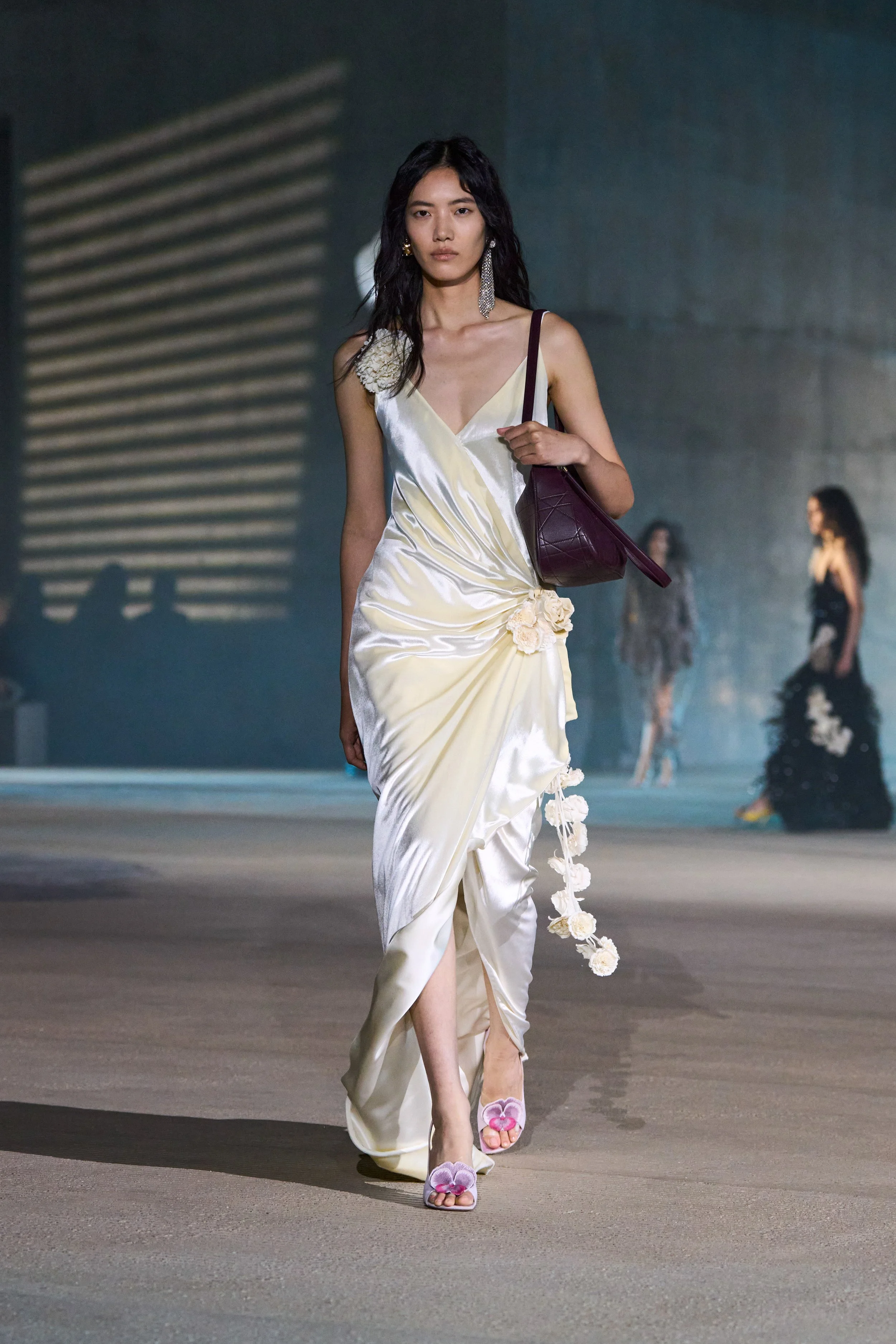
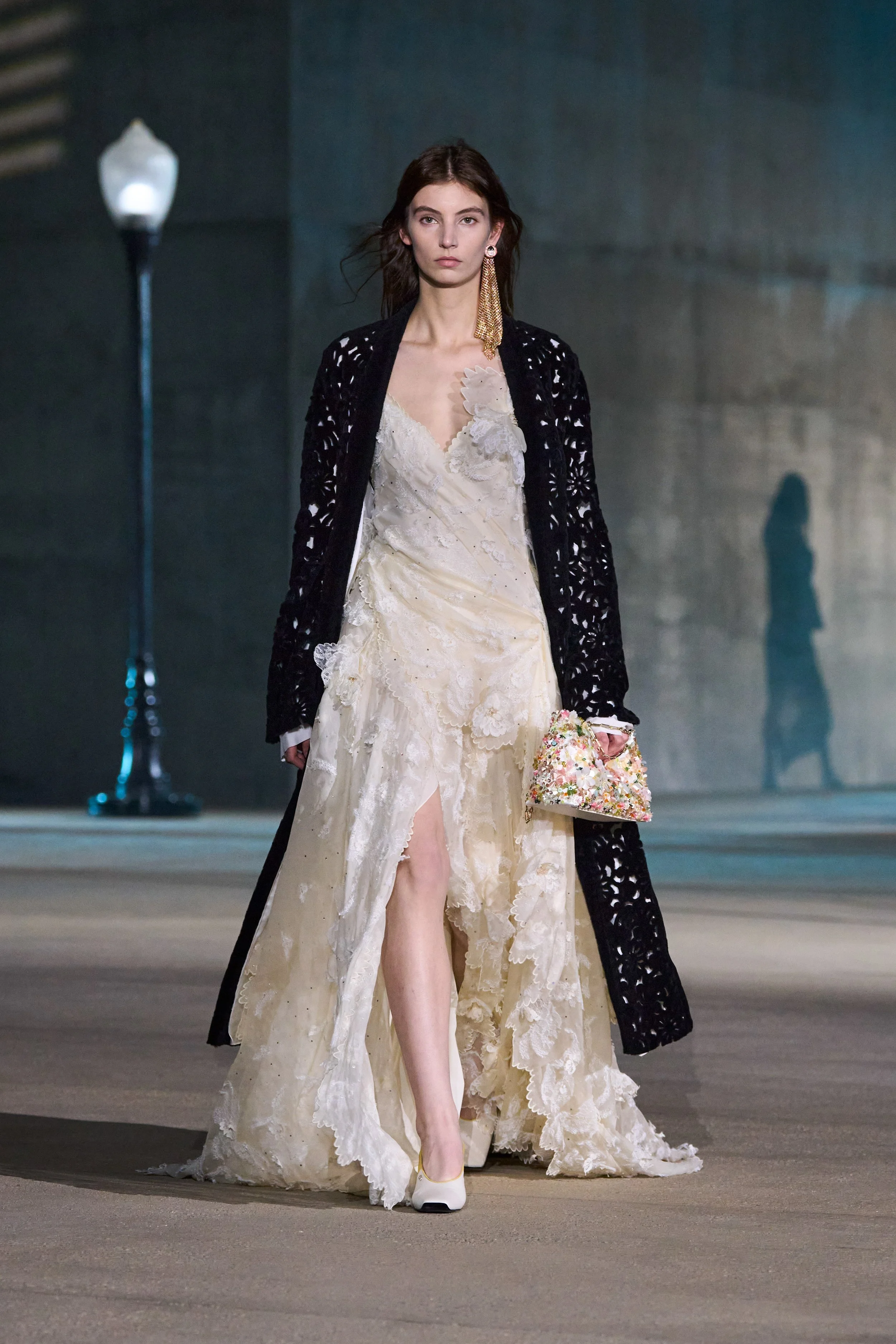
In womenswear, the designer was looking to convey glamour. A white gown scalloped at the edges, a slit swishing open as the model walked. Minute details on scaled dresses were made evident by their sheer repetition. Just shy of the first anniversary of Anderson at the brand – a celebration that will take place at the upcoming men’s show this June – his confidence is palpable. He might’ve had to move things around, put his imprint on the couch, but there’s no denying it: Dior is Anderson’s house.


Words by Pedro Vasconcelos

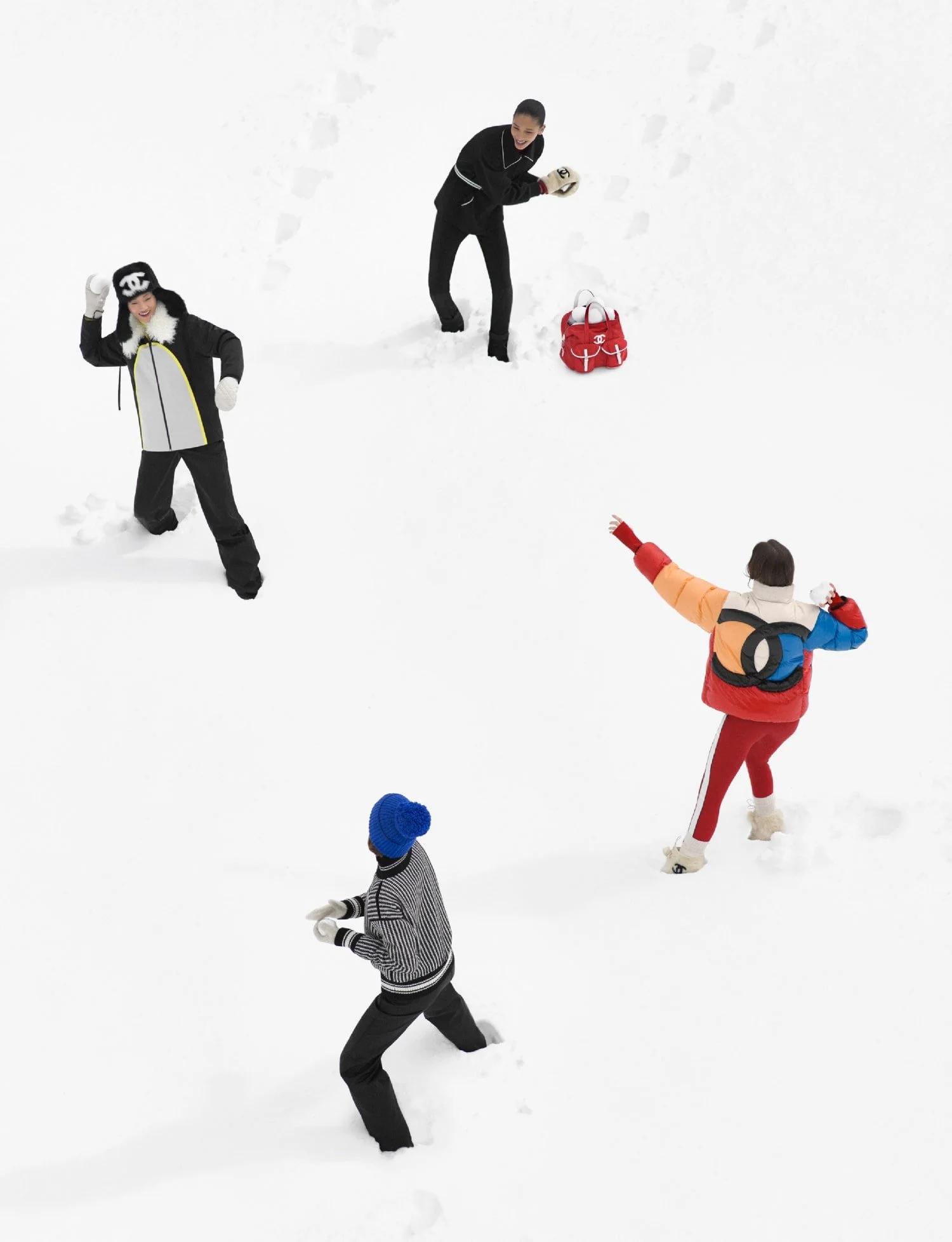
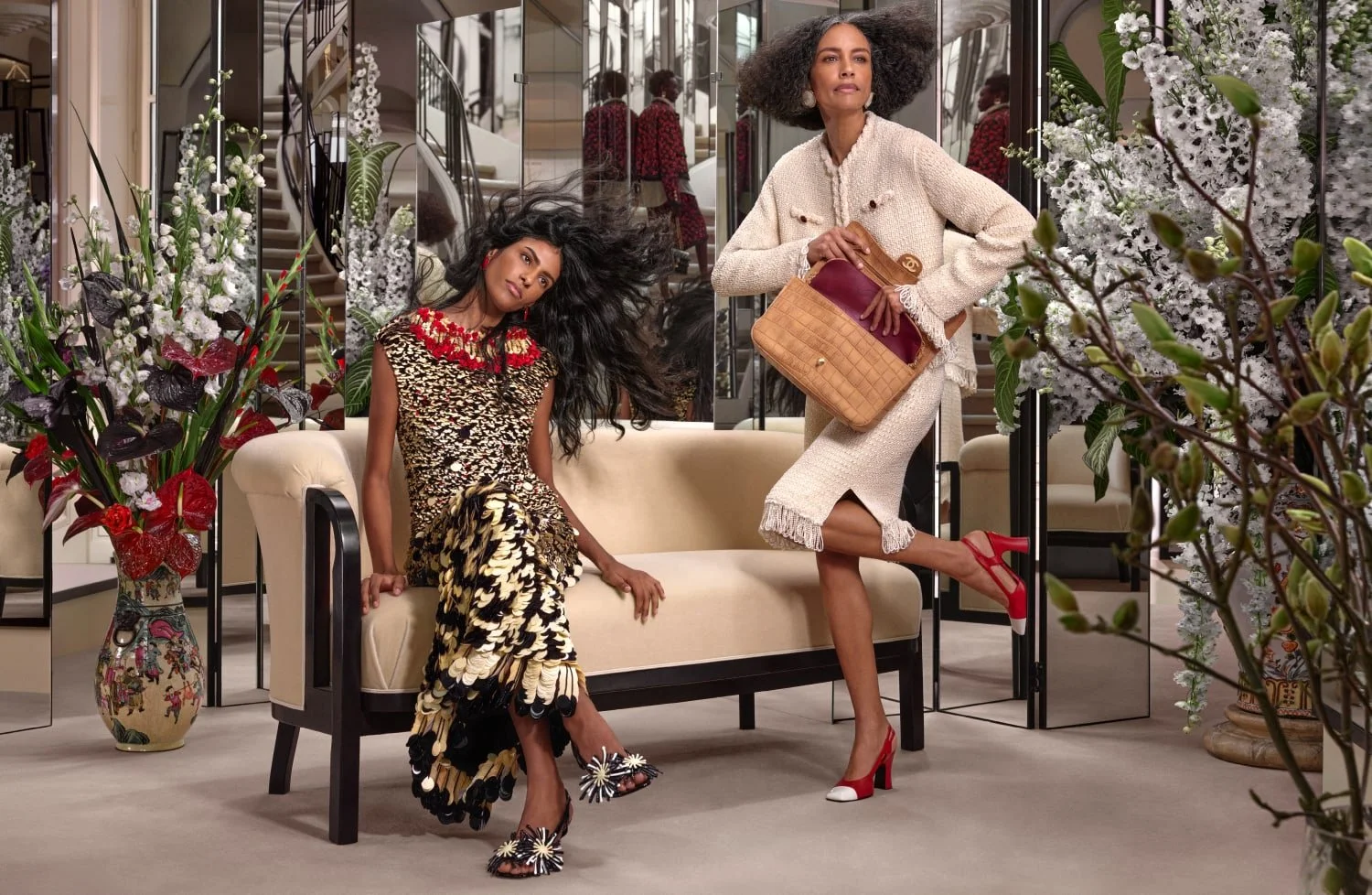
CHANEL CRUISE 2026/27

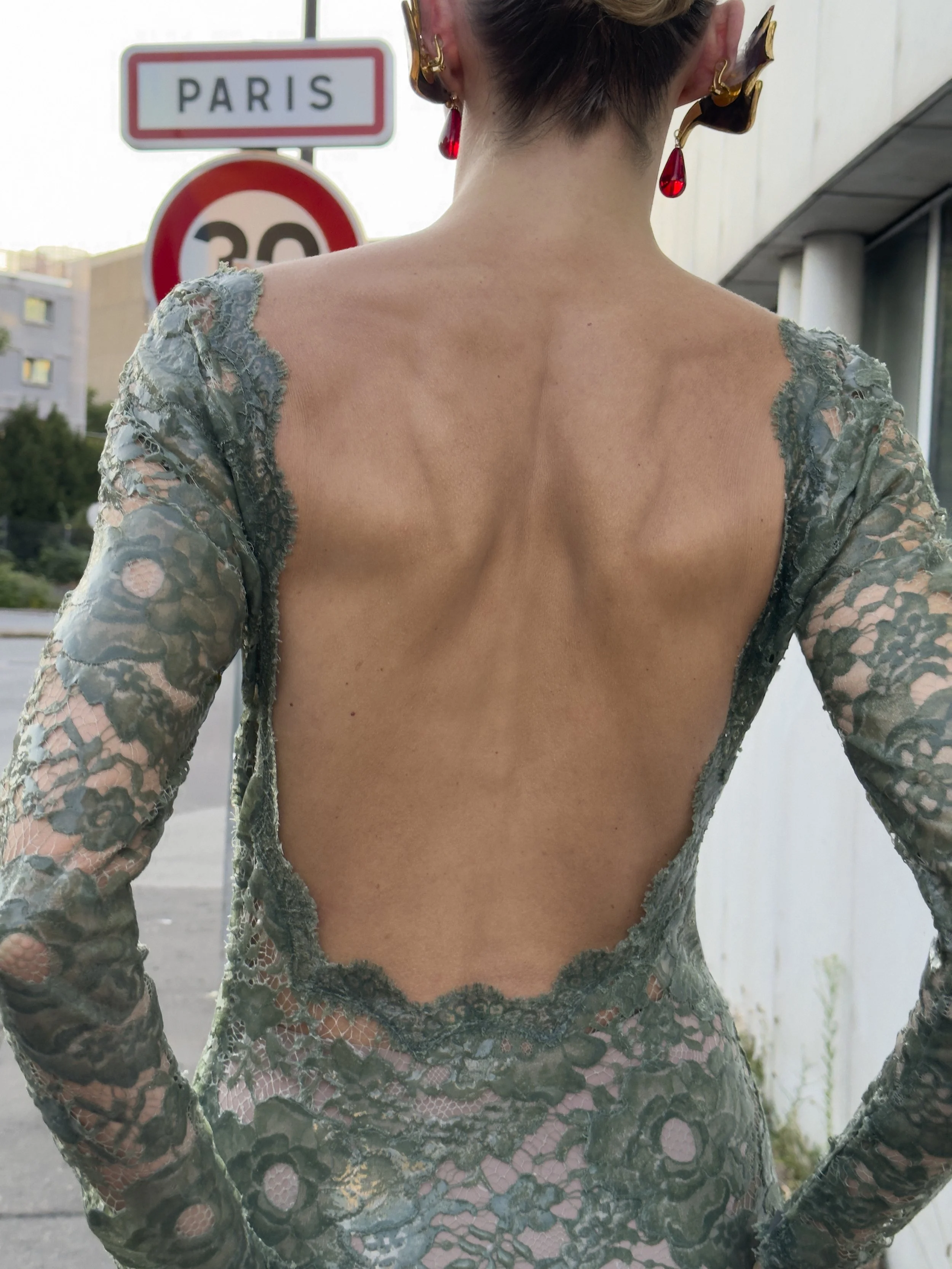
Ever since he joined Chanel, Matthieu Blazy has been tracing its founder’s footsteps. It makes sense, then, that for his first cruise collection for the maison, he would stage the show in Biarritz. Rue Cambon, for all its might in Chanel’s mythology, is perhaps second to the seaside town where Gabrielle Chanel first envisioned her brand.

Not that Blazy is the first to unearth Biarritz from the brand’s history. Spring/Summer 2003 was Karl Lagerfeld’s interpretation of its significance (where surfboards matched the giant glossy CC in the centre of the runway), while as recently as Fall/Winter 2024, Virginie Viard staged a show on a beachside-inspired boardwalk.

Blazy is not as campy as Lagerfeld or as literal as Viard. Instead, he takes the maison’s history as his muse, starting the show with its most distinctive symbol: the LBD. An almost exact replica of the garment that inspired Vogue’s 1926 title of “Chanel’s Ford” appeared on the runway. With the dropped-waist silhouette revived in all five of Blazy’s Chanel collections, the dress was the first to walk down the salon-inspired set. The 1920s inspiration continued in swimming caps, Art Deco jewellery, and handkerchief dresses.

Staples of Blazy’s Chanel were present in voluminous skirts and textured sets, the latter of which drowned embroidered flowers in light feathers and tightly packed textile petal edges. Graphic logo details in silk blouses and pleated skirts are both new and dearly welcomed to Blazy’s lexicon. Accessories were undeniably delicious, from the barefoot heel caps that have taken over my feed to the waterproof flap bags and the practically model-sized raffia bags with enlarged CCs to raffia clutches.

Blazy’s tracing mythology in more than one way. Mermaids filled the pre-show teasers (as well as the shell necklace that served as the show’s invite). Unsurprisingly, they reemerged on the runway, inspiring the two closing looks. The first, a jacket and shirt set with a matching bag – another one of Blazy’s signatures – layered shiny, fiery scales over one another, while the second featured pebbled shades of blue on a dress with a dramatic, scalloped back. Once again, the designer proves that his greatest strength is his balancing act. Blazy’s Chanel is as complex as it is easy-going, as fantasy-filled as it is wearable. Storytelling is woven with wearability in a cohesive gesture.


Words by Pedro Vasconcelos

ABRA FW26

This season, the ABRA show was an extra-special family affair. The starting point for the Fall/Winter 2026 collection, presented in an industrial space in the 11th arrondissement of Paris, was disarmingly personal. The time the designer Abraham Ortuño Perez spent in the studio with his niece and nephew (side note: how lucky are they to have such a cool guncle!) seeped into the process, leaving traces in the form of doll clothes, school craft projects, and spontaneous material combinations scattered across the workspace.

What began as a pleasant background noise gradually shaped the collection’s striking language: exaggerated details, layered silhouettes, and playful proportions that feel instinctive, rather than engineered. Velour cocktail dresses featured chest constructions reminiscent of plush club chairs, while a lavender mini appeared as an avalanche of swinging leather fringe with every step. The show’s standout looks –  in gold and black leather – can only be described with justice as a fantasy on car wash brushes ready to hit the town after dark.

Each look carries a small twist – an offbeat texture pairing, an unexpected construction – that mirrors the spontaneity of childhood creativity. Shirts are given jumbo-sized cuffs, while a deep V-neck blouse is decorated with rows of white collars. Ruffles spill out of an oversized navy blazer with big power shoulders. Elsewhere, a corset detail sat loosely at the hips of a flowing bubblegum-pink dress, tied with an XL satin ribbon.

As the designer took the final lap with his young collaborators, the audience erupted into an ultra-joyous wave of applause. Often in the industry, we lose the sense of fun in favour of unapproachability and putting too much focus on achieving undisputed refinement. Luckily, Ortuño Perez is here to show us that the most compelling fashion begins with curiosity and a refusal to grow up entirely. And with the recent announcement of his appointment as the creative director at CAMPER and CAMPERLAB, the play is just beginning. 


Words by Martin Onufrowicz

MIU MIU FW26

Miuccia Prada wants us to address our insignificance, or better said, to make us reflect on how small the human body is when compared to the size of the world. That was the premise behind Miu Miu’s Fall/Winter 2026 collection, Mindful Intimacy, which placed body and mind as refuge and objects of attention, particularly when existing in unstable environments.

“An ownership and agency of your own body, your own self and value – a warm sensuality, a warm sexuality. A focus on our bodies, our minds, ourselves, to which we must dedicate attention,” described the collection’s notes.

Not by chance, the interior of the Palais d'Iéna, the chosen venue, was turned into an enclosed forest with moss covering its regal floors. Both the palazzo and the staged woodland were chosen to convey feelings of magnitude – to the audience, it worked more as a reminder of our constant need to be close to nature, AKA to touch some grass.

Looking inwards, clothes were then designed using the body as a main basis, with enveloping silhouettes that outlined the figure with a more minimal, ‘90s-centred approach. Delicate bows, centrally placed in almost every presented look, resembled underwear details, with a lot of the pieces crafted prioritising a washed, soft, and sensorial feel, as though they’ve been comfortably worn before.

Mini dresses with square necklines and straight hemlines appeared in a muted palette, as did long-sleeved, micro nylon camisole-resembling garments. Opposed to the romanticism were more utilitarian pieces in robust fabrics such as leather and tweed, often designed with shearling linings and paired with gloves and aviator hats. Coats and jackets carried marks and crinkles, purposefully celebrating the past and a type of clothing that endures, a theme that lives close to Miuccia Prada’s heart and has been equally explored at Prada.

Speaking of endurance, Miu Miu’s bubble-soled footwear, originally debuted in 1999, made a key comeback for FW 26, ranging from trainers to clogs and knee-high boots. The idea of the antique, the season’s press release also stated, was “not about the passage of history, but about existing within times.”

Embroidered sheer tulles and decorated dresses, both Miu Miu signature codes, appeared more towards the end of the show, which had a much-needed multigenerational casting and included legendary supermodels Kristen McMenamy and Gemma Ward. Ultimate it girl Chloë Sevigny was also one of the models, over 20 years after the first time she walked a Miu Miu show, during Spring/Summer 1996. The final strut was delivered by actor Gillian Anderson, wearing a fully embellished nude number paired with a peach-toned bra peeking out in true Miu Miu fashion.


Words by Ketlyn Araujo
AGNÈS B. FW26

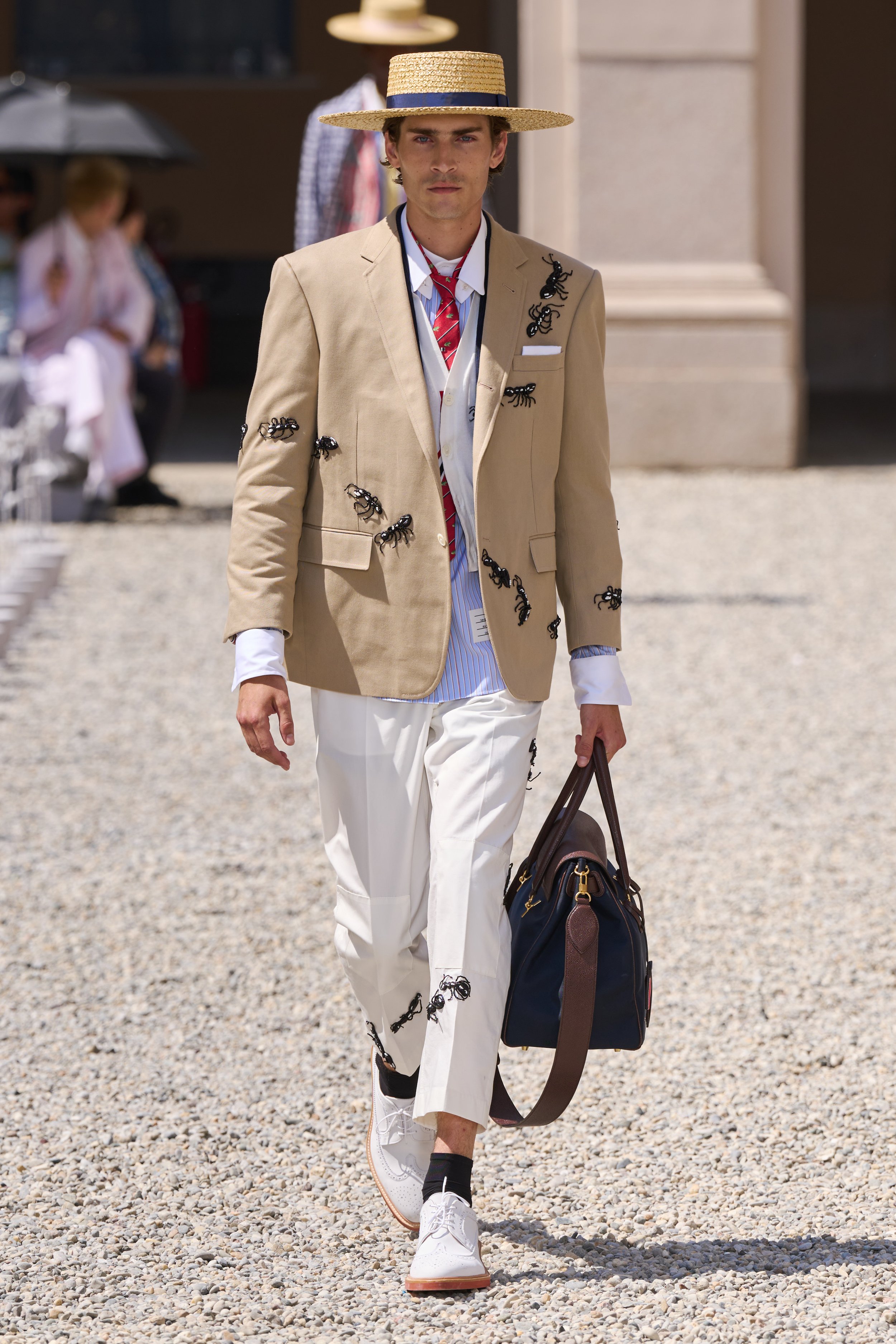
Presented at the six-story building that has housed the brand since the ‘90s, agnès b. introduced a collection with clothing for all the occasions in life: practical and deeply tied to everyday city realities. A refreshing casting of models of all looks and ages reinforced the brand’s commitment to breaking stereotypes and refusing to conform to outdated beauty norms.

Stepping away from classical femininity, the designer created silhouettes that feel genderless yet deeply tied to menswear. Black and white are present in effortless styles, from striped tops to relaxed tailoring. But this time it’s the prints and colours that take centre stage in the collection. Each of them follows contrasting narratives, creating an energetic pace on the runway — from lizard-print tops to sunsets printed on jackets. As for tartan, it is modernised and styled in suits, pencil skirts and hoodies.

Garments don’t hug the body in a restrictive way; instead, they leave space for movement and breathing, privileging silhouettes that are straight rather than fitted. Fabrics feel soft on the body, contributing to that movement.

Masculine and feminine are aligned within the same aesthetic, leaving little space for division and instead complementing each other naturally. There is, however, a reappropriation of male codes by womenswear through tailored suits, coats, trousers, tracksuits and ties, blurring the lines between traditional gender restrictions.


Words by Carolina Benjumea

CHANEL FW26

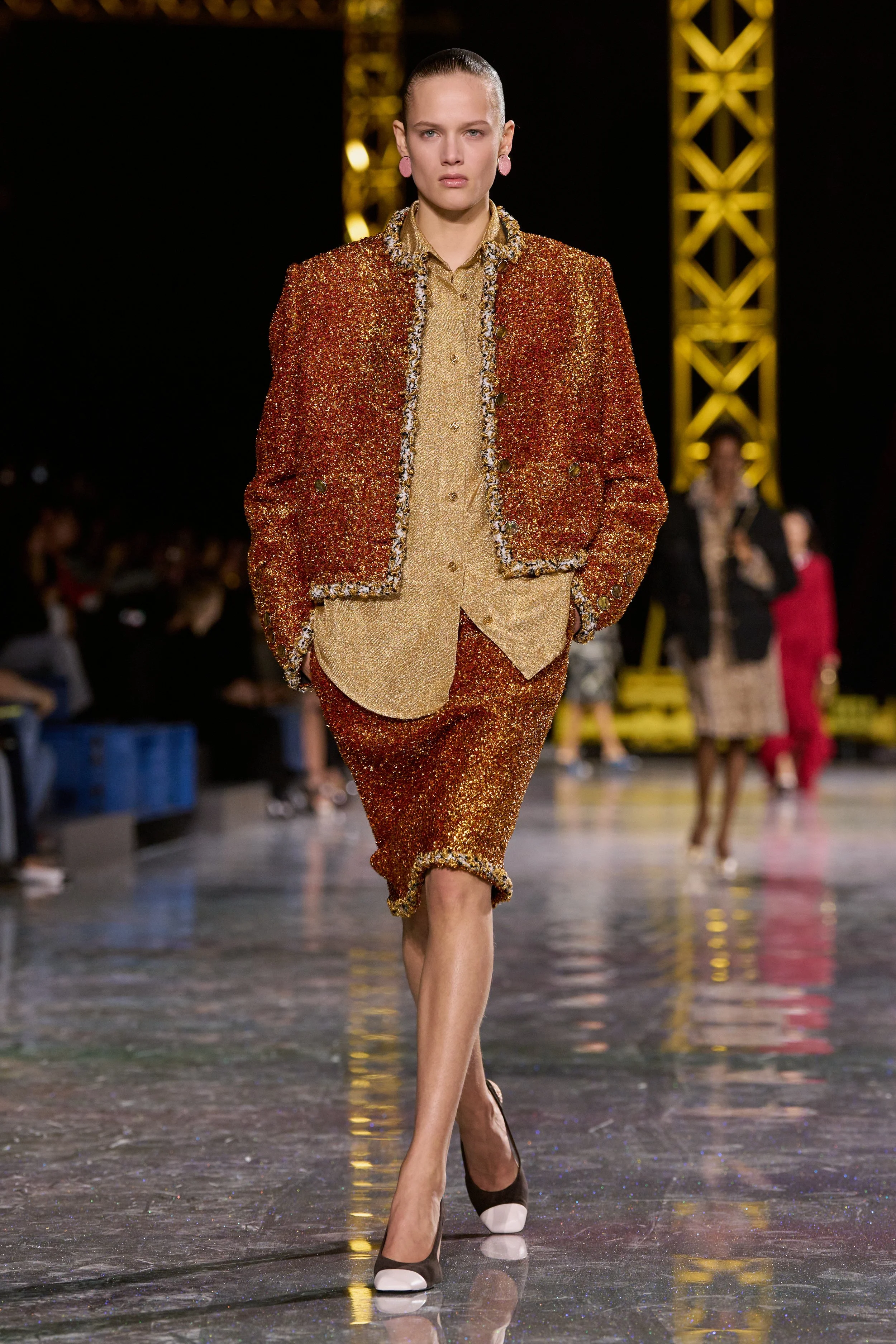
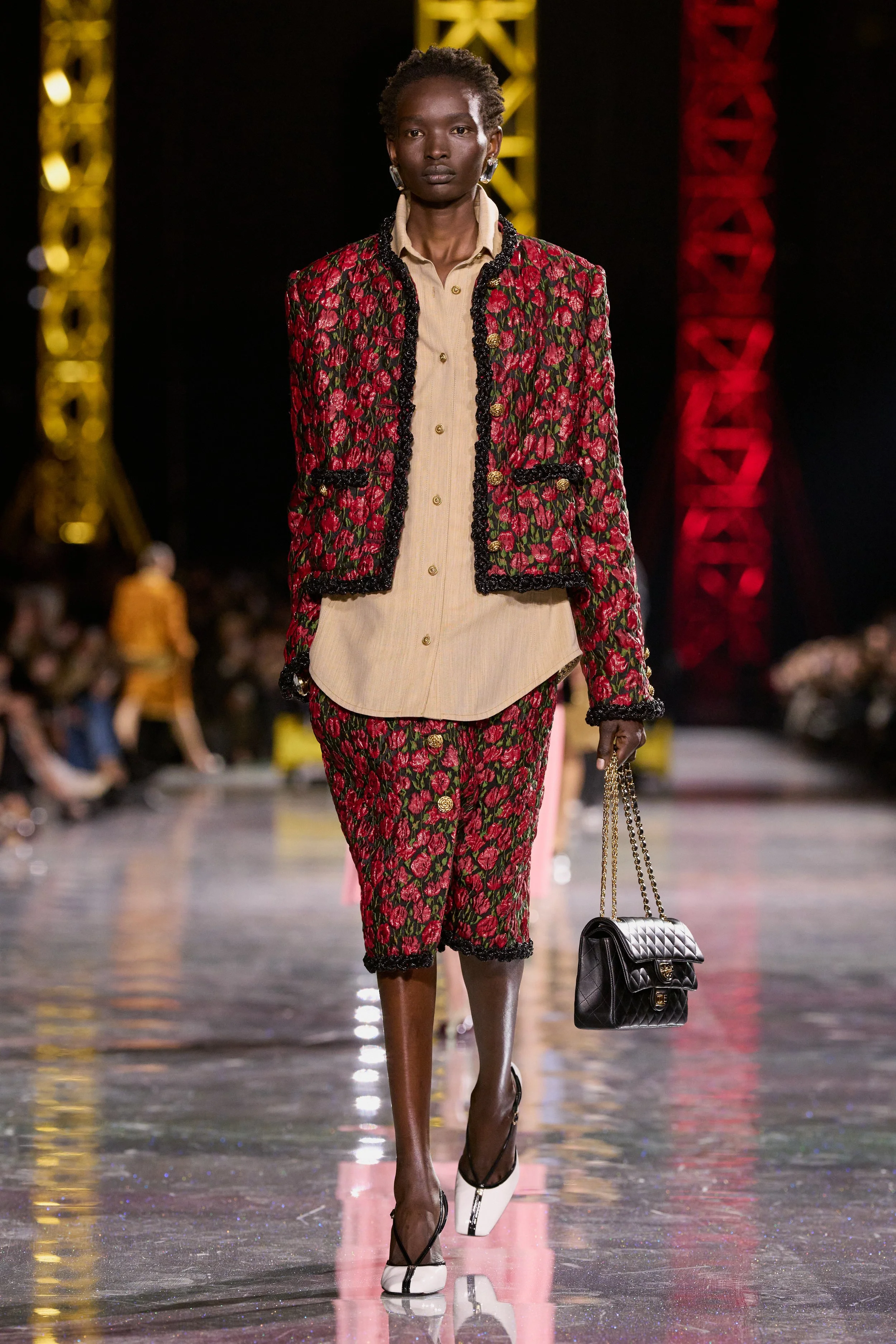
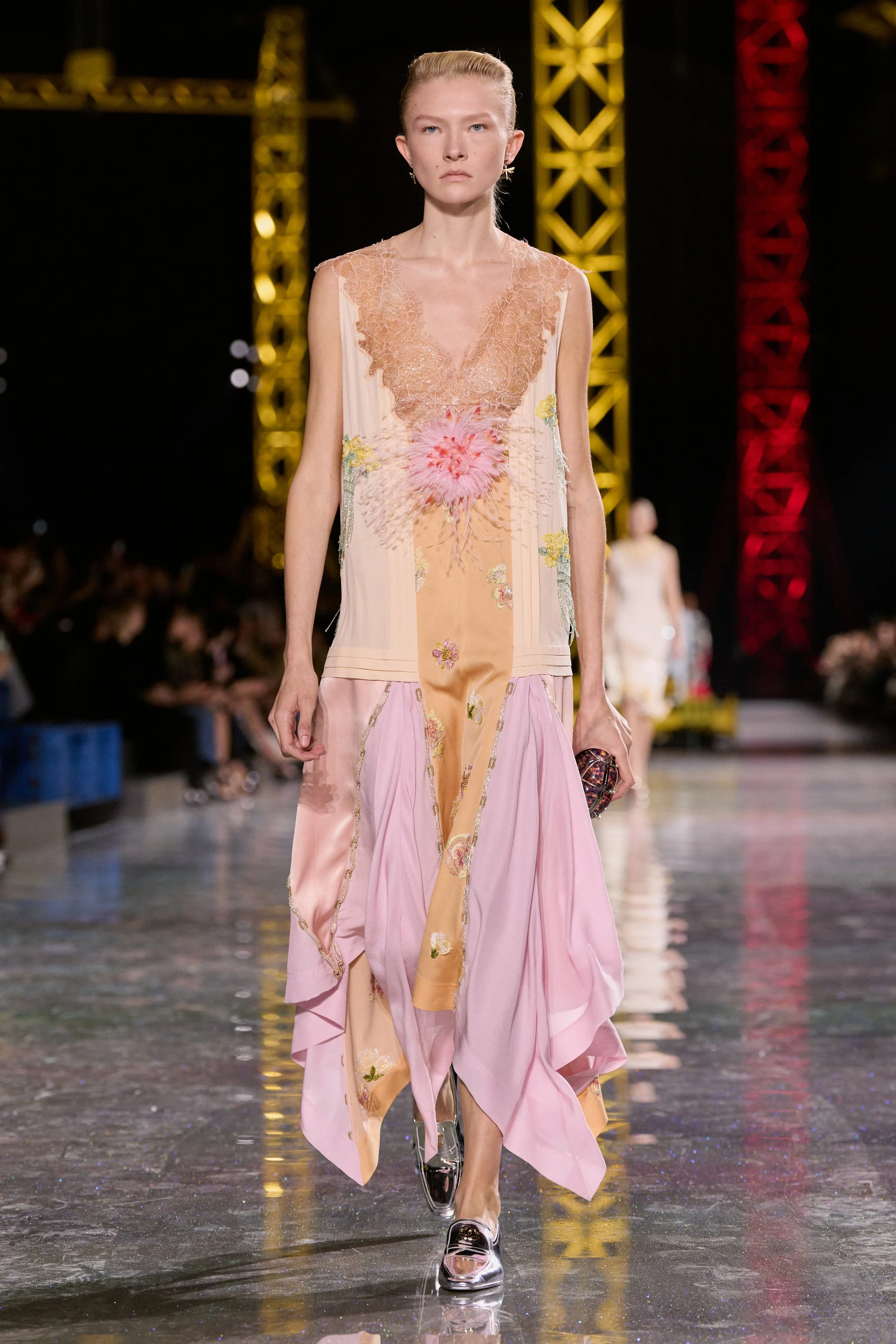
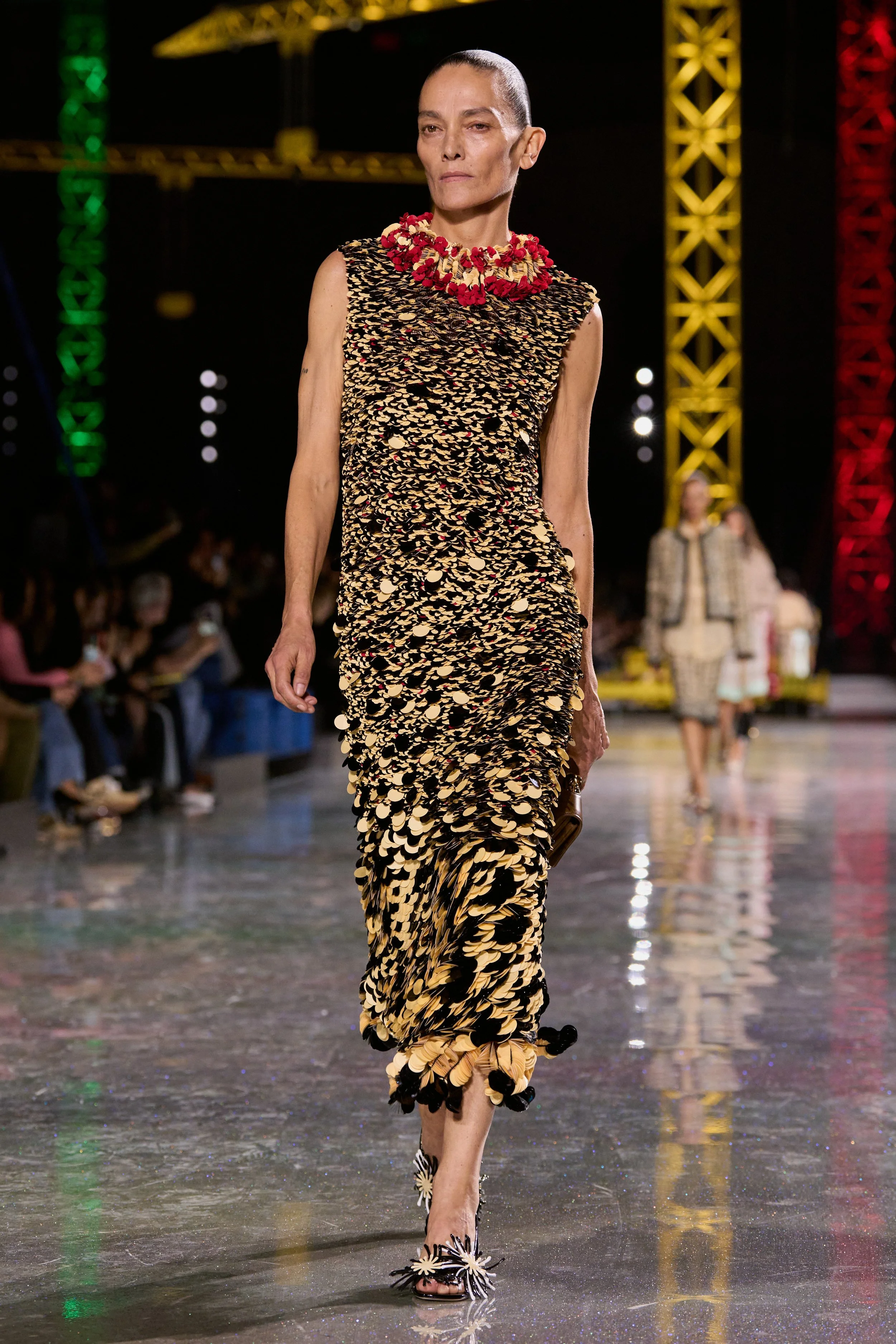
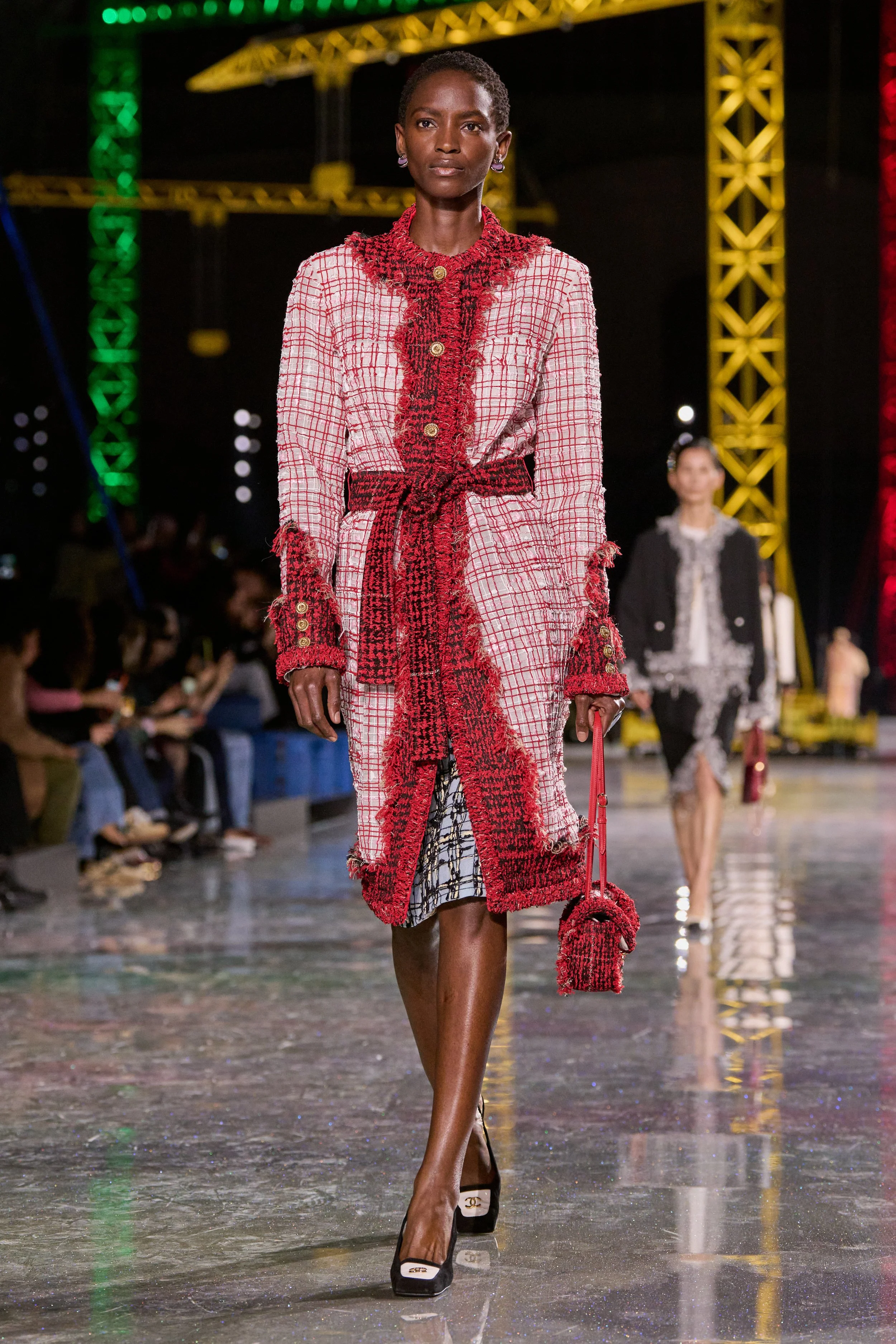
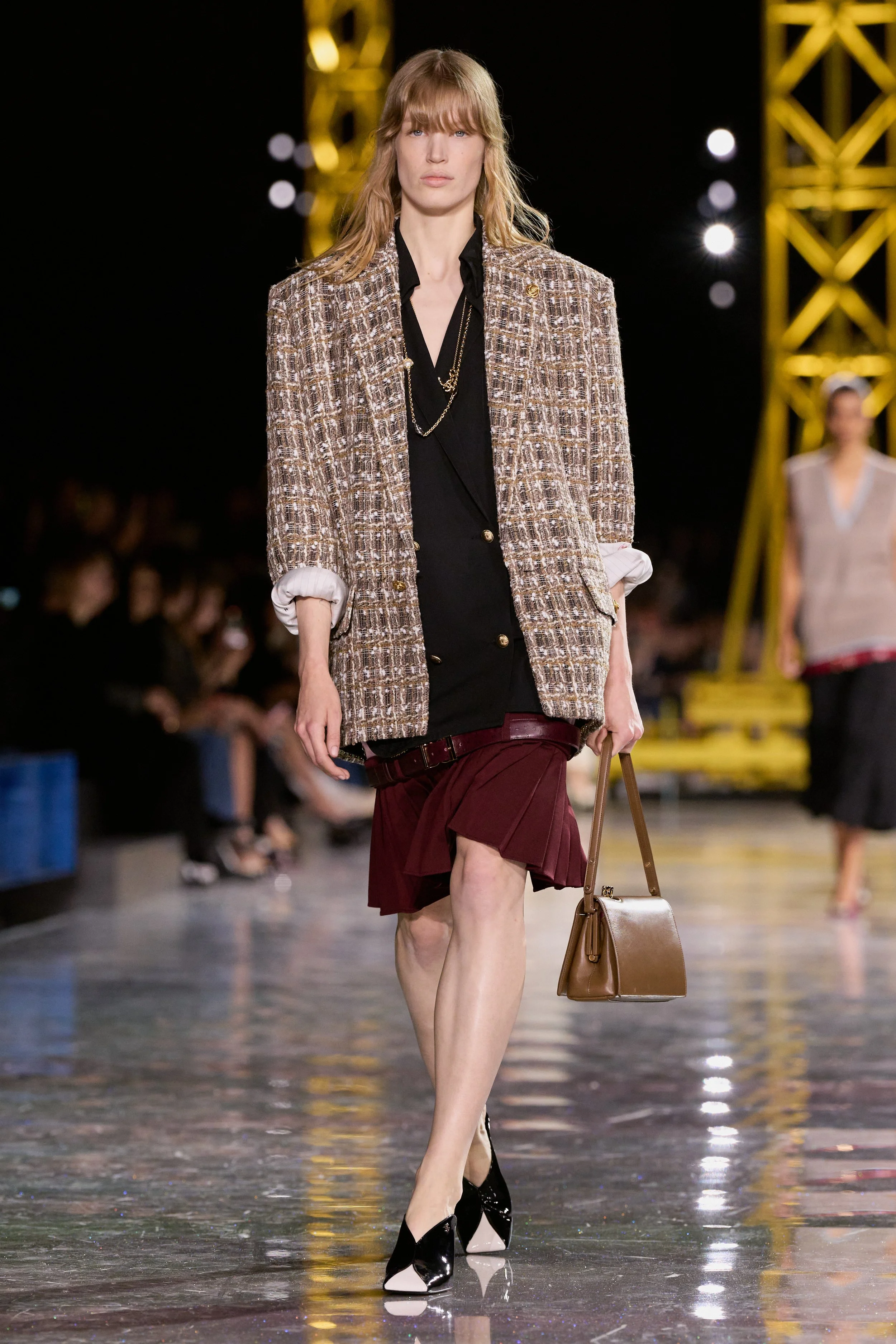
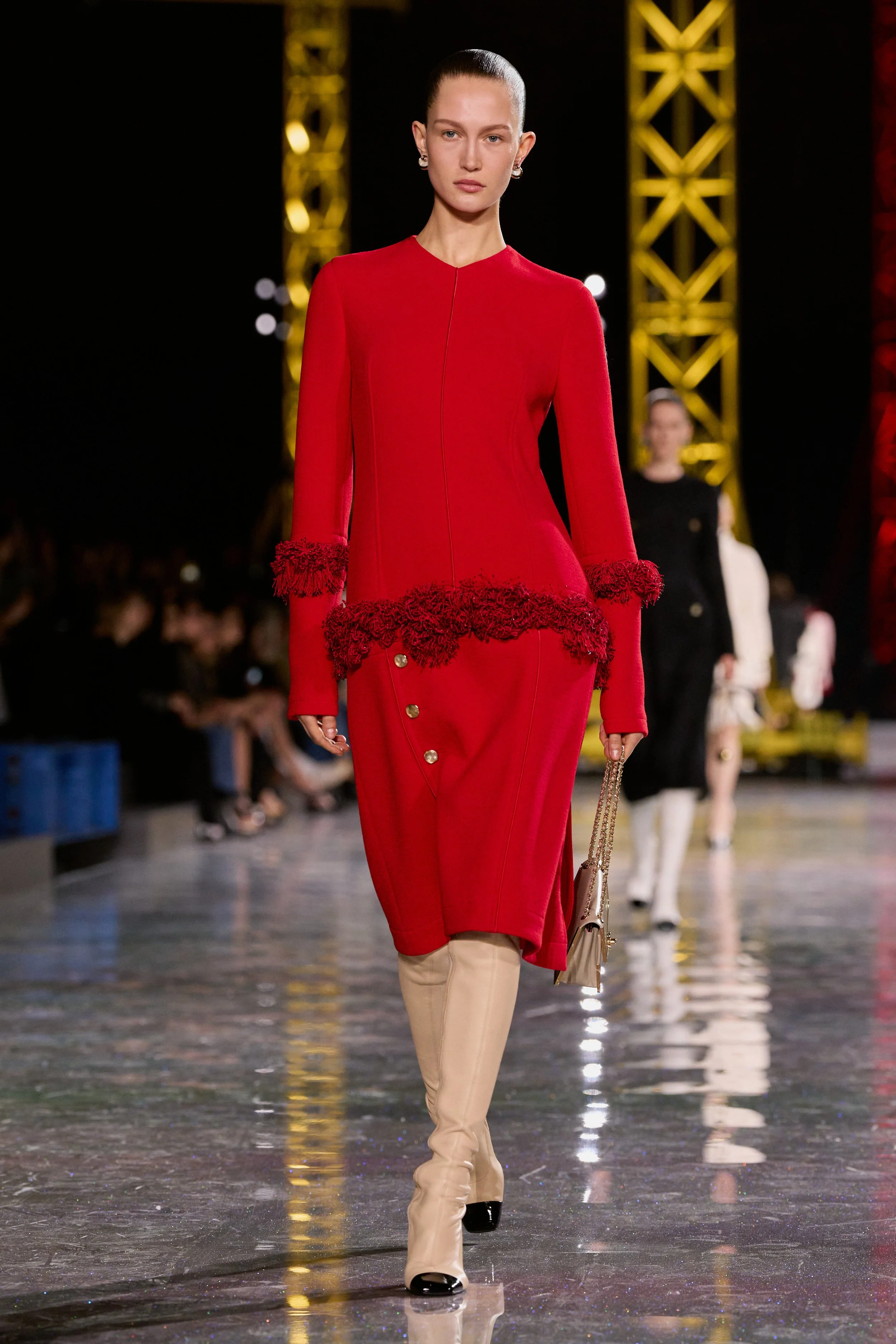
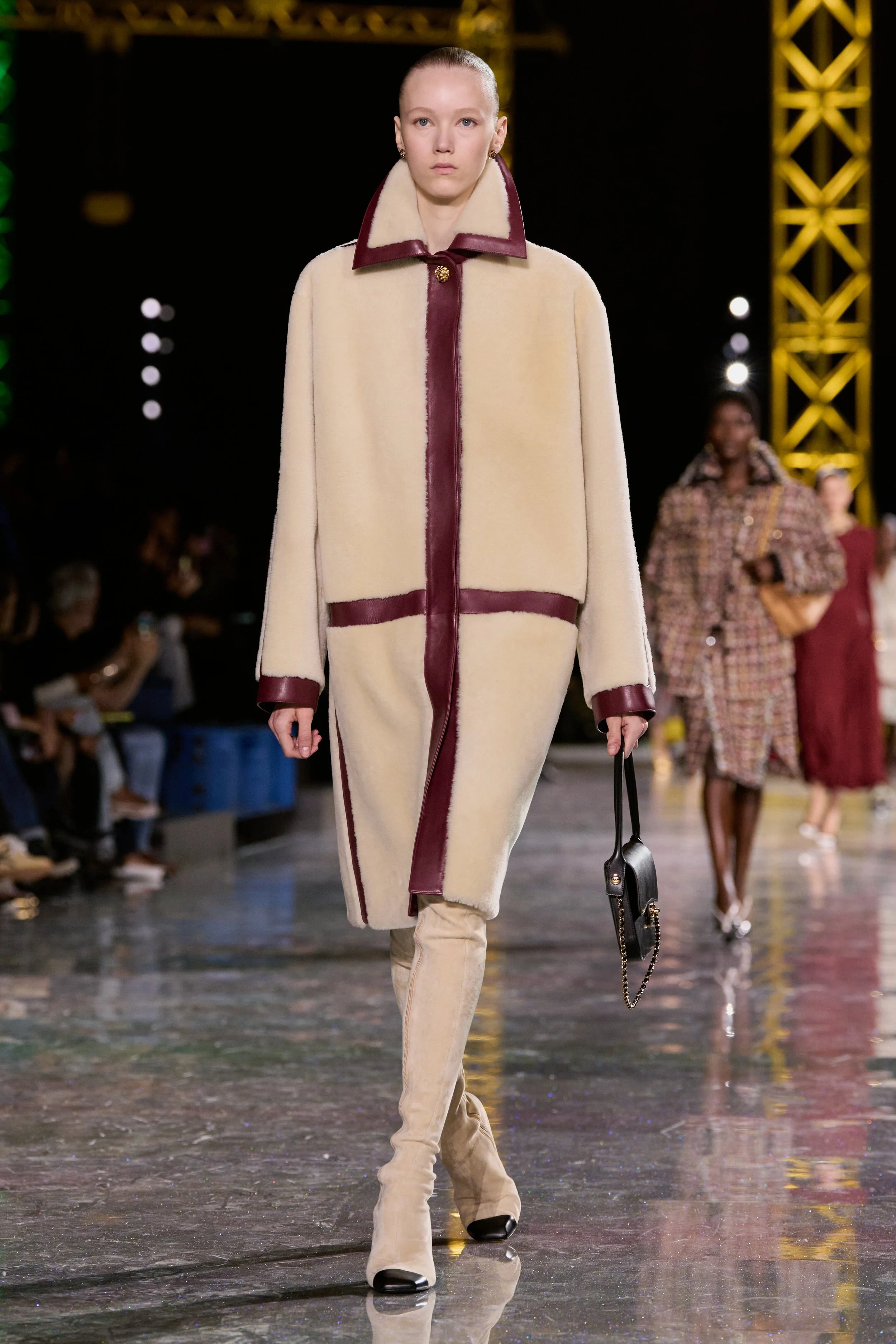
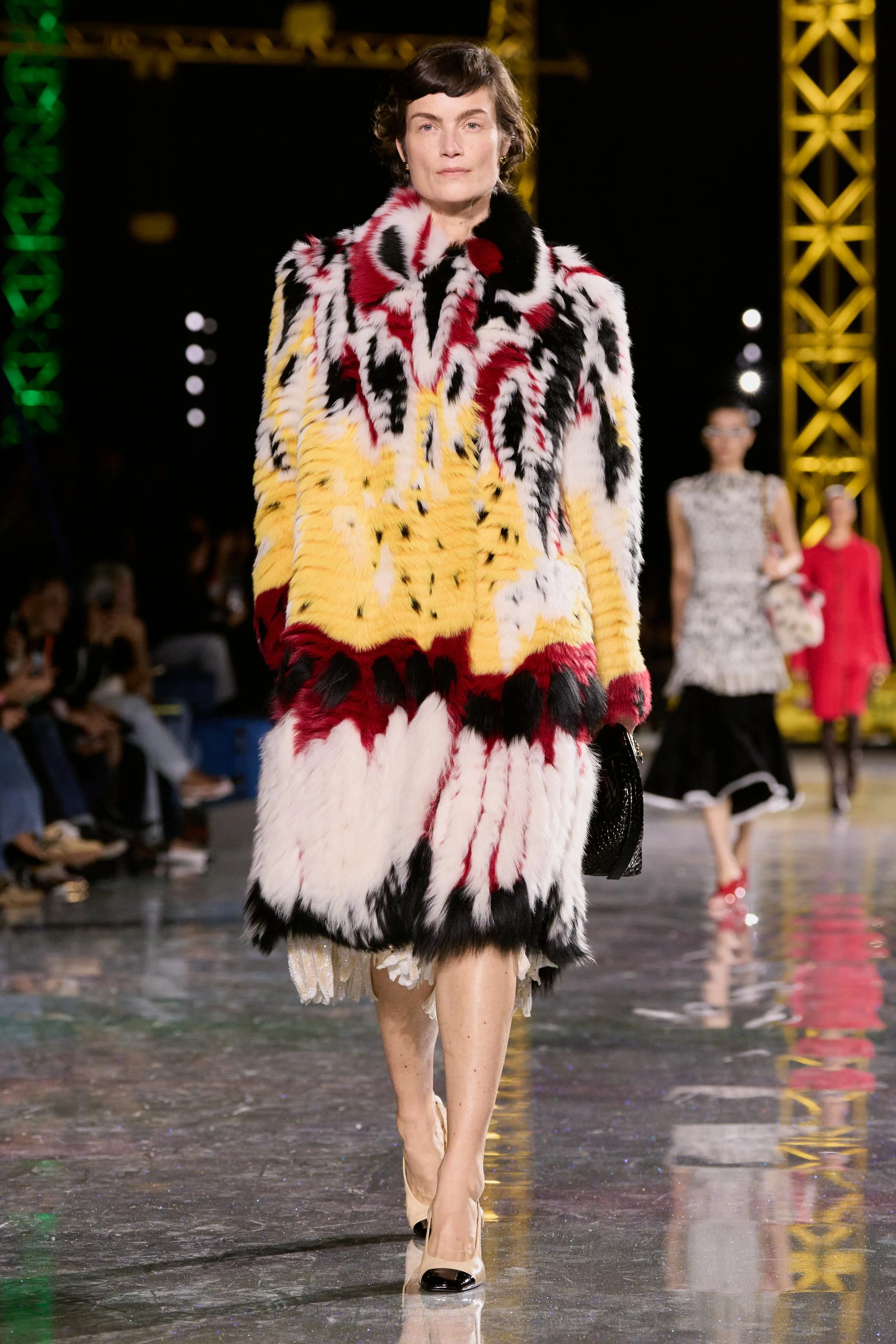
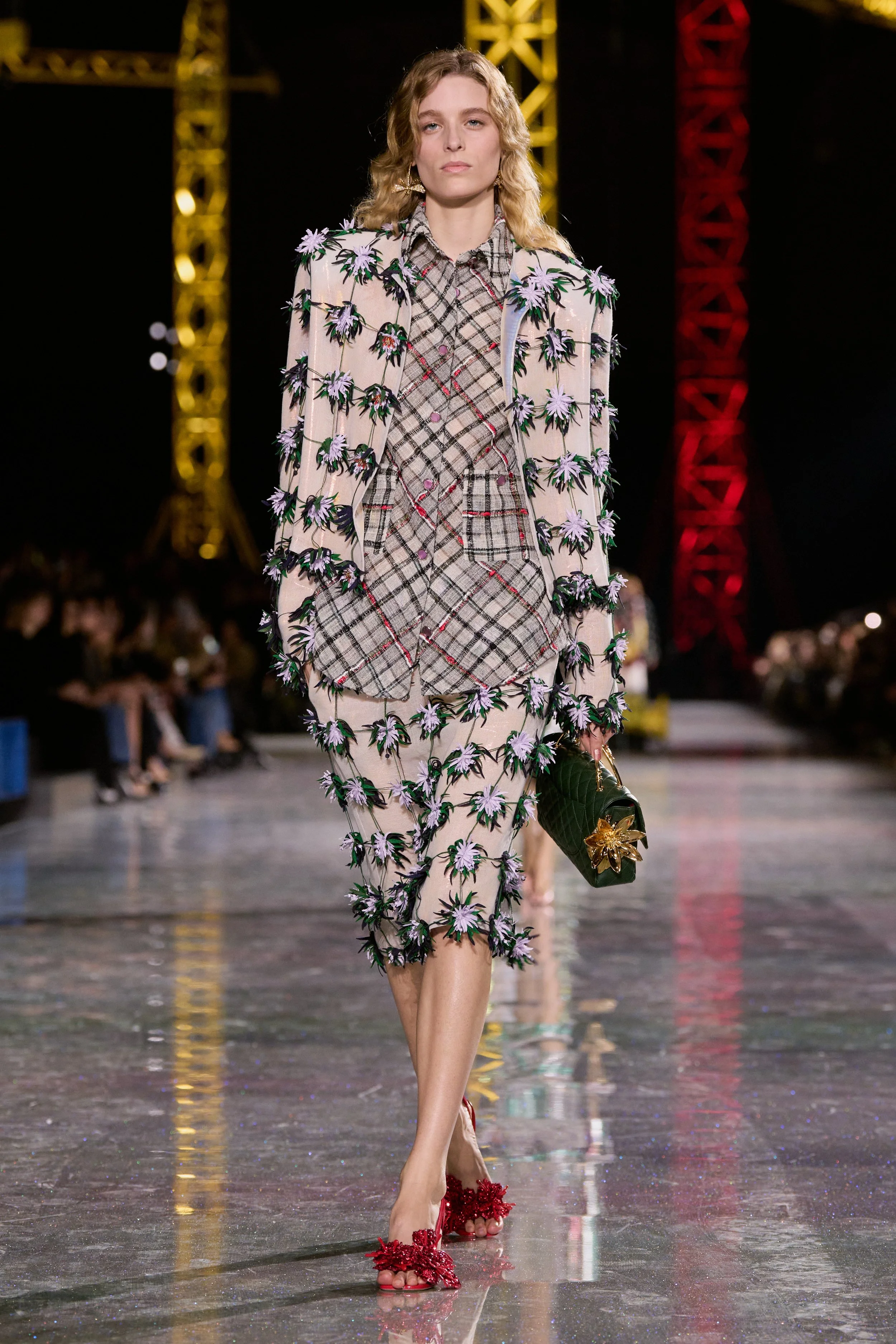
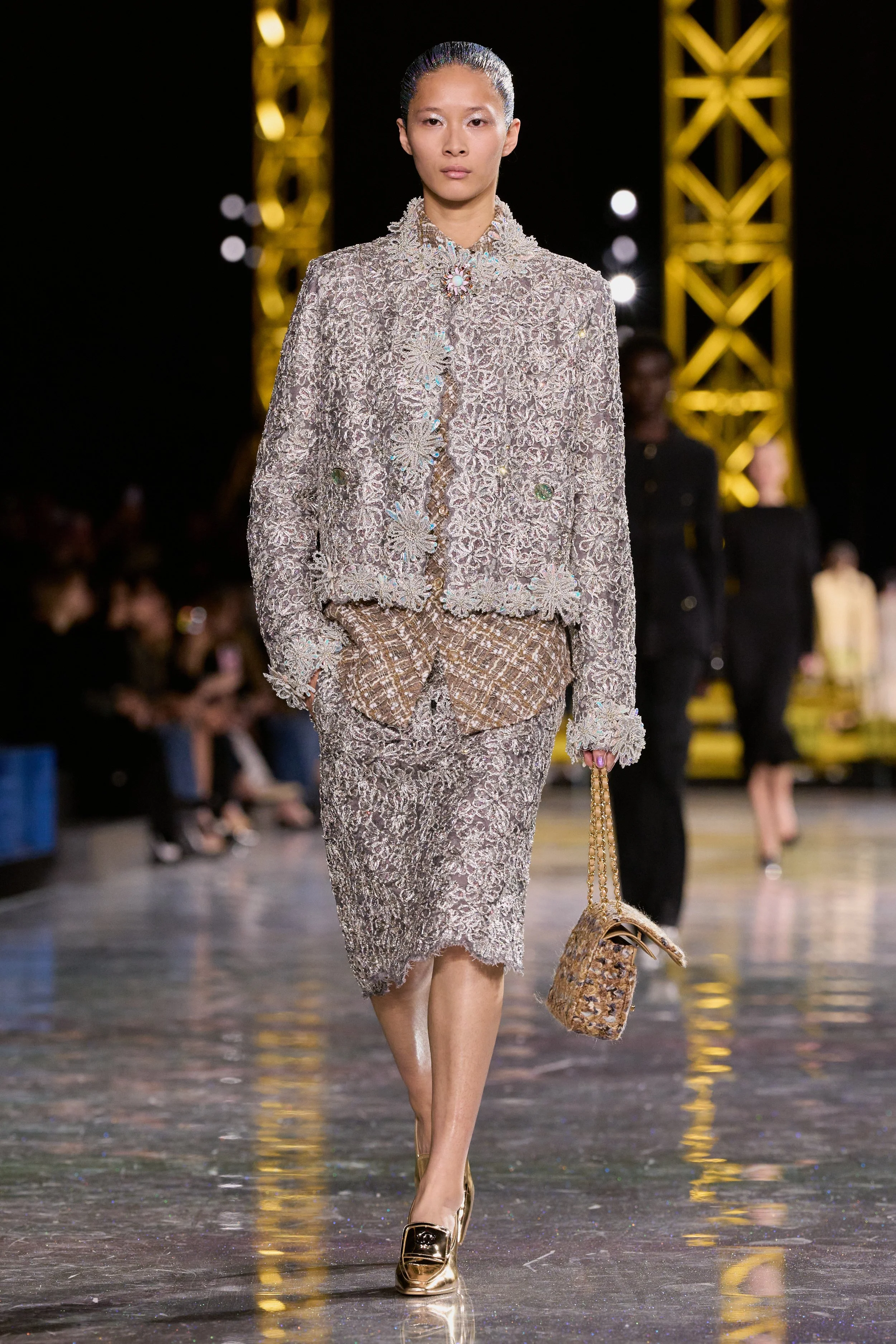
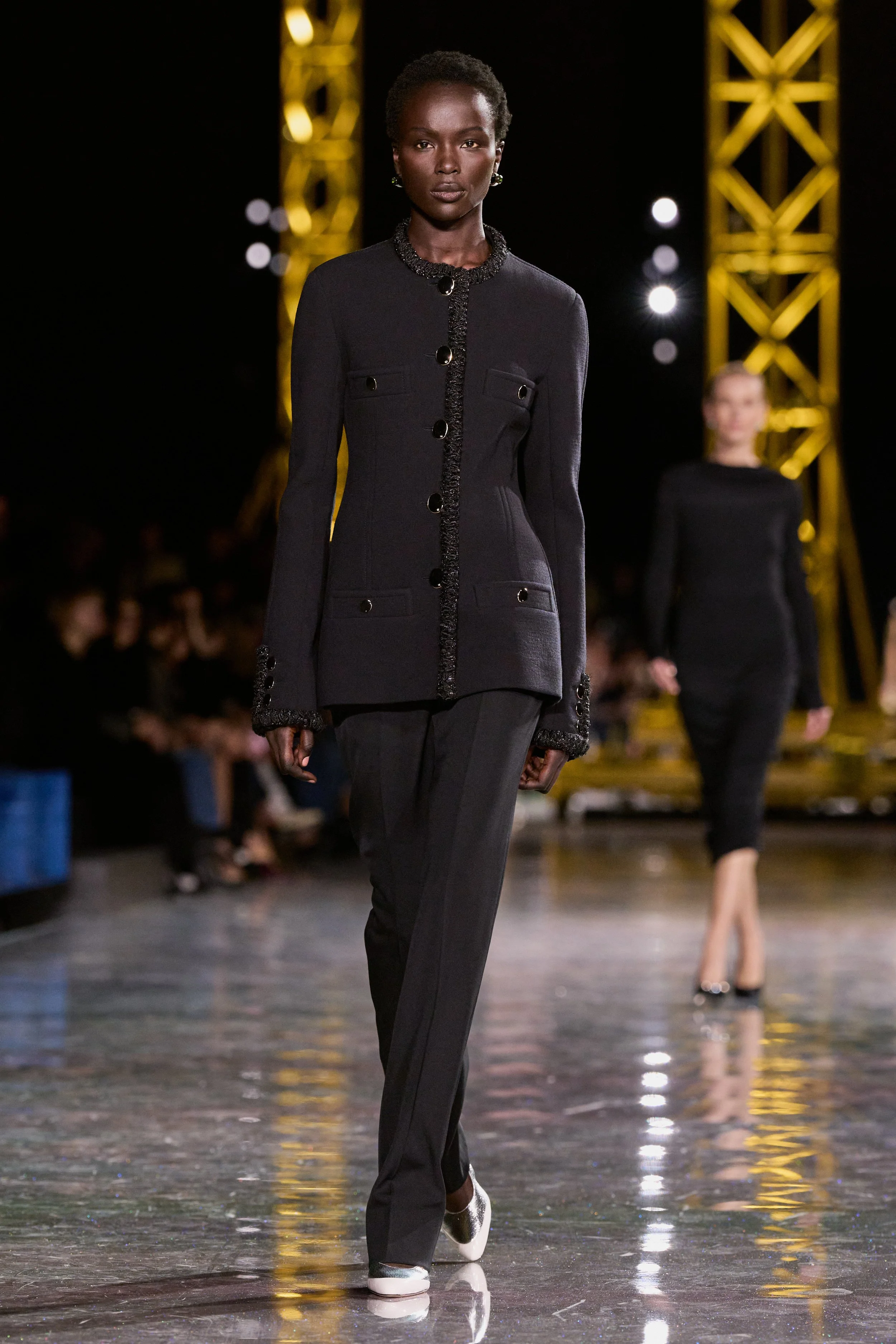
Moments before the Chanel Fall/Winter 2026 show, I’m told the set that transformed the Grand Palais into a colourful construction site reflects Matthieu Blazy’s mindset this season: he was thinking like an architect. In truth, he’s been doing that since his first day on the job. When you inherit a house as historic as Chanel, some remodelling is only natural. Codes must be upgraded, silhouettes need new upholstering, new references beg to be explored. Still, the bones must be respected. God knows what would happen if they weren’t, when the entire world appoints itself architecte des bâtiments. Not that we need to worry. For all the change he has brought to the house in just four collections, Blazy’s Chanel is nothing if not devoted to legacy

Gabrielle Chanel, both the founder of the maison and a recurrent muse of the Belgian designer, is seen in 1930s-inspired pieces, like embroidered silk dresses, that, at the hip level, jolt strips of fabric cut on a bias. Blazy isn’t creating historically accurate garments; he’s establishing a conversation. The dropped-waist silhouette that we’ve seen him toy with since his debut evolves. This season, he belts skirts closer to the hem than their natural waist, further highlighting the silhouette. Imaginary waists are created on the upper thigh with loops through which leather belts slide.

A flower-printed set shines in a way that almost resembles leather despite being cotton. The effect is achieved through a couture technique utilised by Chanel herself. Here, Blazy revives it for ready-to-wear. The dialogue between the two is omnipresent. If the founder of the maison sought to make clothes for women out of the practical fabrics, then exclusive to menswear, the French-Belgian answers in reverse, rummaging through Chanel’s technical lexicon to expand what ready-to-wear feels like.

At the re-see the next day, held in the same space (crates and all), I spent close to two hours navigating through looks. Translucent tweed, Pollock-esque silicone overlays, sequin-threaded knits, pastel chain mail, layered lurex, feather flowers, embroidered silk, washed linen, geometrically shaved fur, My Little Pony-inspired tweed blends: it’s hard to hyperbolise Blazy’s textile intelligence.

Even with all the imagination required to use this diverse scope of fabrics, Blazy doesn’t design for fictional, fetishised women. The silhouettes are made to be comfortable when worn. The classic tweed set is reinvented through that mantra, its jacket wider in the shoulders, roomier at the waist. The interior of a garment is as important as its outer shell. In certain jackets, the lining’s beauty matches that of the outside – quite a feat on garments made of pearl-threaded knits with encrusted fringes at the hem. These assume a more visible role in jackets made of razor-thin tweed, where their translucency offers a peek into the colourful lining.

The ability to create pieces that are as special as they are wearable is where Blazy is most successful. Beyond critical acclaim and artistic satisfaction, the designer is making something that people want. To have been in Paris in the first week of March is to have heard of the chaos that followed the release of Blazy’s debut collection in stores. You couldn’t go somewhere without overhearing the struggle to purchase even just one pair of shoes or a bag. We predict a similar despair in six months, when Fall/Winter 2026 hits the stores. Here, Chanel’s legacy is a first step on whimsical adventures. The black toe squares off in a pair of thigh-high boots. The idea is pushed further in pumps, with the toe shaped like a waxing moon, inspired by the dipping of madeleines in chocolate. The same philosophy is applied to bags: crocodile-embossed patent leather totes, a hybrid of Chanel’s double flap and the 2.55 with two buckles, and a metallic tweed oversized classic flap bag.

On the night of the show, guests wore new season bags just as they did the slot machine or spaceship bags. Somehow, even among the maison’s most recognisable pieces, Blazy’s creations felt at home. He’s not distancing himself from the past; he’s not tearing down walls. He’s breathing life into a house already alive. Chanel is both past and present, and in his hands, it becomes urgent again.


Words by Pedro Vasconcelos

LOUIS VUITTON FW26

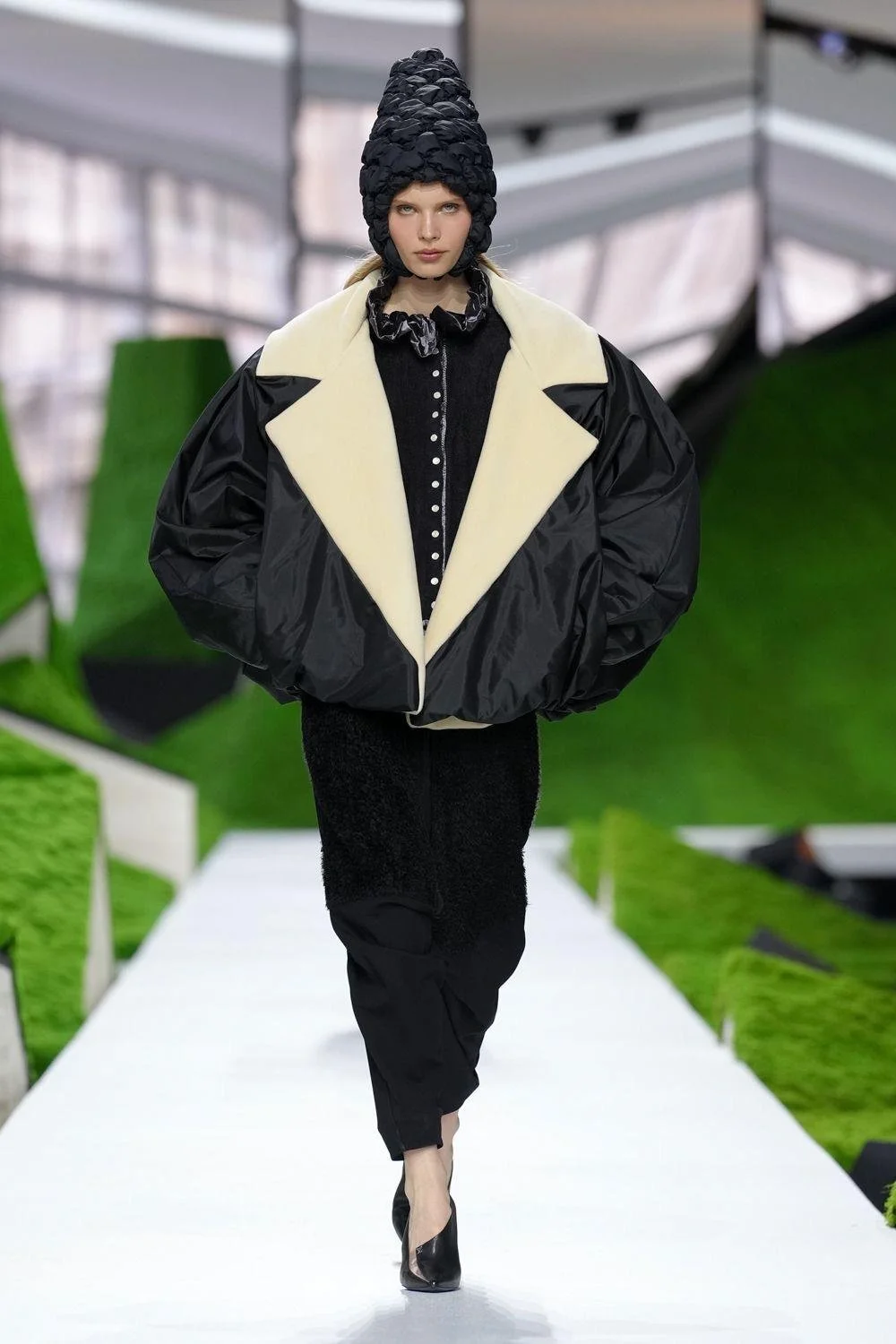
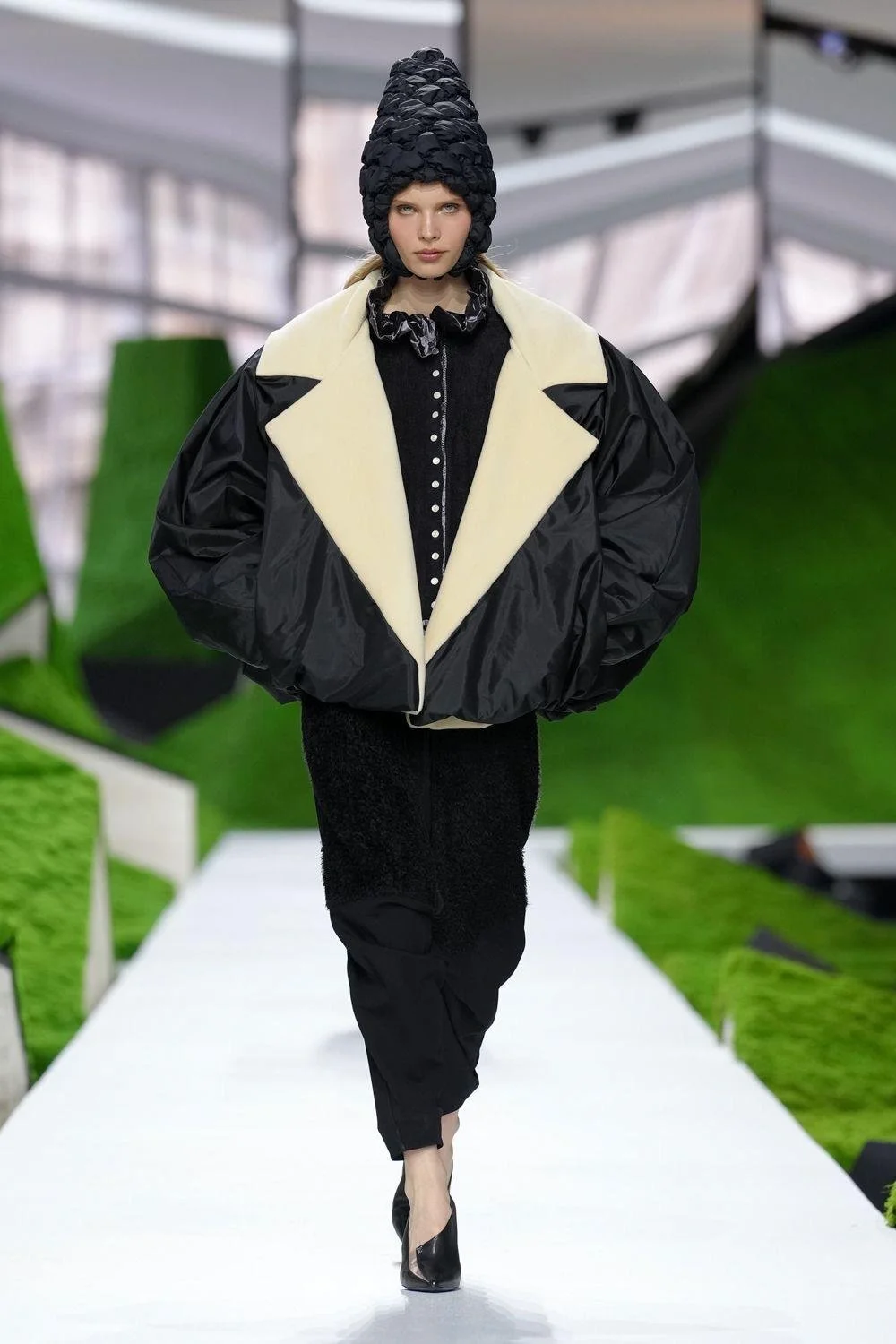
A pilgrimage, a journey, a mission. Perhaps a search for whatever seems to be missing in an ultra-connected, AI-pushing society. For Louis Vuitton’s Fall/Winter 2026, Nicolas Ghesquière focused on a travelling quest, where the magnitude of nature and multiculturalism inspired enduring clothing silhouettes and were equally translated into protective gear and fabric choices.

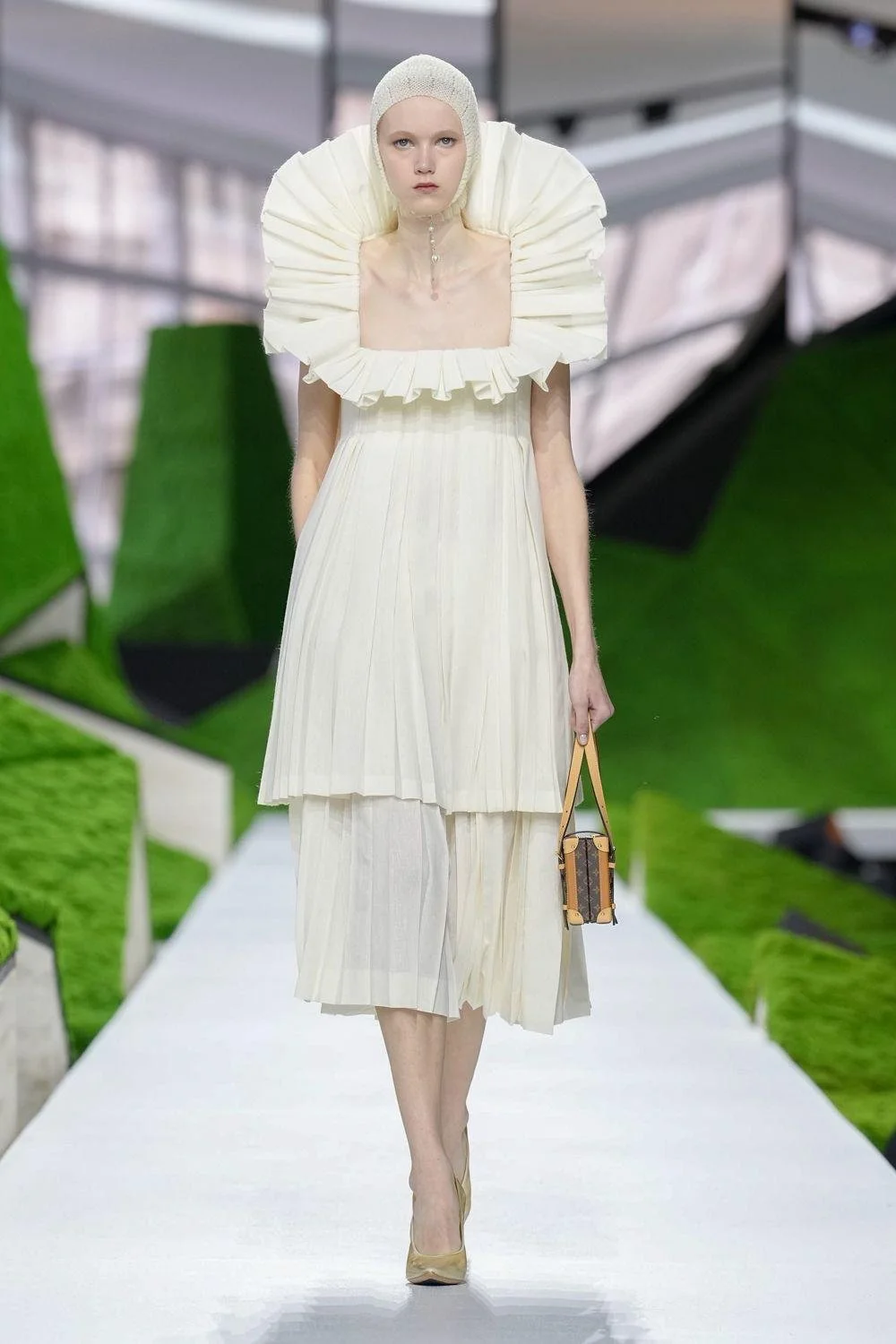
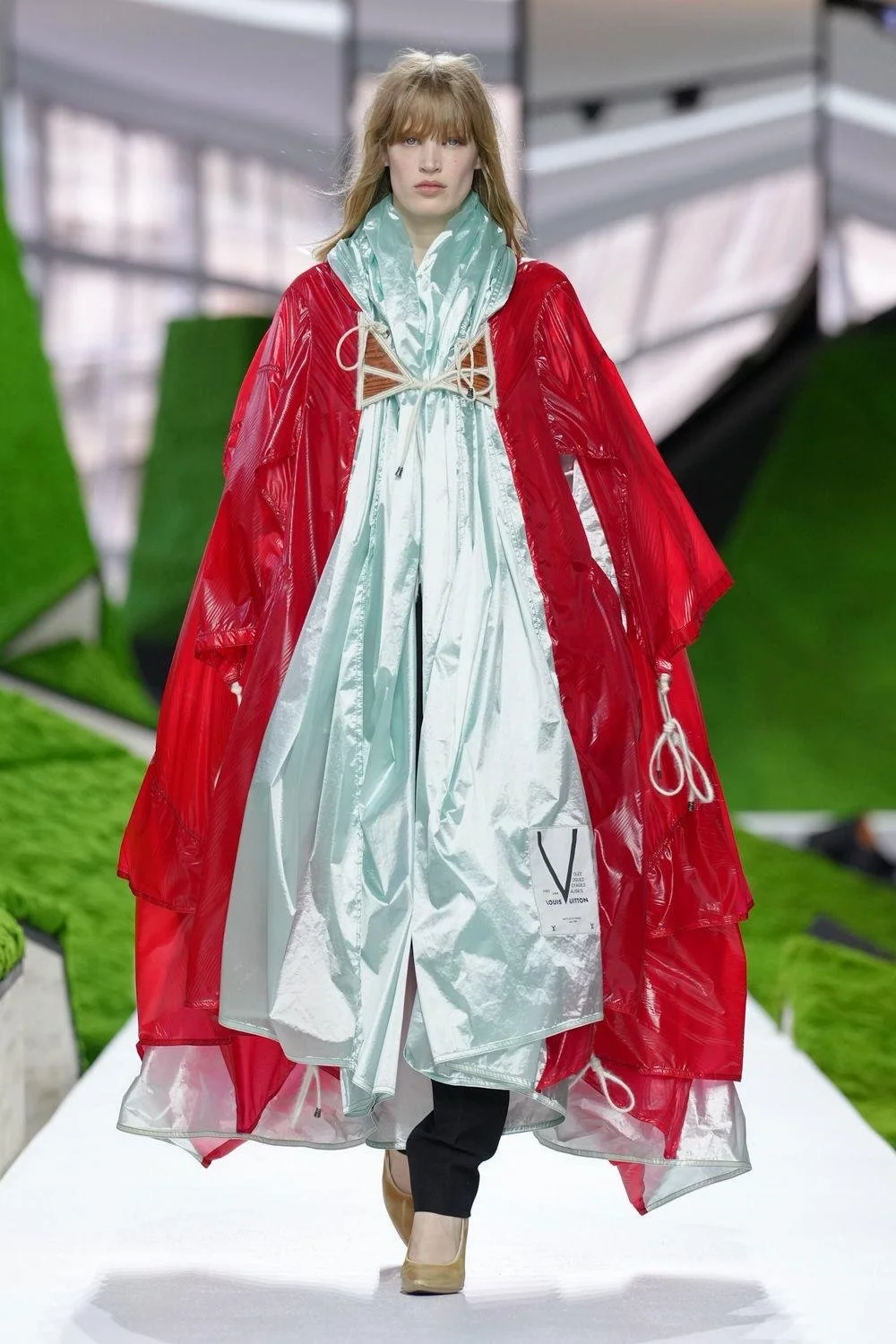
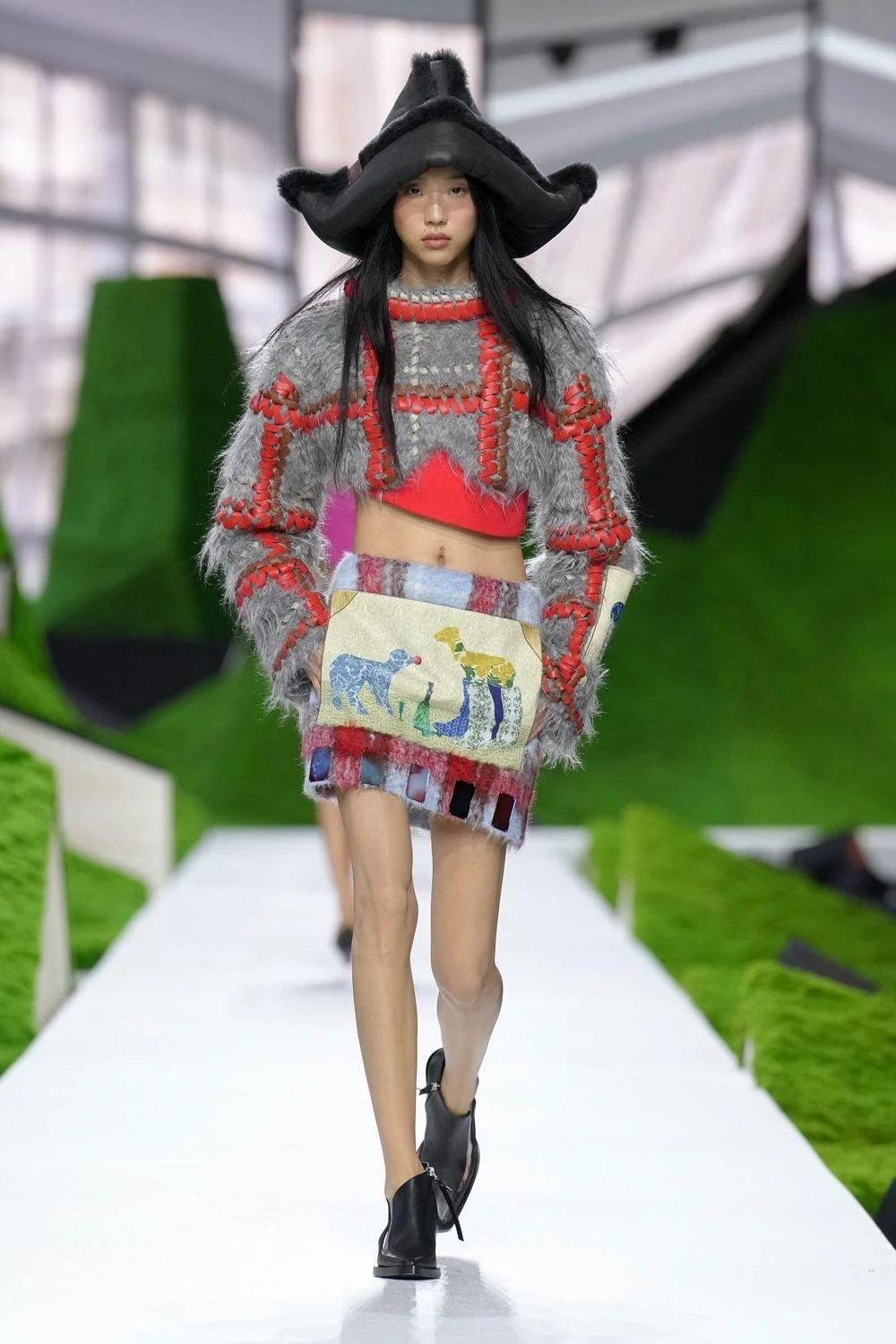
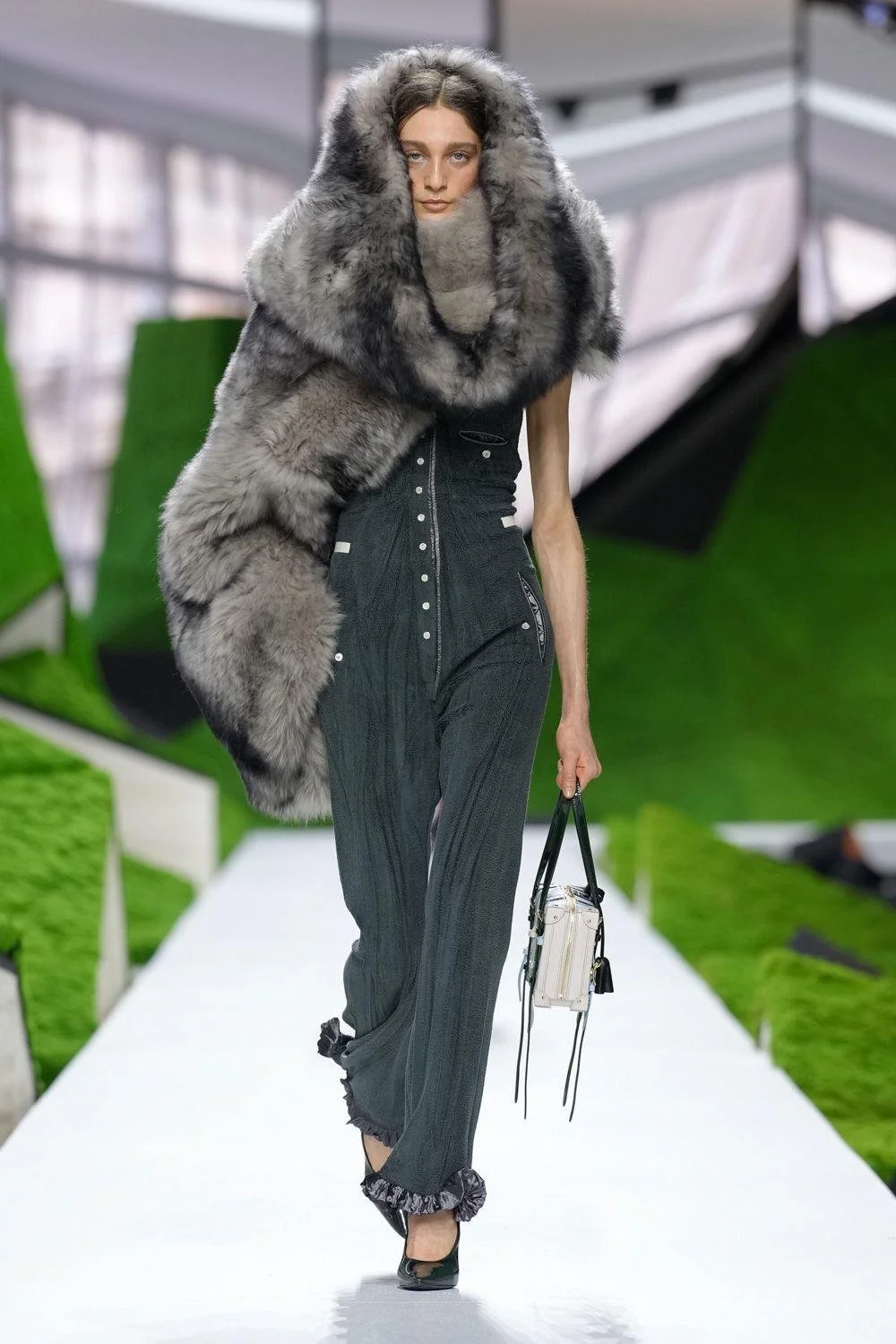
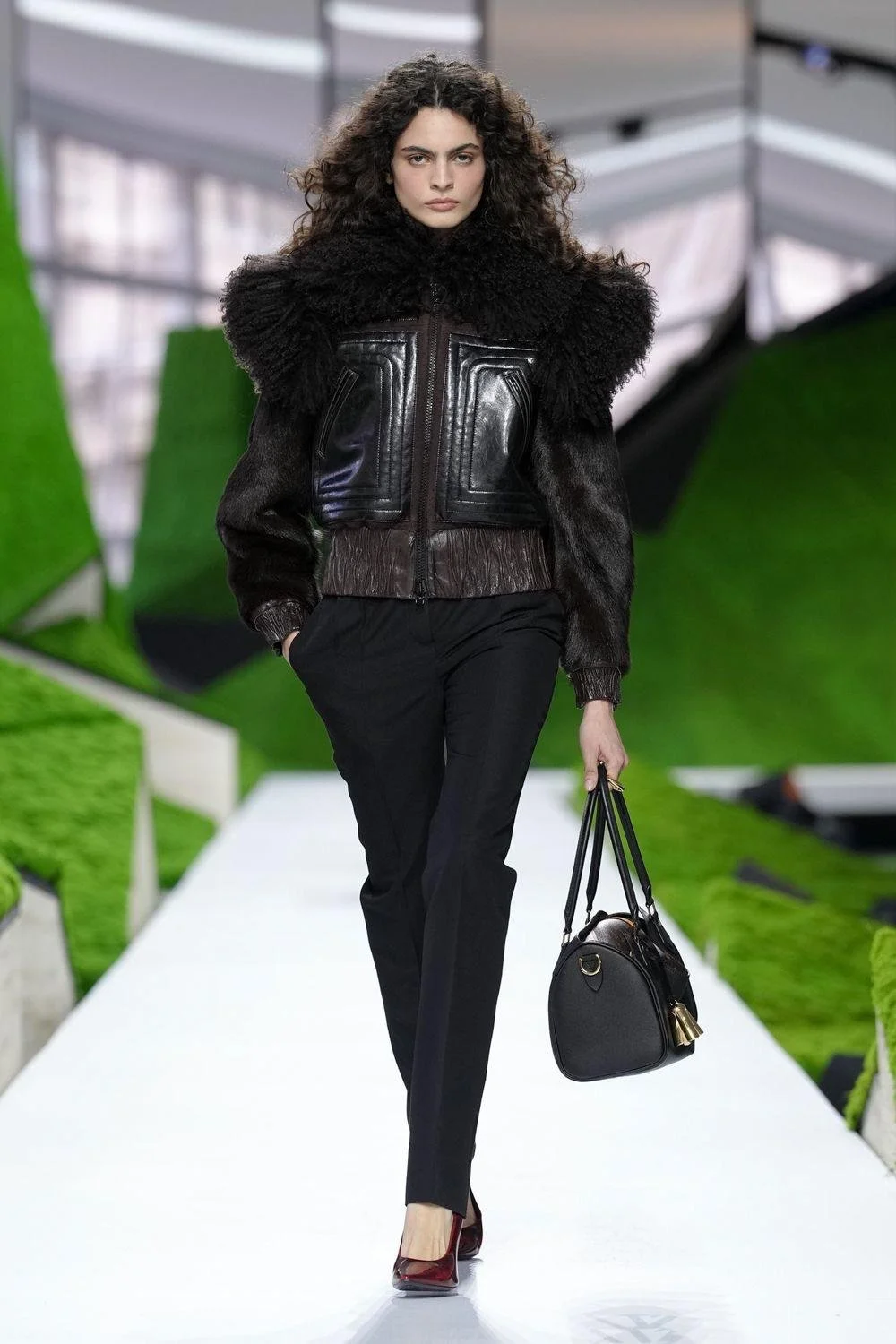
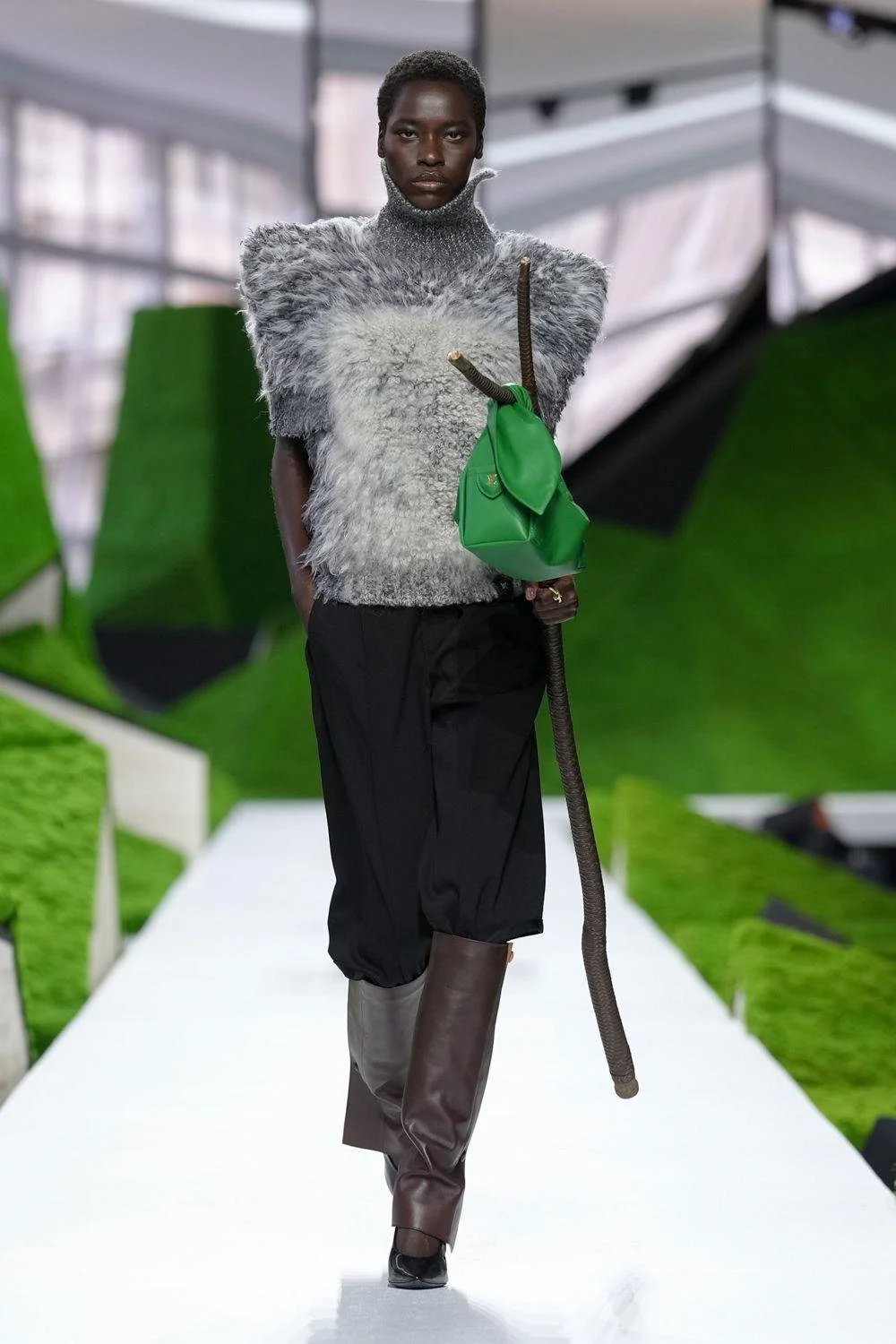
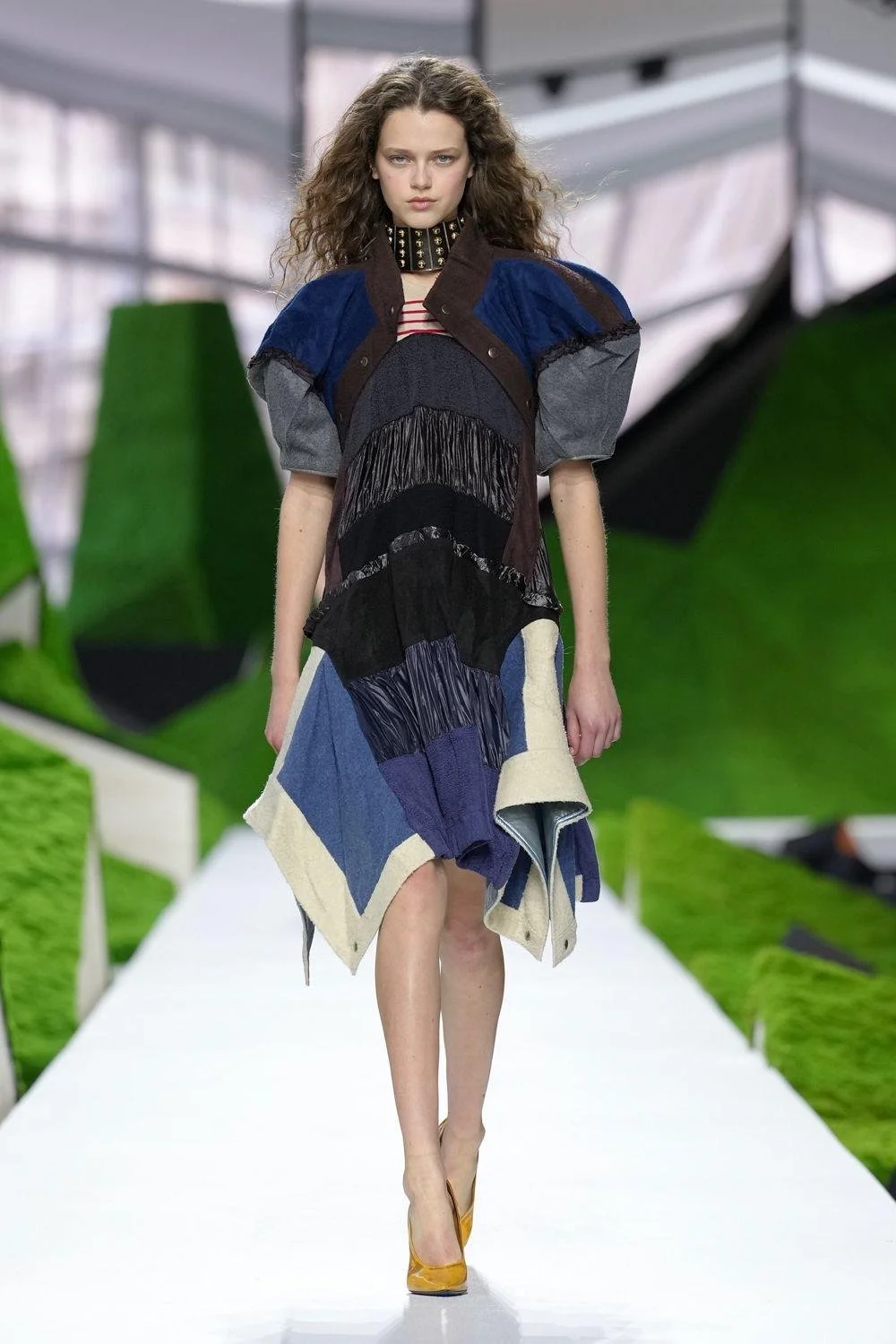
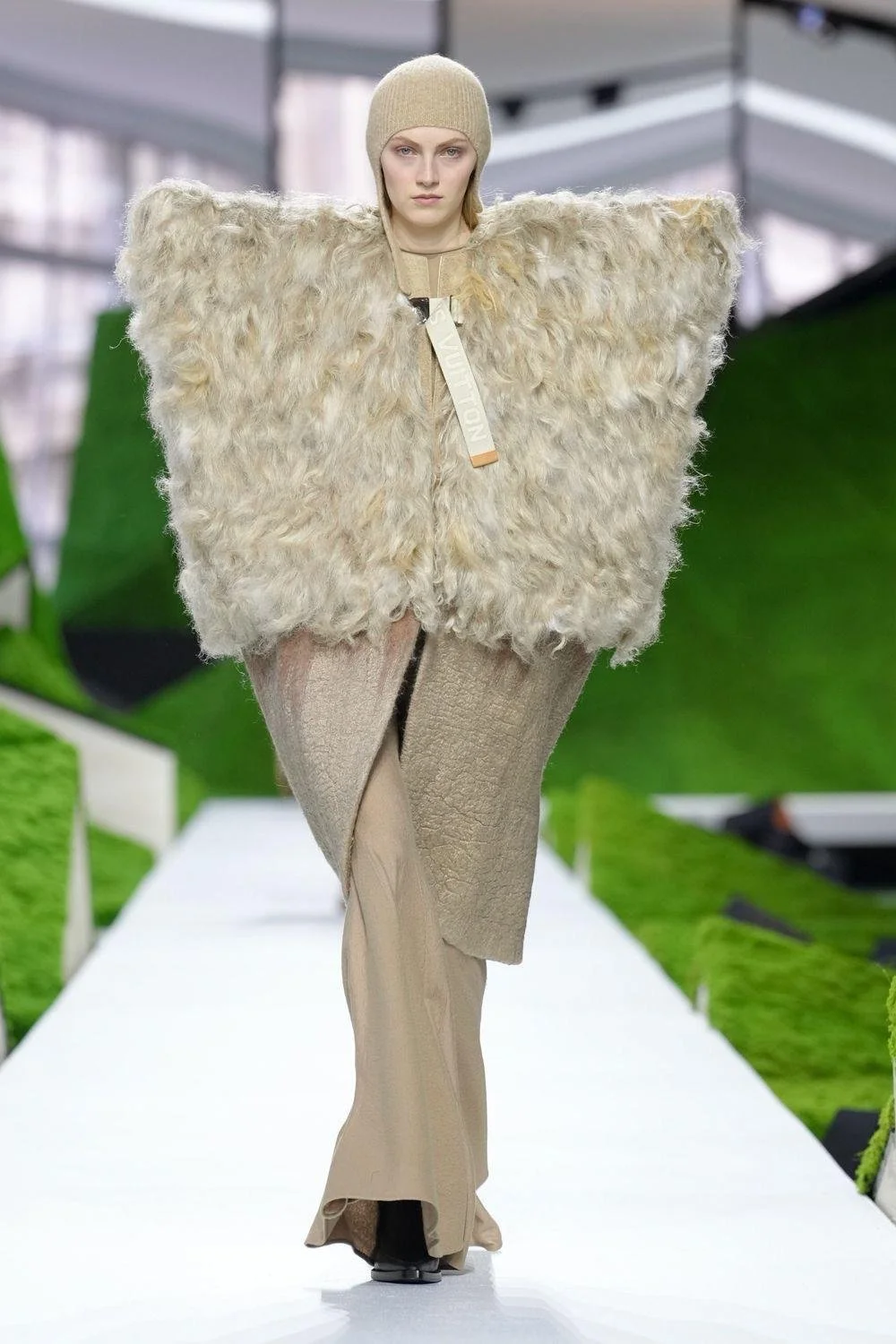
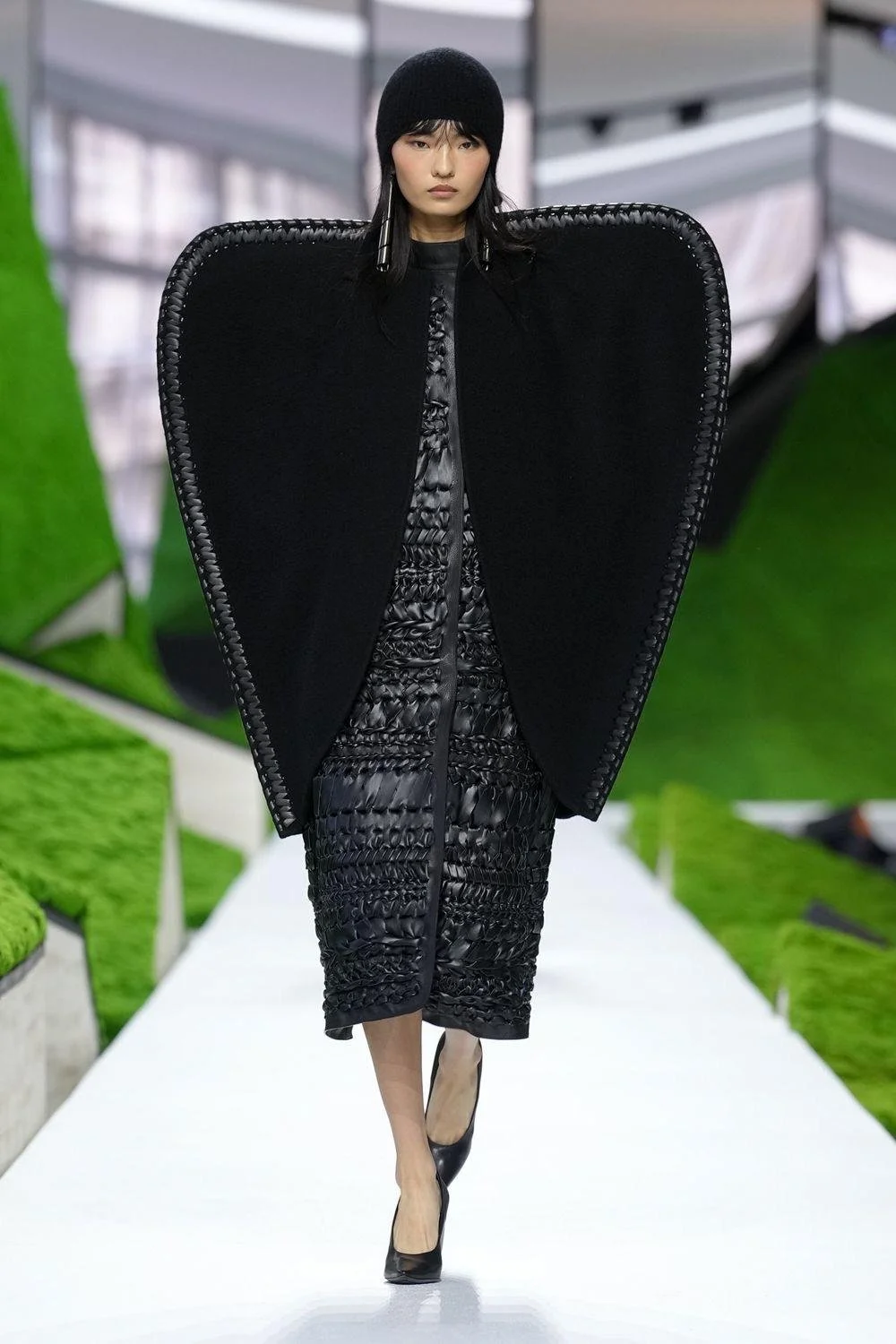
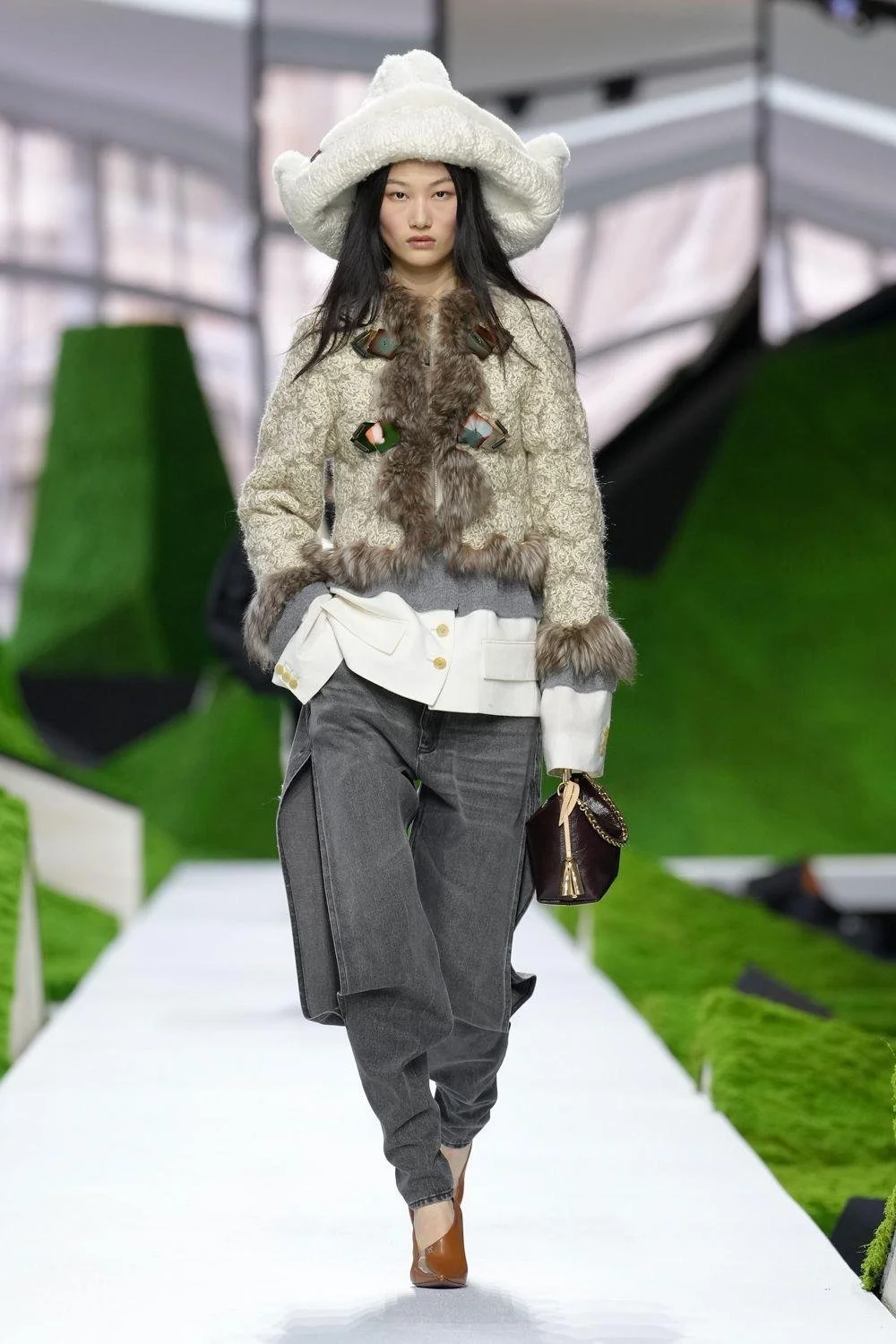
Production designer Jeremy Hindle, famously credited for crafting the mood of Apple TV’s major success series Severance, developed the moss-covered Vuitton show space, which simulated futuristic, swirling green mountains for the models to freely walk.

Held at the Cour Carrée du Louvre, this season’s path started with four looks featuring gigantic, broad-shouldered architectural forms and ended with more romantic, ruffled-collared pleated dresses, one of them paired with a matching crocheted bonnet.

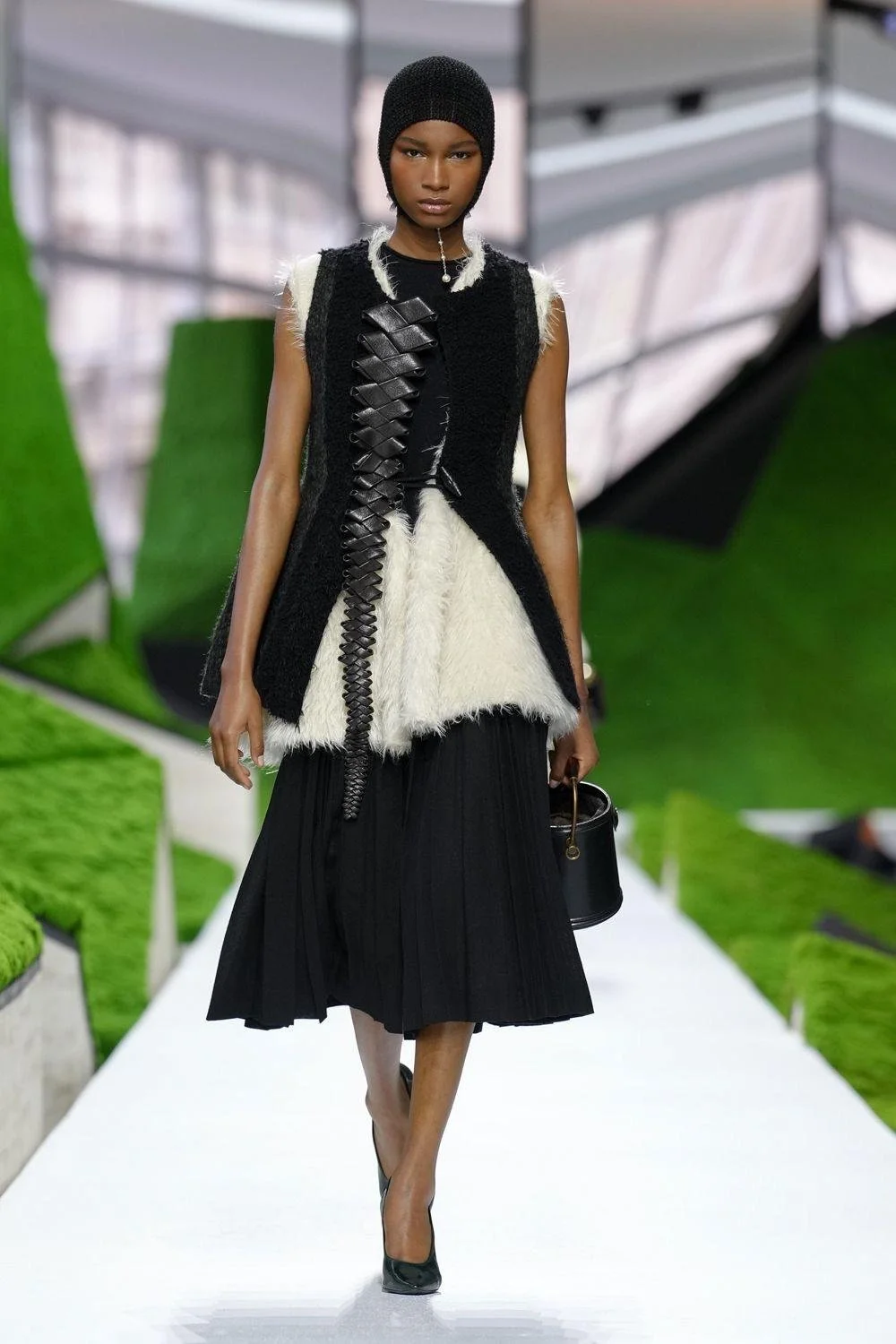
With accents of folklore and references to the mountain people of the South American Andes and the Himalayan and Mongolian landscapes, fur-lined garments conveyed ideas of shielding, as did the various headwear pieces spotted on the catwalk, the latter ranging from subtle hoods to enormous hats in different geometrical shapes.

Sunglasses resembled pilots’ goggles, pockets served as a utilitarian detail, and a few handbags, always a coveted Louis Vuitton piece, were carried with the help of a walking stick. Earthy and muted tones fused with the vibrancy of windbreaking capes, waterproof-looking jackets and checkered sets with printed, sheep-themed surrealist illustrations designed by Ukrainian artist Nazar Strelyaev-Nazarko.

Nature was honoured as "the greatest designer,” Ghesquière said to the press, and therefore used to inspire not only the abundance of silhouettes seen as part of the collection but also its sophisticated array of textures, embroideries and materials, spanning from leather to tweed and denim to shearling.

During FW 26, Ghesquière, known as an avant-garde fashion designer, seemed to practically and metaphorically acknowledge not just what our future holds, but what we lack in contemporaneity, too. There was this anthropological idea of gathering items of clothing and natural elements as wearable souvenirs, a motto of appreciation along the way.


Words by Ketlyn Araujo
KIKO KOSTADINOV FW26

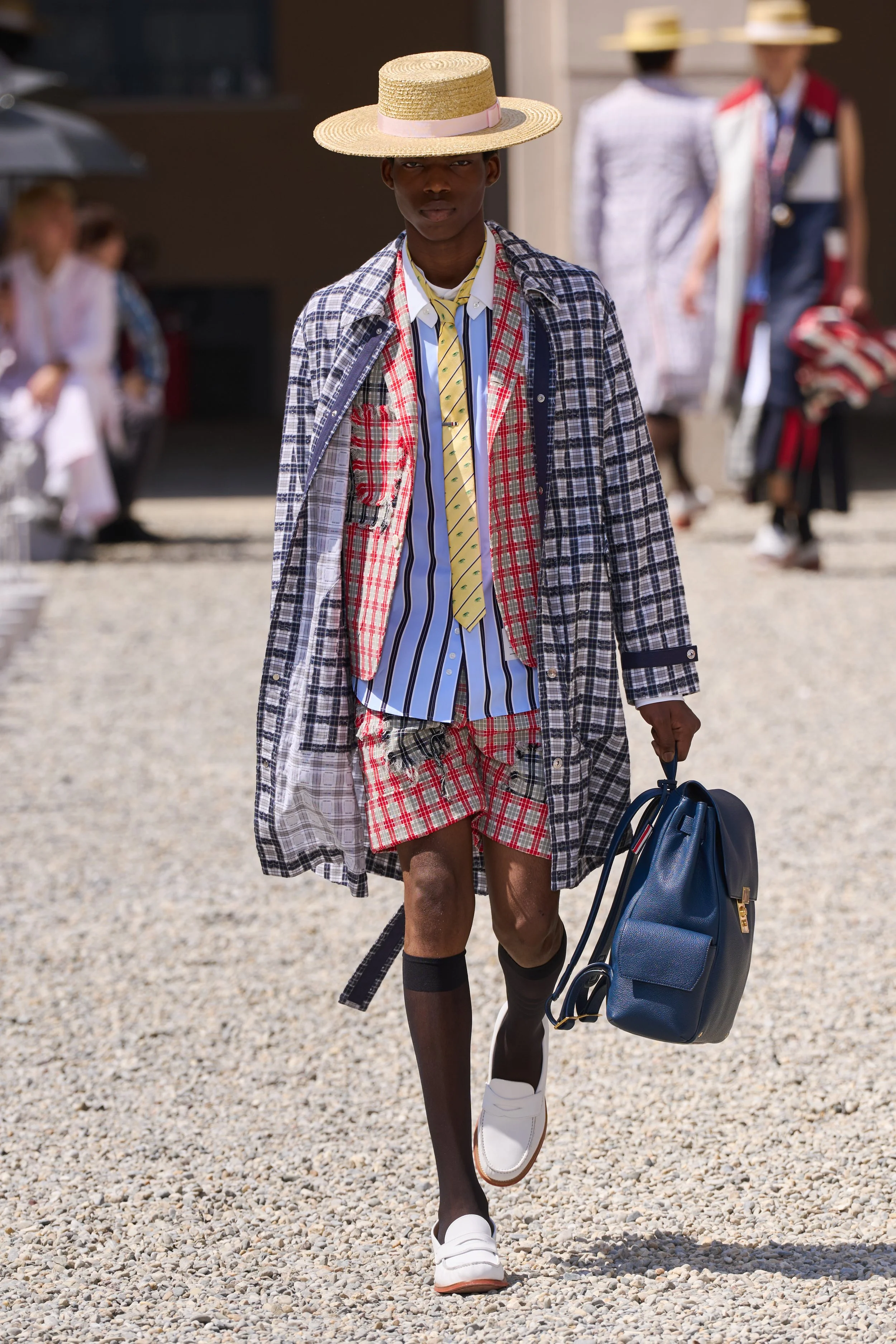
“What does it mean to see and to be seen? This question lies at the heart of womanhood,” wrote Australia-born, London-based designers Laura and Deanna Fanning as part of the opening lines for their Fall/Winter 2026 womenswear Kiko Kostadinov collection notes. The query was posed alongside the concept of an observer and observed, derived from the act of gazing attentively at the presence of nature, more specifically, birds, even amidst the chaotic life of grand urban centres.

Other sources included Fitcher's Bird, one of the Brothers Grimm’s fairy tales, as well as the 1992 namesake photographic book by American artist Cindy Sherman, which retells Grimm’s story through a visual and haunting narrative. The season’s general theme of exploration, as well as the collection’s rich colour spectrum and its feathered details, were all inspired by the two references.

While various designers sometimes struggle to give real women what they actually want when it comes to fashion, the Fanning duo seem to effortlessly nail it, show after show. Exhibit A is the collection’s focus on modular items, crafted from fabrics and designs that adapt accordingly to what the customer needs. Exhibit B lies with the development of utilitarian and practical trousers, lightweight waistcoats, and jackets, all with pockets that can carry everything from notebooks to binoculars. Exhibit C, as if the previous two weren’t enough, are practical, tailored silhouettes borrowed from menswear – if they've always moved and taken space with freedom, so should we.

Drawn from nature and the skies were also the collection’s shades, prints, and patterns. Gradient greens with brown and yellow accents, light, medium, and deep blue tones, powder pinks, oranges, and burgundy variations formed the FW 26 palette. Iridescent and light-reactive pieces made an impact, such as the draped skirts seen on looks 11 and 13, as well as the loose-fitting, golden dress chosen to end the show.

Fanning’s birdwatching efforts, too, resulted in a constant feeling of lightness and liberation through the clothes' chosen materials and design techniques, as if the weightless nature of fluttering sleeves, flowy skirts, and fluid dresses allowed some of the garments to sway while worn. The looks were often a hybrid, the perfect analogy to female multitudes: undoubtedly as beautiful as birds, yet protected by layers of utilitarian outerwear, as any adventurous, untamed spectator would be.


Words by Ketlyn Araujo
POLO RALPH LAUREN FW26

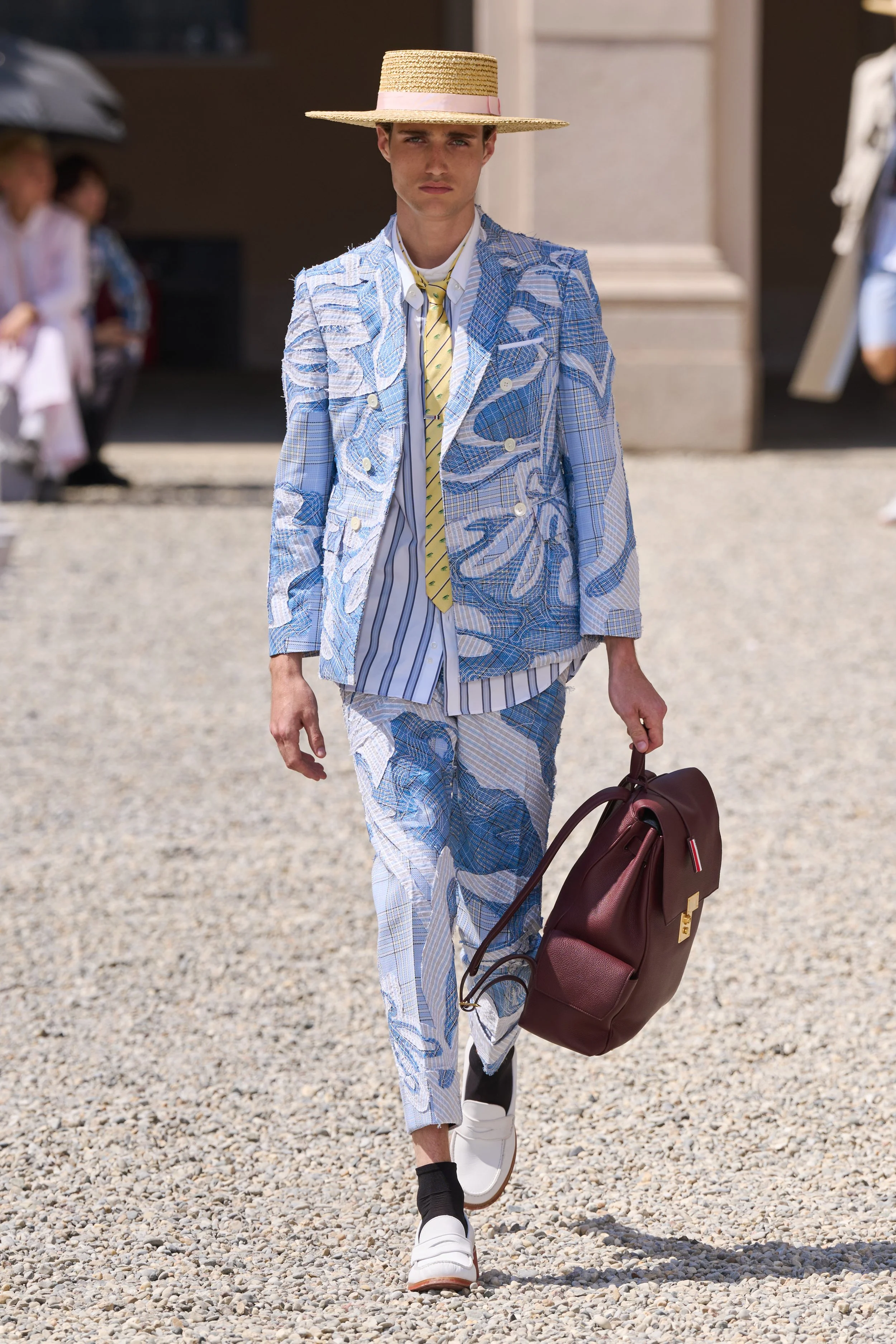
When a career spans over five decades, self-referencing can be a brilliant tool. Evidence lives in Ralph Lauren – both the designer and the brand universe – and in his latest womenswear Fall/Winter 2026 ready-to-wear collection for his preppy sister label, Polo.

Developed by Karen Brown Brody, senior brand creative director for the women’s Polo line under Lauren’s direction, the looks drew inspiration from two main sources: Lauren’s earlier women’s collections and the American designer’s own personal style during 1970s New York City.

Held at an art space in the Parisian Le Marais, the mix of presentation and catwalk show caught attention for its great styling, with looks that fused vintage-looking pieces with a more contemporary, high-low, layering proposal.

There was a clear influence of Western and Americana cultures, more specifically, the American Southwest. Hence, the myriad of cowboy hats and boots, fringed detailing, checkered shirts, and double denim. Juxtaposed and masterfully paired were baseball caps, long wool coats, leather and sporty bomber jackets, and contrasting gloves in bright yellow and green.

Accessories played a key role this season and were co-created with Native American artists who participated in the Ralph Lauren Artist in Residence (AiR) and Authentic Makers partnership programmes. Honouring craftsmanship and Indigenous heritage, artists and silversmiths Neil Zarama and Jimmy Begay were responsible for designing handmade belts and jewellery pieces, while wife-and-husband designer duo Jocy and Trae Little Sky, from Indigenous-led clothing brand TÓPA, worked along with Lauren to create a suede-fringed jacket.

Jhumka-style earrings, a traditional South Asian bell-shaped accessory originally from India, were also spotted on a few models, as were printed silk scarves, tied or placed on the body in various ways.

The collection aimed to celebrate Lauren’s rich heritage, yet with a more romantic and urban, NYC-centred feel. And it turned out to be a delight for any fashion aficionado's mood board.


Words by Ketlyn Araujo
ZADIG & VOLTAIRE FW26

The Zadig & Voltaire Fall/Winter 2026 collection by Dan Sablon made us think of effortlessly cool teenage irreverence. An aesthetic that is daring, provocative, and unapologetically youthful, carrying echoes of the ‘90s clubbing scene, channelling a “too-cool-for-school” energy.

Jackets take centre stage throughout cropped silhouettes, bombers, and leather pieces, leading the brand’s signature rock attitude. Coats, on the other hand, appear oversized and dramatic, adding a glamorous edge to the offering.

The collection has a unisex appeal, where masculine and feminine aesthetics intertwine, each contributing to the other to create strong silhouettes. Skin becomes central to understanding the provocative nature of the looks. At Zadig & Voltaire, sensuality feels empowering and fully assumed. Lace, sheer garments, lingerie worn as outerwear, and ultra-low-rise pants create a sense of confidence and defiance.

Leather and lace are mixed throughout several looks, building an interesting visual interplay between strength and delicacy, showcasing femininity as both powerful and vulnerable. Golden details elevate some pieces, lending a subtle sense of glamour and lavishness.

The collection is rich in textures and contrasts, driving the narrative towards an assumed maximalism instead of the quiet luxury discourse of recent years. Black is the core colour, accented by gold, deep browns, and some touches of white.

The men’s and women’s silhouettes come together in an eclectic mix of styles to form a distinct camp take on rockstar wardrobe. The overall energy feels reminiscent of Y2K trends, such as extra-low-rise pants, denim ensembles, and the black-and-white striped scarf, while evoking the rebellious spirit of the Avril Lavigne era.


Words by Carolina Benjumea

JEAN PAUL GAULTIER FW26

If Duran Lantink's debut collection for Jean Paul Gaultier – showcased during Spring/Summer 2026 – was controversial enough to spark conversation inside and out of the fashion industry, the Dutch designer's sophomore show for the French house came with a slightly different approach. However, his witty manner, publicly approved by Monsieur Gaultier himself (who has been a supporter of Lantink’s work so far), did not vanish.

For Fall/Winter 2026, the starting point was an image of German-American actress and singer Marlene Dietrich, sourced from Lantink’s own wardrobe, as seen on one of the designer’s vintage T-shirts. Dietrich’s hybridised mood of dominance and grace was then placed alongside a whip, resulting in a mood board that had the archetype of this "madame masculinity" as its anchor, as Lantink explained in an interview with CNN.

Honouring the essence of Jean Paul Gaultier as a house that thrives in complementary opposites, Lantink developed more characters to play a fundamental role during his offering – all born from the cinematic juxtaposition of past and future, masculine and feminine. Western motifs, sportswear, lingerie and boudoir elements were combined, with a greater focus on sharper and more experimentally tailored pieces, mostly in black and white.

Challenging body proportions, round-shaped details resembling car tyres cinched waists, hugged necks and were placed as bracelets, while eveningwear carried flowy, rounded, and bouncy jersey forms, created with pleating. Futuristic hoods with a helmet look and a waterproof feel were styled with classic neckties, while shirt collars were maximally stretched until covering the head. Later on, Dietrich’s image returned to the catwalk, more literally, with a photograph of the actor smoking printed on a long-sleeved, turtleneck, midi-length dress, and real smoke coming out of its back – steamy!

A trip to the brand’s archives, personally discussed between Lantink and Monsieur Gaultier, resulted in contemporary iterations of previously seen garments, from haute couture to ready-to-wear. The waist of a pinstripe suit from a couture collection named Le Palace from 2016, for example, inspired the silhouettes of various F/W 26 pieces, the season’s press release described. Gaultier’s early-career shows, where tailored garments were, by design, displayed with visible, exposed lining, were also used as a key reference.

From a 1990s F/W collection, Scottish Fair Isle knitwear was transformed into skin-hugging bodysuits, while looks 12 and 13, both trompe l'oeil wooden puppet outfits, evoked JPG’s 2004 collection, Les Marionnettes. A cropped bomber jacket, dated from both the 1980s and early 2000s, was once again revisited, a proof point of fashion’s cyclical nature.


Words by Ketlyn Araujo
VIVIENNE WESTWOOD FW26

Three were the main references used by Andreas Kronthaler before designing his Fall/Winter 2026 collection for Vivienne Westwood, a lineup of over 40 looks crafted to embody joy and establish continuity, despite the complexity of ongoing grief and the state of the world. Dame Vivienne Westwood died three years ago, in December, leaving a legacy that Kronthaler has been committed to honouring ever since.
Rooted in theatricality and – good – chaos, Kronthaler’s F/W 26 mood board was firstly inspired by German and French screen actor Romy Schneider, known as one of the greatest of all time. Schneider’s fierceness and eclectic acting choices were used as a tool to convey emotion through the season’s pieces.

Still in the cinematic universe, Kronthaler was equally inspired by 1972’s The Canterbury Tales, Pier Paolo Pasolini’s film adaptation of the namesake medieval poem by English author Geoffrey Chaucer. The film's costume design, developed by Italian costume and production designer Danilo Donati, was crucial to conveying the show’s intentional smorgasbord aesthetic. Finally, Chaucer’s literary work also served as the final piece for Kronthaler’s trio of muses, adding a touch of historical humour to the final result.

With the three elements combined, the broad collection had Kronthaler’s characteristic eroticism always present, teamed with Westwood’s classic 1980s punk flair. Checkered and tartan prints were seen on wide-shouldered coats, corseted dresses, and skirt suits. Masculine and feminine traditional codes were purposefully blurred, with ballet flats, stockings, and garter belts garnishing both women's and menswear looks.

Corsetry work, striped gowns, and cinched waists, yet still relevant, were a secondary focus of the collection, which mostly featured loose structures over rigidity. Voluminous shapes with open seams and drapes, as well as slouchy footwear and vibrancy in colour, led the way. The playful aspect came through the use of headpieces, often oversized and purposefully mismatched with the looks.

A bridal ivory satin skirt suit closed the show, carried by a model with yellow-polished nails and smudged red lipstick – in case anyone has forgotten, there’s nothing strict about being a Westwood bride. With a radish-red bouquet in hand, she had an ultra-tall cylindrical hat crowning her head. Her name is Vivienne Rohner. In the end, we always go back to Vivienne.


Words by Ketlyn Araujo